
Microsoft Research unveils new methods to boost LLM reasoning
Serge Bulaev
Microsoft Research has introduced new methods that may improve reasoning in language models by adding structured logic on top of their pattern recognition abilities. Studies suggest that combining language models with external symbolic solvers can raise accuracy, especially on math tasks, but may still leave some reliability gaps. Researchers now focus on using statistical tools to monitor and evaluate models for issues like drift or safety problems. Teams often use a set of simple metrics and regular tests to catch failures early. Experts believe that treating language models as statistical tools first, while adding clear logic checks, might lead to more reliable and safer AI systems.

Recent efforts from the Microsoft Research team on new methods to boost LLM reasoning, such as LIPS and rStar-Math, highlight a critical shift in AI development. This evolution moves from pure pattern recognition towards models augmented with structured, logical frameworks. This approach addresses the core tension between the probabilistic nature of transformers, which simply predict the next token, and the practical need for verifiable accuracy in mathematics, code generation, and policy adherence. This challenge is now driving innovations in both training methods, like reinforcement learning with verifiable rewards (RLVR), and more robust production monitoring.
From Pattern Recognition to Reasoning Scaffolds
These methods augment Large Language Models by integrating external symbolic solvers and verifiers. Instead of just predicting the next word based on patterns, the LLM proposes a logical plan, which is then checked for correctness by a separate tool, creating a more reliable, hybrid reasoning system.
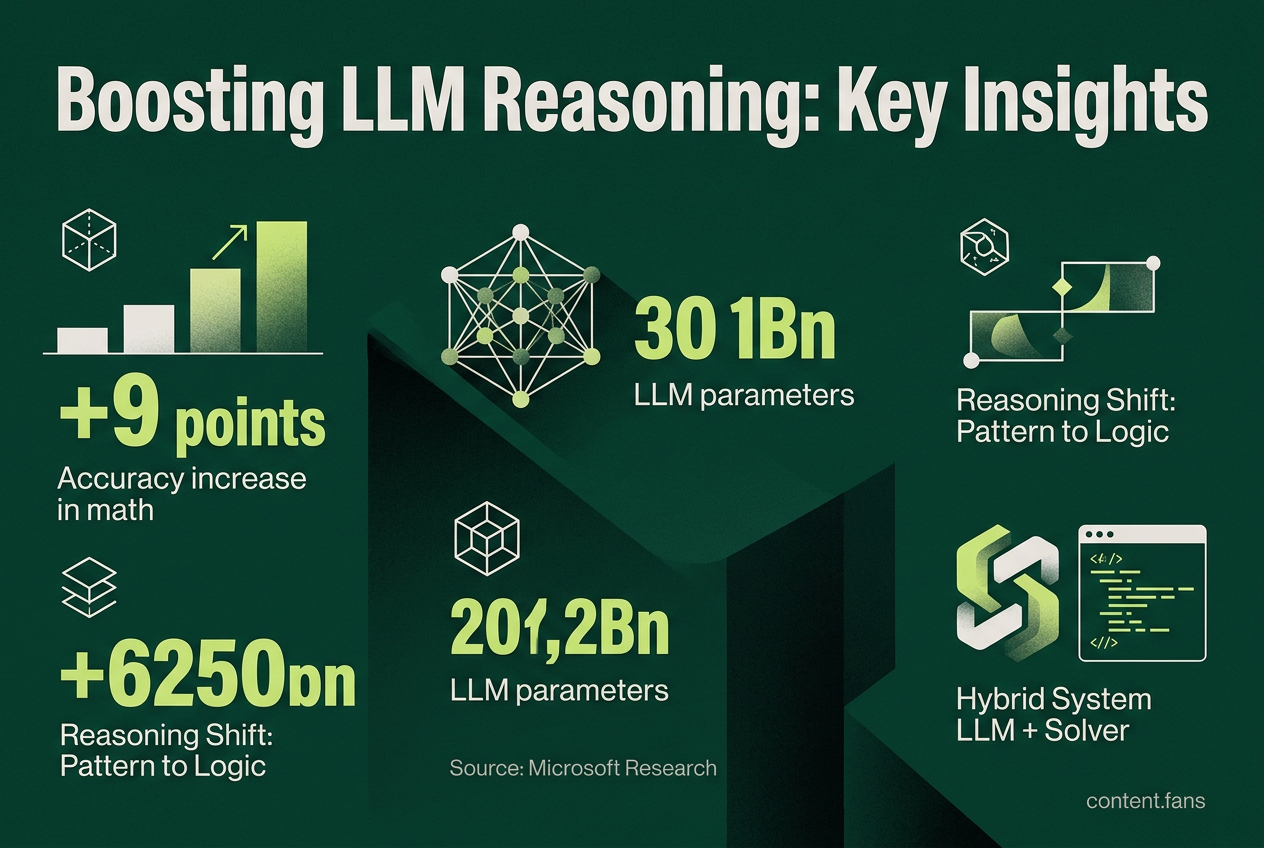
A key strategy involves creating hybrid pipelines where the LLM proposes operational plans and an external symbolic solver verifies each step for correctness. This preserves the creative fluency of pattern recognition while eliminating silent logical failures. A 2024 study, Learning Beyond Pattern Matching?, demonstrates this benefit, reporting a 9-point accuracy increase on mathematical tasks after integrating symbolic solvers Learning Beyond Pattern Matching paper, confirming that raw token statistics alone create reliability gaps.
Statistical Foundations Engineers Should Track
To build and maintain reliable LLMs, engineers must track several core statistical concepts:
- Probability Theory: Understanding next-token prediction as a conditional probability: P(word|context).
- Generalization Bounds: Analyzing how models with billions of parameters extrapolate from training data to new, unseen prompts.
- Uncertainty Quantification: Scoring a model's confidence by measuring token entropy or ensemble variance before generating a final answer.
- Data-Mixture Optimization: Strategically weighting different training corpora to minimize bias and prevent performance drift.
- Hypothesis Testing: Rigorously determining if changes, like a new prompt template, genuinely improve output faithfulness.
These statistical pillars are foundational to both research and production operations. As noted in recent overviews, the immense scale of modern LLMs makes robust statistical methods essential for ensuring alignment, implementing watermarking, and conducting meaningful evaluation.
Evaluation Moves From Benchmarks to Failure Modes
Modern MLOps practice emphasizes that single-point benchmarks like ROUGE or exact match can hide critical emergent bugs. Instead, cutting-edge evaluation relies on frameworks like the Failure Modes, Drift Patterns framework, which catalogs specific issues like retrieval mismatch or unsafe recommendation drift Failure Modes, Drift Patterns framework. This leads teams to adopt a two-pronged assessment strategy:
- Offline Gates: Pre-deployment checks using golden test sets, adversarial "red team" prompts, and rubric-based scoring (often using an LLM-as-Judge).
- Online Monitors: Real-time tracking of latency, task success rates, context precision, and automated drift alerts based on embedding distance.
A commonly cited heuristic that a sustained 2-5 point drop in rolling rubric scores over one hour should trigger an incident review remains a valuable, albeit informal, rule of thumb.
Core Production Metrics for Modern LLMs
To maintain control, engineering teams focus on a compact dashboard of essential metrics:
- Task success or exact match on the business objective.
- Faithfulness against retrieval context.
- Safety or policy compliance rubric.
- Latency tail (p95 TPOT) and availability.
- Output drift via embedding distance on canary prompts.
Using this compact dashboard allows engineers to surface the most expensive failure first, then iterate.
Diagnostics and Drift Monitoring in Practice
In practice, production logging now integrates quality and operations data. Each request log might join the prompt, model version, tool calls, latency, and automated judge scores. Mature teams often sample 5-10% of live traffic for continuous auditing, complementing full offline test suites run before each release. A key technique is using canary prompts - a set of fixed inputs replayed hourly to serve as an early warning system for semantic or policy drift.
If a drift alert fires, the recommended triage path is to confirm retrieval quality, replay with the previous model checkpoint, and escalate to human review if the change crosses a safety rubric threshold.
The New Paradigm: Statistical Tools with Logical Guardrails
The emerging consensus is that treating LLMs as statistical tools first - and reasoning engines second - provides clearer, more effective debugging hooks. This paradigm doesn't dismiss the power of pattern recognition; rather, it contains it within a robust framework of verifiable logic, explicit performance metrics, and continuous drift monitoring. The mathematical core of pattern recognition remains essential, but it operates within an increasingly tight operational perimeter to ensure reliability and safety.
How do the new Microsoft methods move LLMs beyond pure pattern matching?
Microsoft's latest work grafts symbolic reasoning scaffolds onto the LLM's native pattern-atching engine.
In the LIPS pipeline, for example, the model proposes a high-level plan, a lightweight symbolic verifier checks each step, and the loop repeats. The result is a hybrid architecture that keeps the fluency of next-token prediction while adding guarantees that were impossible when the system relied on pattern completion alone.
Which evaluation metrics actually catch emergent failure modes in 2026?
Offline accuracy or ROUGE still have a place, but production teams now gate releases on failure-mode-driven rubrics:
- Faithfulness / grounding - catches hallucinations that look fluent yet are unsupported by retrieved context
- Tool-use precision - flags silent corruption where the correct API is called with subtly wrong parameters
- Canary-prompt drift - a fixed set of sensitive prompts is issued every hour; a 2-5 point drop sustained for 30-60 min triggers a rollback
These targeted checks spot regressions that aggregate scores miss.
How should engineers monitor distribution shift without a human in the loop?
Embed incoming prompts into the same latent space used during training, then track Population Stability Index or KS distance on the resulting vectors. If the PSI exceeds 0.25, schedule an automatic re-run of your golden test suite; above 0.35, route traffic to a shadow model while you retrain. The entire pipeline runs on < 5% of live traffic, so overhead stays negligible.
Where does pattern recognition math fit into the 2026 reliability stack?
Pattern recognition remains the fast path for normal inputs, but it is never the last line of defence. Think of the stack as:
- Pattern layer - handles 80-90% of traffic at low latency
- Symbolic checker - enforces hard constraints on math or code fragments
- Canary & Drift Monitor - watches for slow concept drift and fires alarms
This layered setup is what lets teams ship smaller, cheaper models without giving up robustness.
What is the single biggest blind spot in current LLM eval pipelines?
Many pipelines treat latency as a UX metric, not as an early warning signal. Microsoft's own telemetry shows that TTFT degrades 8-12% before any drop in token-level accuracy appears. Teams that gate releases on a hard TTFT ceiling (often 350ms P95) catch regressions one to two deploy cycles earlier than teams that wait for explicit quality drops.