
Microsoft Foundry Unveils AI ROI Metrics for Enterprises
Serge Bulaev
Microsoft Foundry has introduced a way for businesses to measure whether AI agents provide more value than they cost. This process may involve tracking each AI run, attaching quality and cost evaluators, and showing the ratio of benefits to costs on dashboards. Experts suggest using at least 90 to 180 days of data and control groups to avoid misleading results. Reports indicate that organizations might be giving AI access only when the return on investment can be shown. Dashboards appear to help both technical teams and executives make faster, clearer decisions about their AI projects.

Enterprises consistently face one critical question: how can we prove our AI agents deliver more value than they cost? To solve this, Microsoft Foundry's AI ROI metrics provide a repeatable workflow that ties business outcomes directly to performance telemetry. This framework allows organizations to instrument each AI run, evaluate its performance, attribute costs and benefits, and display the resulting ROI on dashboards for clear, data-driven decisions.
Many organizations adopt AI tools first, only to find that stakeholders later demand hard evidence of their value. The solution is to instrument every agent interaction, evaluate the work performed, attribute both cost and benefit, and visualize the ratio where finance and product teams can easily see it. Industry reports suggest a growing number of businesses are granting AI access only when a clear return on investment can be shown.
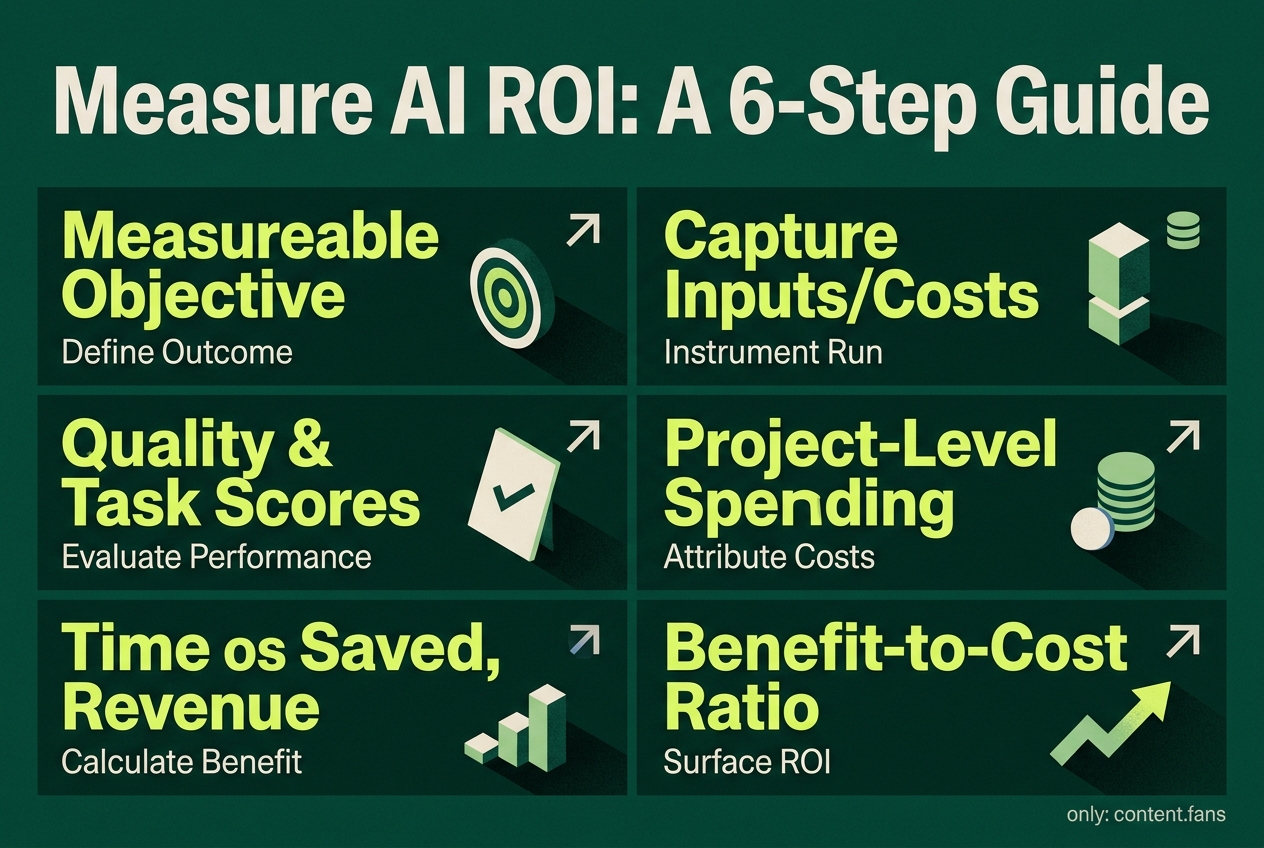
A Practical Guide to Measuring AI ROI
To measure AI ROI, enterprises must instrument every agent interaction, evaluate its quality and task completion, and attribute both cost and financial benefit. Displaying the benefit-to-cost ratio on dashboards provides clear evidence of performance for both technical and financial stakeholders.
- Define a Measurable Outcome. Start with a single, tangible objective, such as faster customer onboarding or reduced ticket handling costs. Establish a pre-AI baseline to ensure credible comparisons.
- Instrument Every Run. According to a Build 2026 post, Foundry tracing captures agent inputs, outputs, tool calls, token consumption, and timing/cost signals, and surfaces them in Observability and Application Insights.
- Evaluate Performance. Foundry provides built-in quality, safety, and task-completion evaluators to grade each run and conversational flow. These scores help teams identify low-value AI behavior before costs escalate.
- Attribute Costs. Microsoft has introduced project-level cost attribution capabilities, enabling infrastructure spending to be mapped directly to specific teams and experiments.
- Calculate Financial Benefit. Use standard financial metrics like time saved, error reduction, or incremental revenue. For instance, if an agent reduces ticket handling time by three minutes and an analyst's time is valued at $0.60 per minute, the gross benefit is $1.80 per ticket.
- Surface the ROI Ratio. Foundry's ROI view presents the benefit-to-cost ratio for each version and date range. This allows teams to drill down into traces with negative ROI to debug the root cause.
How to Avoid Inaccurate Data
Early pilot programs often produce volatile metrics due to low data volume. To ensure credible results, experts recommend using a substantial evaluation window before declaring success. To reduce statistical noise:
- Implement control groups or phased rollouts.
- Track leading indicators like adoption and cycle time alongside lagging financial metrics.
- Re-baseline your metrics whenever the underlying workflow changes.
Linking ROI to Governance Decisions
Dashboards that connect performance to financial outcomes serve two key audiences: technical operators monitoring for errors and executives evaluating project viability. Industry reports indicate that many organizations are shifting towards continuous portfolio review, granting AI access only when ROI models justify the investment.
Unified governance platforms now incorporate ROI metrics into approval gates, allowing low-value or high-risk agents to be paused automatically. When both operational and executive views are powered by the same trace-based telemetry, financial discussions accelerate and development teams receive clearer signals for upgrades.
What new ROI capabilities did Microsoft add to Foundry recently?
Microsoft announced project-level cost attribution and the ability to grade production traces from agents running anywhere. The portal (and corresponding API) automatically ties task completion rates, time saved, and cost efficiency to every trace, letting teams see dollar value next to runtime cost for each model version. A single click drills into the low-ROI traces so engineers can debug step-by-step. The same update added project-level cost attribution, so CFOs can map spend back to individual teams or business units without extra spreadsheets.
How do I wire my existing agents into Foundry ROI without rewriting them?
You only need three lines of code to instrument any agent, no matter where it runs. Add the Foundry trace-exporter library to capture prompts, model calls, tool usage, and latency; mark business events with custom tags such as order_id or ticket_type; and point the exporter to your Foundry workspace. Once traces flow, the trace-based evaluators that scored synthetic data in the lab can now grade real production traffic. Microsoft says this approach works for agents running on GCP, AWS, or any open-source framework.
Which KPIs should I expose to non-technical stakeholders?
Keep the C-Suite view short and currency-focused:
- Task completion rate - percentage of end-to-end workflows that finished without human hand-off
- Time saved - average minutes per interaction multiplied by loaded labor cost
- Cost efficiency - benefit dollar divided by compute dollar for the same period
Foundry's built-in templates present these three metrics side by side in a quarterly dashboard that automatically compares the current version against the prior two releases, making it easy to prove or disprove the business case in board meetings.
How can I defend ROI numbers when market conditions change?
Use a cohort or phased rollout instead of a big-bang launch. Hold out a portion of users or geographies as a control group for an extended period; during that window, the dashboards will show both cohorts in parallel. The gap between the two lines becomes the causal ROI claim, isolating the AI effect from seasonality, staffing changes, or pricing adjustments. If the gap shrinks, you can pause scaling and relaunch after tuning.
What governance actions can I trigger automatically when ROI drops?
In Foundry, you can set policy thresholds to automatically respond when performance metrics decline. These rules can connect to Azure Monitor alerts that already integrate with ServiceNow or Jira, creating a closed-loop Agent DevOps cycle: trace → evaluate → monitor → optimize → ROI → policy action. Enterprises report that this loop shortens the time between detected drift and remediation from weeks to same-day changes.