
Meta's Rivos Acquisition Reveals AI Chip Cost-Saving Strategy
Serge Bulaev
Meta's planned purchase of Rivos may help it make custom AI chips faster and at lower long-term costs than buying GPUs from other companies. Reports suggest custom chips might save money on electricity and give Meta more control, especially as U.S. rules make buying advanced GPUs harder. Custom chips can take two to four years to build and cost a lot at first, but could be cheaper if used a lot. However, using off-the-shelf GPUs is quicker and more flexible for changing needs. The best choice may depend on how much the chips are used, power costs, and changing government rules.

Meta signed a definitive agreement to acquire Rivos to bolster its internal semiconductor development and control more of its AI infrastructure. This analysis examines the broader strategic debate over building custom AI chips versus buying off-the-shelf GPUs, driven by complex trade-offs in cost, time-to-market, and supply chain control.
Why Meta's Rivos move matters
Meta's acquisition of Rivos aims to reduce long-term AI hardware costs by developing custom chips in-house. This strategy targets significant savings on power consumption and avoids high vendor margins, giving Meta greater control over its technology roadmap and supply chain amid tightening U.S. export regulations on advanced GPUs.
Meta's move to acquire Rivos, reported by [Reuters] in September 2025, is a strategic play to accelerate its custom AI chip development. The Rivos team's prior contributions to Meta's MTIA accelerators, detailed by an in-depth [Next Platform] article, highlight the goal: leveraging in-house talent and RISC-V IP to achieve faster design cycles and reduce long-term dependency on merchant GPUs. This acquisition is primarily driven by three key financial and strategic motives:
- Vendor Margin Recovery: Industry reports suggest merchant GPU premiums can represent a significant portion of silicon cost at hyperscale volumes.
- Power Savings: Custom inference ASICs may substantially reduce data-center electricity expense on targeted workloads, according to analyses from [SemiAnalysis].
- Supply-Chain Control: Policy experts note that U.S. export controls are tightening access to advanced GPUs, making a trusted, custom supply chain strategically attractive.
Comparative timelines and break-even math
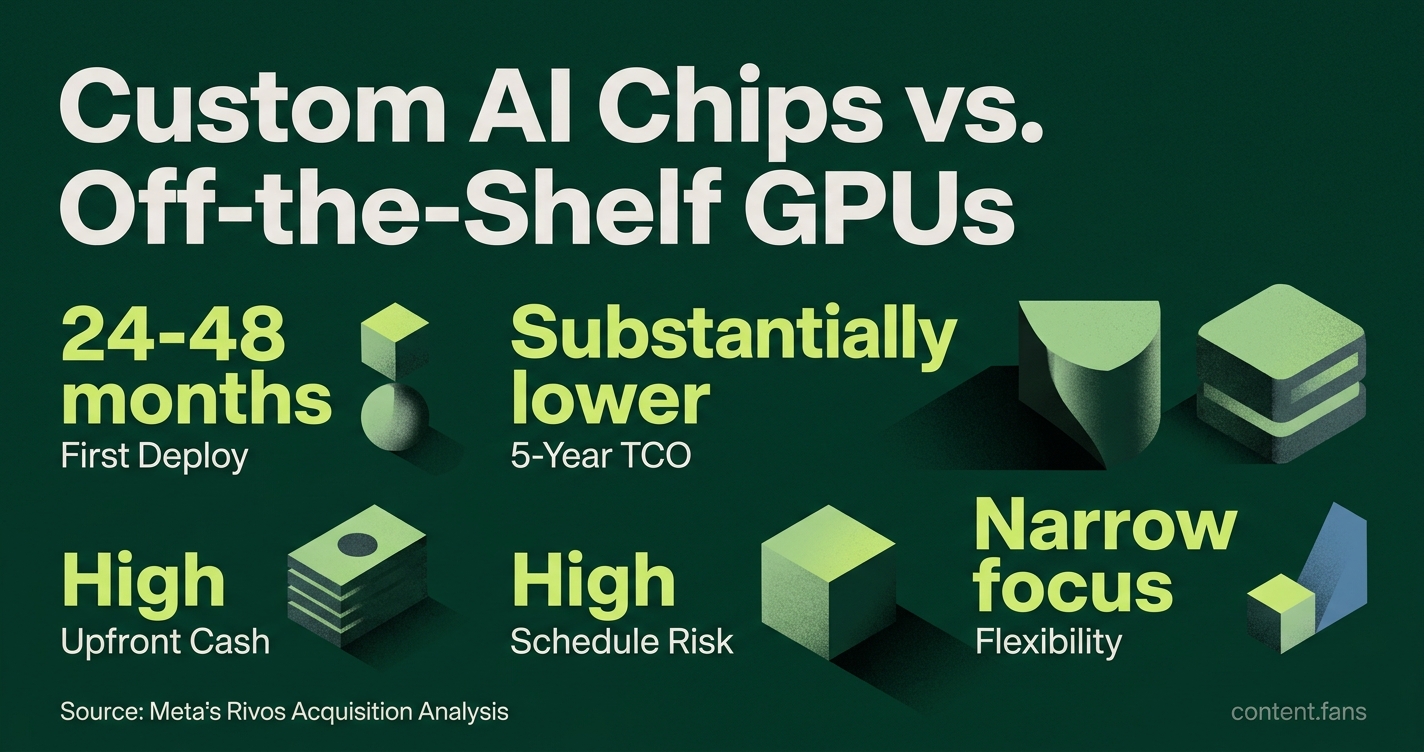
Developing custom silicon is a long-term commitment, with industry TCO models showing a two-to-four-year timeline from design to deployment. This horizon covers architecture, verification, tape-out, and licensing. In contrast, off-the-shelf GPUs offer immediate deployment but come with higher per-unit costs and recurring fees. Industry reports indicate that GPUs constitute a significant portion of a five-year cluster TCO, with the remainder being power, cooling, and networking. Custom chips with superior performance-per-watt directly reduce these substantial operational expenses.
| Dimension | Custom AI chip | Off-the-shelf GPU |
|---|---|---|
| Upfront cash | High (design plus multi-foundry commitments) | Moderate (hardware purchase or cloud rent) |
| First deploy | 24-48 months | Immediate |
| Five-year TCO at high utilization | Reportedly substantially lower | Higher, sensitive to vendor pricing |
| Flexibility | Narrow workload focus | Broad model support |
| Schedule risk | High | Low |
Sensitivity levers for enterprise buyers
The single most critical factor determining the financial viability of custom chips is the utilization rate. According to industry analyses, GPUs are more cost-effective for workloads with lower average utilization rates. Above certain utilization thresholds, bespoke chips gain a significant advantage in both total cost of ownership and energy efficiency. When evaluating this decision, enterprises must model the following key variables:
- Silicon volume and expected utilization window
- Power price trajectory and facility PUE
- Software porting effort, including compiler engineering
- Refresh cadence for both custom and merchant hardware
Policy backdrop and its pricing impact
Geopolitics significantly influences AI hardware economics. With the United States controlling a substantial portion of global frontier AI compute, its policies have a direct impact. U.S. export controls restrict access to advanced GPUs, while CHIPS Act incentives subsidize domestic fabs for custom accelerators. Industry reports cite substantial announced private commitments, which may ease capital access but also intensify competition for talent. In contrast, a [Bruegel] analysis suggests Europe "has no realistic prospect" of short-term self-sufficiency, potentially exposing enterprises there to higher supply-chain risks for custom silicon projects.
Putting it together
The decision to build or buy AI accelerators is not a binary choice but a strategic calculation based on scale and workload stability. Custom ASICs deliver compelling long-term TCO for high-volume, predictable workloads, but only after a significant multi-year investment. For organizations with experimental or fluctuating needs, the flexibility of commercial GPUs remains superior. Meta's Rivos deal perfectly illustrates the hybrid strategy of a hyperscaler: investing in a custom silicon future to secure cost advantages while relying on merchant GPUs to bridge the development gap.
What exactly did Meta just do with Rivos and how does it fit Meta's long-term silicon roadmap?
Meta signed a definitive acquisition agreement for Rivos, a RISC-V server-chip startup that had previously collaborated on the MTIA 1i and MTIA 2i compute engines. By absorbing Rivos' 200-plus chip designers, Meta gains full-stack expertise in RISC-V CPU design, AI accelerator integration, and data-center power optimization. The move shortens Meta's silicon cycle from a multi-year vendor negotiation to an in-house roadmap that scales directly with its AI fleet size, cutting projected reliance on merchant GPUs for inference workloads.
How much can hyperscalers really save by switching from Nvidia GPUs to custom chips?
Industry benchmarks suggest that custom ASICs can substantially reduce total cost of ownership once daily utilization reaches sufficient levels. In large-scale GPU clusters, the GPUs themselves account for a significant portion of the five-year TCO; the rest is power, cooling, networking, and facility overhead. Custom silicon lowers both the silicon bill and the watts per inference metric, shrinking the non-GPU share of TCO as well. Industry reports suggest the Rivos IP could substantially reduce Meta's annual GPU spend for its recommendation and ranking models.
Does every enterprise get the same savings, or is scale the decisive factor?
Scale and workload stability dominate the economics. Hyperscalers with predictable, high-volume inference see substantial TCO advantages, whereas enterprises with bursty or experimental workloads often find cloud GPUs more cost-effective at lower utilization rates. Custom chips also carry a multi-year design-to-deployment cycle of 2-4 years, while merchant GPUs can be rented tomorrow and released next month. In short, only companies that can amortize substantial development programs across tens of thousands of servers should consider the custom path.
What geopolitical risks are pushing more U.S. firms toward custom or domestic silicon?
U.S. export controls on advanced GPUs and the concentration of leading-edge foundries in Taiwan have made supply-chain resilience a board-level issue. Custom chips designed in the U.S. and fabricated within the CHIPS-Act-funded fab network reduce dependence on single-source foreign suppliers. National-security reviews also favor architectures that can be built in U.S.-controlled or allied facilities, turning custom silicon from a cost play into a risk-mitigation strategy. Meta's acquisition keeps critical IP and talent onshore, aligning with Washington's domestic manufacturing goals.
How soon will Meta's Rivos-powered chips appear in production, and what workloads get priority?
Industry observers expect first silicon in the coming years targeting recommendation inference and light-weight training that currently represents a significant portion of Meta's GPU cycles. The new Rivos-designed tiles are expected to integrate with the existing MTIA architecture, so migration would be a firmware update rather than a rack overhaul. If yield and power targets hold, Meta could move a substantial portion of its inference fleet onto the Rivos architecture while still purchasing high-end Nvidia GPUs for frontier-model training.