
Meta limits employee AI token usage, pushes MetaCode to cut 2026 costs
Serge Bulaev
Meta is putting new limits on how much its employees can use AI tools, as a recent memo suggests unchecked use might cost the company billions next year.

In a significant move to manage rising internal AI costs, Meta is reportedly implementing company-wide quotas to limit employee AI token usage. According to industry reports, a recent staff memo warns that unchecked use of generative AI could cost the company billions of dollars in the coming year.
Inside Meta's Plan to Control AI Spending
Meta is implementing strict token limits and budget controls for its employees to curb runaway generative AI expenses, which are projected to cost billions. The new policy reverses previous encouragement of rapid AI adoption and aims to establish financial discipline over internal tool usage and infrastructure spend.
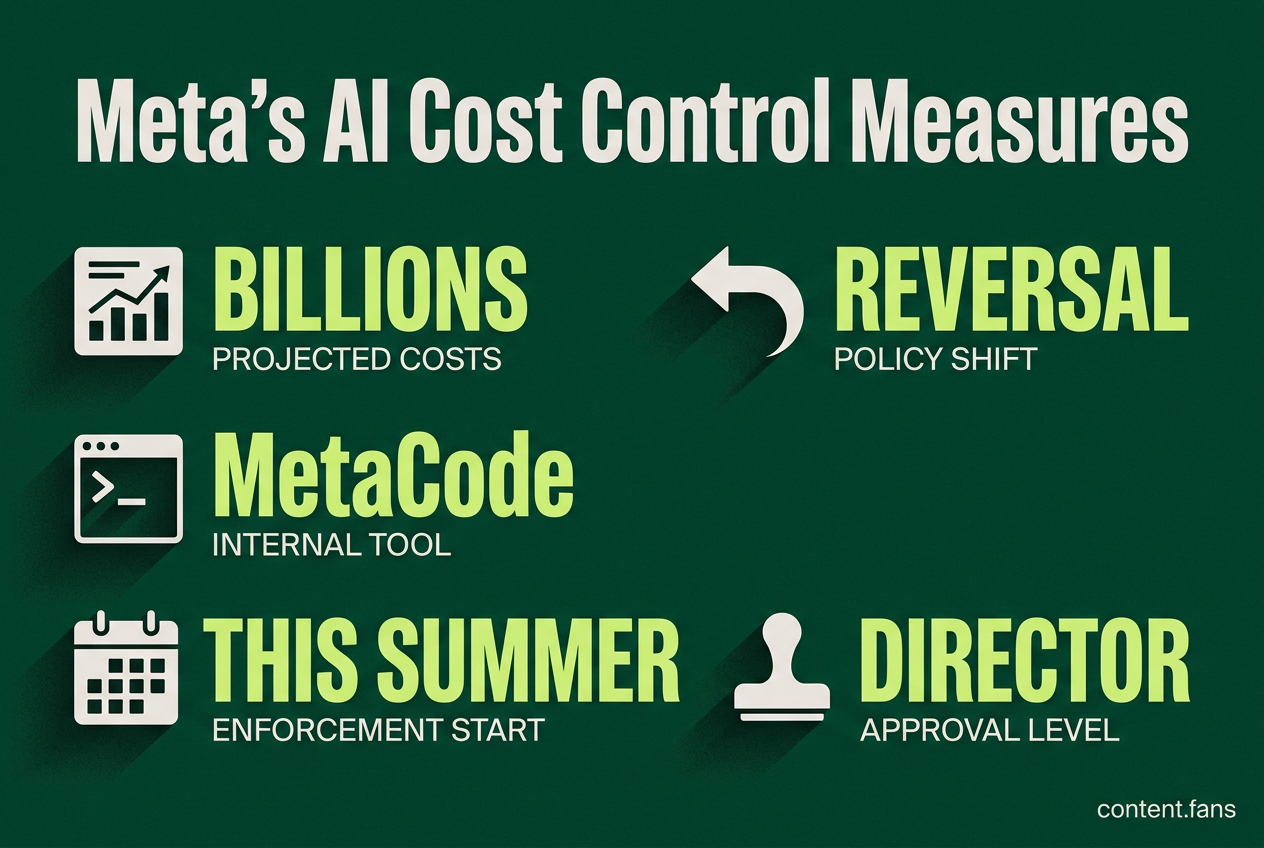
The policy marks a sharp reversal from last year's push for rapid AI adoption. Key measures outlined in the memo include:
- Token Ceilings: Individual and team-level budgets will replace leaderboards that previously rewarded high usage, a practice known as "tokenmaxxing."
- AI Gateway: A new centralized dashboard will track spending and automatically alert teams to unusual usage spikes.
- Shift to MetaCode: Employees are directed to migrate from third-party AI coding tools to Meta's internal solution, MetaCode (formerly DevMate).
The plan, confirmed in a LinkedIn post by journalist Jyoti Mann, will see new budget enforcement begin this summer, just weeks after previous expansion efforts.
How the AI Gateway Enforces Budgets
The AI Gateway will provide engineering teams with precise data on token consumption and its associated dollar value. As projects near their monthly allowance, managers will receive automated notifications. The system offers granular tracking by user, model, and department, allowing for immediate shutdowns of experiments that exceed their budget. Meta plans to complete the initial rollout within weeks and expects to manage AI tokens with the same formal budgeting and forecasting applied to physical computing resources.
MetaCode: Driving Productivity While Cutting Costs
The memo presents MetaCode as a more cost-effective alternative to external AI platforms. According to industry reports, the tool has delivered significant productivity gains for users. While these gains could lower per-feature development costs, analysts note that actual savings will depend on internal inference costs and potential rework, which the memo does not detail. This internal push reflects broader industry pressure, as AI infrastructure spending across major tech companies continues to grow substantially.
Implementation Timeline and Future Outlook
The immediate plan involves onboarding all teams to the AI Gateway and enforcing the initial token ceilings. Employees requiring additional capacity beyond their quota must secure director-level approval. While specific caps remain undisclosed, they are expected to tighten as more usage data becomes available. Concurrently, Meta will measure the ROI of MetaCode. If the tool proves to deliver sustained cost benefits, it could become mandatory for certain engineering roles, a move that could set a precedent for other tech giants facing similar AI expenditure challenges.
What specific token limits is Meta imposing on employees?
Meta will impose strict token quotas on every team and shut down internal leaderboards that used to reward "tokenmaxxing." The company is rolling out an internal AI Gateway platform that will give each org a real-time budget dashboard and trigger automated alerts when usage spikes. These caps come from a recent memo that was shared with employees, framing the move as critical to avoid "runaway internal costs" that were forecast to reach significant amounts.
Why is Meta pivoting to MetaCode and away from third-party AI tools?
The memo explicitly tells staff to replace external AI coding tools with MetaCode (previously called Devmate). The in-house assistant is expected to be the primary lever to bring costs down, because it lets Meta negotiate its own GPU time, throttle token burn in real time, and avoid third-party mark-ups. In recent benchmarking, engineers using MetaCode reported substantial productivity improvements, suggesting that tighter cost controls will not necessarily mean lower output.
How big is the projected AI expense for Meta?
Internal forecasts now put internal AI spend alone in the low double-digit billions. When combined with hyperscale infrastructure plans that already guide Wall Street estimates, the total AI bill for Meta is guided at $115 B - $135 B, according to Yahoo Finance summaries. These figures do not include the risk multiplier if employee token usage had remained uncapped.
What broader industry patterns make these controls logical?
Across the major hyperscalers (Meta, Amazon, Alphabet, Microsoft), combined AI infrastructure capex is expected to reach substantial amounts. Analysts warn that unchecked internal usage would push total spend even higher, straining free cash flow at every firm. Amazon, Microsoft, and Alphabet have already deployed internal billing, quota dashboards, and usage caps-making Meta's moves part of a sector-wide "spend-discipline" cycle.
When will the new rules be fully active?
Implementation is happening in phases:
- Initial rollout - AI Gateway and token quotas roll out company-wide.
- Future phases - Meta expects a fully structured framework in which every project, team, and product group will receive a token budget, just like headcount or marketing dollars, with regular allocation reviews.