
Meta expands AI data collection with employee keystroke tracking
Serge Bulaev
Meta has started tracking employee keystrokes and mouse activity in the U.S. to collect data for training AI assistants, but this monitoring may capture private messages and sensitive information. Experts say this is allowed in most U.S. states if workers are told, but it might not meet privacy laws in Europe, which may be why the program is not in the UK or EU. Employees can now pause tracking for 30 minutes or ask for exemptions after staff pushed back, but screenshots may still be taken. Other companies are watching closely, and the rules around this kind of monitoring could change as new laws are discussed in the U.S. and Europe.

Meta has initiated an employee keystroke tracking program in the U.S. to gather data for training its next generation of AI assistants. The company justifies the data collection as necessary for refining AI tools, but the monitoring can inadvertently capture sensitive employee data, including private messages.
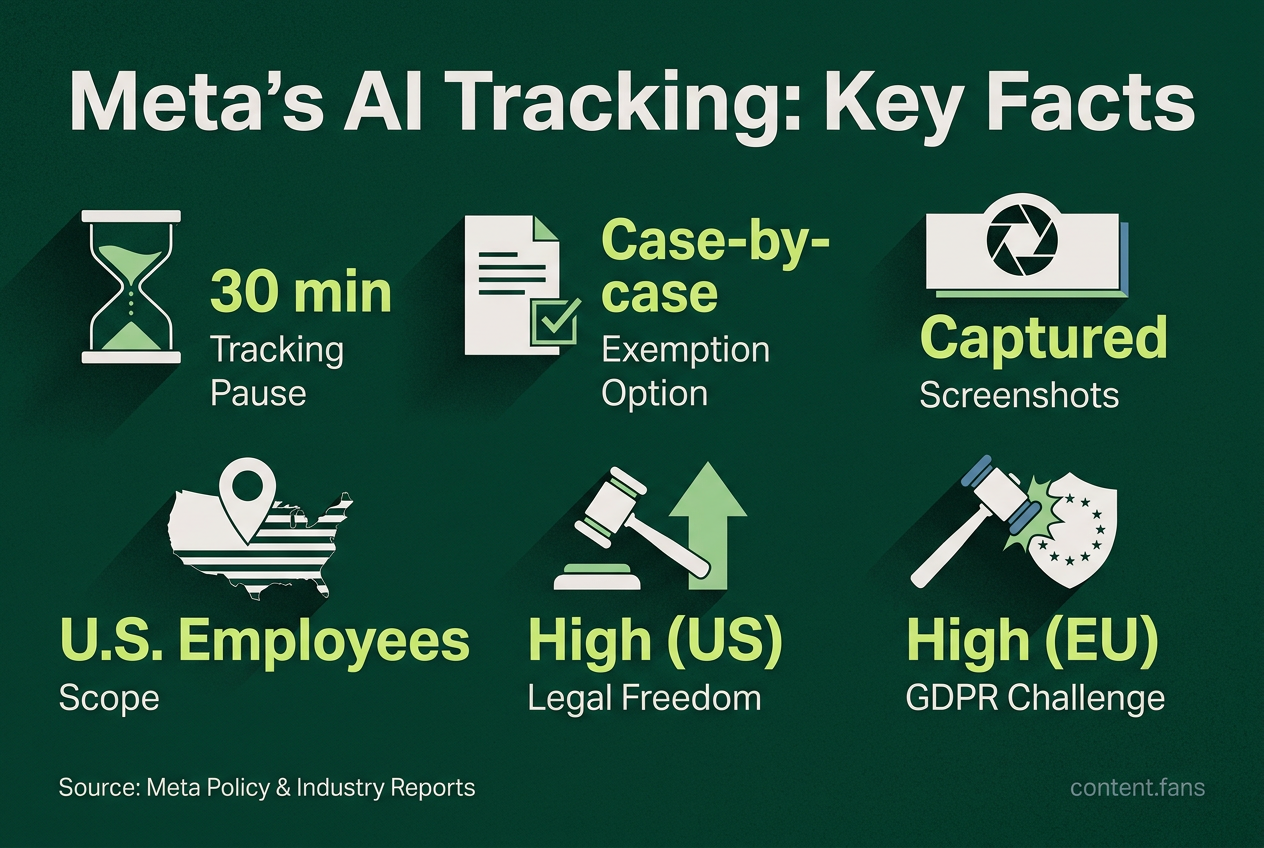
The updated policy allows employees to pause the tracking for 30-minute intervals and request full exemptions. However, according to industry reports, these concessions came following staff concerns about the program's scope and potential privacy implications.
Meta rolls out invasive keystroke and mouse-tracking for employees to harvest AI training data
Meta's program captures employee keystrokes, mouse movements, and screenshots to train AI assistants. The goal is to use real-world examples of computer activity to build models capable of automating routine digital tasks, a project the company calls its Model Capability Initiative.
Initially, CTO Andrew Bosworth informed staff there was "no option to opt out" of the tracking on work-provided devices. This policy was revised following an internal petition where employees raised concerns that the tool could capture sensitive information, such as client code or personal health details.
The revised policy includes the following key concessions:
- Employees can pause data logging for 30-minute periods using a toolbar button.
- Full exemptions from the program can be requested and are reviewed on a case-by-case basis.
- Screenshots continue to be captured unless a full exemption has been granted.
- The data collection program is currently confined to U.S. employees, with no expansion to the EU announced.
Legal and industry context
From a legal standpoint, U.S. federal law grants employers significant freedom to monitor employees, provided clear notice is given. While states like California and New York mandate specific written notices, the practice is largely permitted. Conversely, privacy experts note that in the European Union, the GDPR's principles of "purpose limitation" and "proportionality" would make justifying continuous keystroke logging for AI training legally challenging.
While other tech giants monitor employees, the purpose differs. Microsoft's Viva Insights analyzes collaboration patterns for productivity, not AI training, and Amazon focuses on metrics like "Time Off Task." Although many Fortune 500 companies measure AI tool usage, Meta's program appears unique in using raw employee activity to directly train new models.
This new frontier of data collection is setting the stage for future regulatory debate, especially as the EU AI Act is finalized and U.S. states update their electronic monitoring laws. Meta's program highlights the growing tension between rapid AI development and established principles of workplace privacy and employee autonomy.
What exactly is Meta collecting from employees and why?
Meta is capturing every keystroke, mouse movement, click and screenshot from engineers using company-issued laptops. According to the BBC, the data is fed into Meta's Model Capability Initiative (MCI) to train AI agents that can "assist individuals in completing daily tasks on computers" by learning from authentic examples of actual usage.
Did employees have any say at the beginning?
No. When the program began in late April, Reuters-derived reporting shows CTO Andrew Bosworth told staff there was "no option to opt out of this on your work provided laptop." The initial weeks produced strong internal backlash, with workers fearing the tool was capturing typos, personal messages, or sensitive internal messages.
What changed after the backlash?
On 2 June an internal memo from Stephane Kasriel granted two concessions:
1. Employees can pause collection for up to 30 minutes at a time.
2. They may request full exemptions - for example, those with bandwidth constraints or who handle highly sensitive code.
These changes are the only documented modifications since the program's launch.
Is the program active outside the United States?
No. Meta has not rolled the system out in the UK or other EU jurisdictions. Reporting in the Guardian and Tech Policy Press cites stricter data-protection rules and the need for works-council approval in Europe as the main barriers. Every public reference to the MCI tool since April places it strictly on U.S. company devices.
How does Meta compare with other tech giants?
- Microsoft uses Viva Insights to track email response times, meeting attendance and collaboration patterns for workforce analytics - not AI training.
- Amazon reportedly measures AI-tool adoption via internal dashboards and continues warehouse Time-Off-Task monitoring.
- JPMorgan, KPMG and similar firms only track aggregate AI usage for performance reviews.
Meta remains the clearest case where raw keystroke and screenshot data are explicitly repurposed to train new AI models.