
Meta cuts 8,000 jobs as AI costs mount, shifts strategy
Serge Bulaev
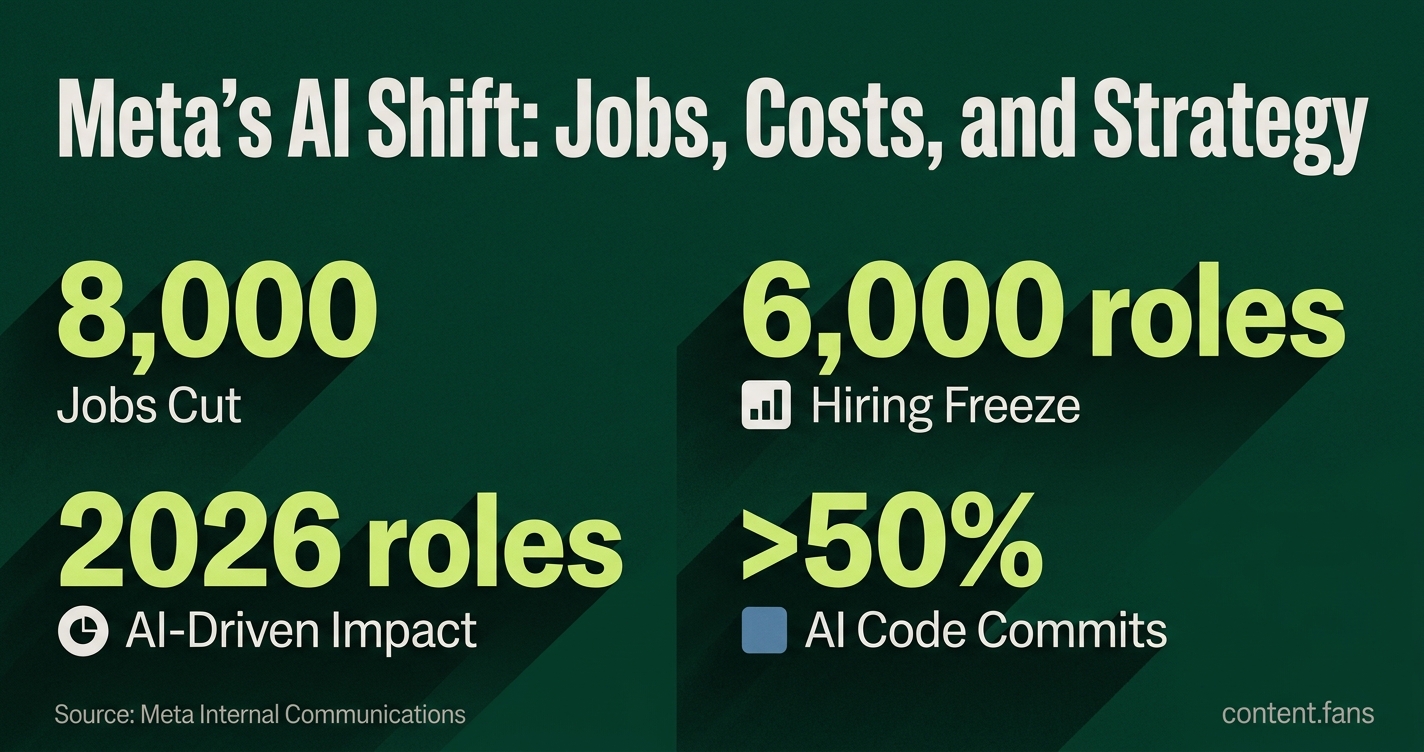
Meta is cutting about 8,000 jobs, which may be linked to the rising costs of building AI tools and custom computer chips. Reports suggest the company is shifting spending towards data centers and technology for training AI, while freezing hiring for thousands of open positions. Some teams like recruiting, sales, and operations appear to be most affected, as many tasks might soon be automated. Analysts say this move shows how AI could change not just Meta but many jobs across the US. It is not certain if more layoffs will happen, but further cuts may depend on how much Meta spends on AI and how well new ways to measure employee performance work.

Meta is cutting 8,000 jobs as part of a major strategic shift toward an AI-first operating model, a move that highlights the immense costs of developing advanced artificial intelligence. Internal communications link the layoffs directly to rising capital demands for large language models and custom chips. Industry reports have framed the decision as a significant financial consequence of Meta's AI transformation.
The company has stated that productivity must rise as it redirects spending from payroll to physical infrastructure like data centers, AI training clusters, and in-house silicon. Analysts view this as the clearest signal yet that AI is fundamentally reshaping both corporate balance sheets and employee performance metrics.
Why thousands of roles face elimination
Meta's job cuts are a strategic reallocation of capital, not simply a cost-saving measure. The company is redirecting funds from payroll to finance its large-scale AI ambitions, including building new data centers, developing custom chips, and training advanced models to boost long-term productivity and automation.
While public filings have not specified every team affected, news outlets report a significant headcount reduction. Quartz named Reality Labs, recruiting, sales, and global operations as some of the units impacted, while CNN Business added that a hiring freeze on 6,000 open roles expands the scale of the contraction. This dual approach trims current staff while curbing future wage growth.
Consultancy DWU notes that an internal system is ranking tasks by automation potential. Its analysis suggests that high-volume administrative work faces the greatest exposure, while roles in machine learning operations and data engineering remain key hiring priorities.
An AI-first operating model inside the org chart
The pivot to an AI-first model centers on two key changes:
- Capital is flowing toward infrastructure: Investments are being tracked in new data centers and custom chips designed for model training.
- Performance reviews are shifting: A Business Insider summary on Reddit indicates that beginning in 2026, employees will be measured on "AI-driven impact."
If adopted, engineers may need to show that AI assistance contributed to over half of their code commits, a figure cited by analyst Umar Ruhi. These unconfirmed targets echo a wider industry push toward measurable AI leverage.
Departments with the highest automation risk
- Recruiting - Internal chatbots now screen early-stage applicants.
- Global operations - Routine process tickets feed directly into AI triage tools.
- Sales support - Lead qualification is migrating to predictive algorithms.
- Content operations - First-pass moderation uses computer vision and multilingual classifiers.
- Middle management layers - Dashboards reduce manual status reporting.
This move aligns with broader industry trends suggesting AI will significantly reshape many jobs across various sectors, with experts pointing more toward role redesign and augmentation rather than outright job elimination.
What the shift means for remaining staff
Employees who stay can expect smaller cross-functional teams, higher individual output goals, and mandatory upskilling in prompt engineering or data governance. Industry commentators suggest that a significant portion of the workforce could eventually be affected if AI cost pressures persist, though such scenarios remain speculative.
For now, the clearest verified fact is the initial wave of about 8,000 layoffs. Whether subsequent rounds follow will hinge on the pace of AI infrastructure spending and the success of new performance metrics linked to algorithmic productivity.