
Meta acquires 49% of Scale AI for $14.8B, boosts AI data capabilities
Serge Bulaev
Meta bought a 49% non-voting stake in Scale AI for $14.8 billion, which may help Meta get better training data for its AI models. The deal gives Meta special access to Scale AI's labeling tools, but it is not a full takeover. Some reports suggest that competing AI labs are now looking for other data providers, possibly to avoid depending too much on Meta and Scale. The exact payment details and how Scale AI will work with outside customers are still unclear. This move suggests Meta believes having control over high-quality data may be key for future AI improvements.

In a landmark move for its AI strategy, Meta invested about $14.3 billion to $14.8 billion for a 49% non-voting stake in Scale AI, which remained an independent company, securing privileged access to the firm's critical data capabilities. The deal, valued at approximately $14.3-14.8 billion for a 49 percent non-voting stake, also brings Scale AI founder Alexandr Wang into Meta's new superintelligence group, according to a Reuters report. This strategic investment reshapes the competitive landscape for large language model (LLM) developers, many of whom relied on Scale AI's data labeling pipelines.
Deal structure and immediate effects
Meta's investment secured a 49% non-voting stake in Scale AI, giving it priority access to elite data labeling and human feedback services. The deal avoids a full acquisition but strategically aligns Scale AI's data infrastructure with Meta's AI roadmap, while also bringing founder Alexandr Wang into Meta.
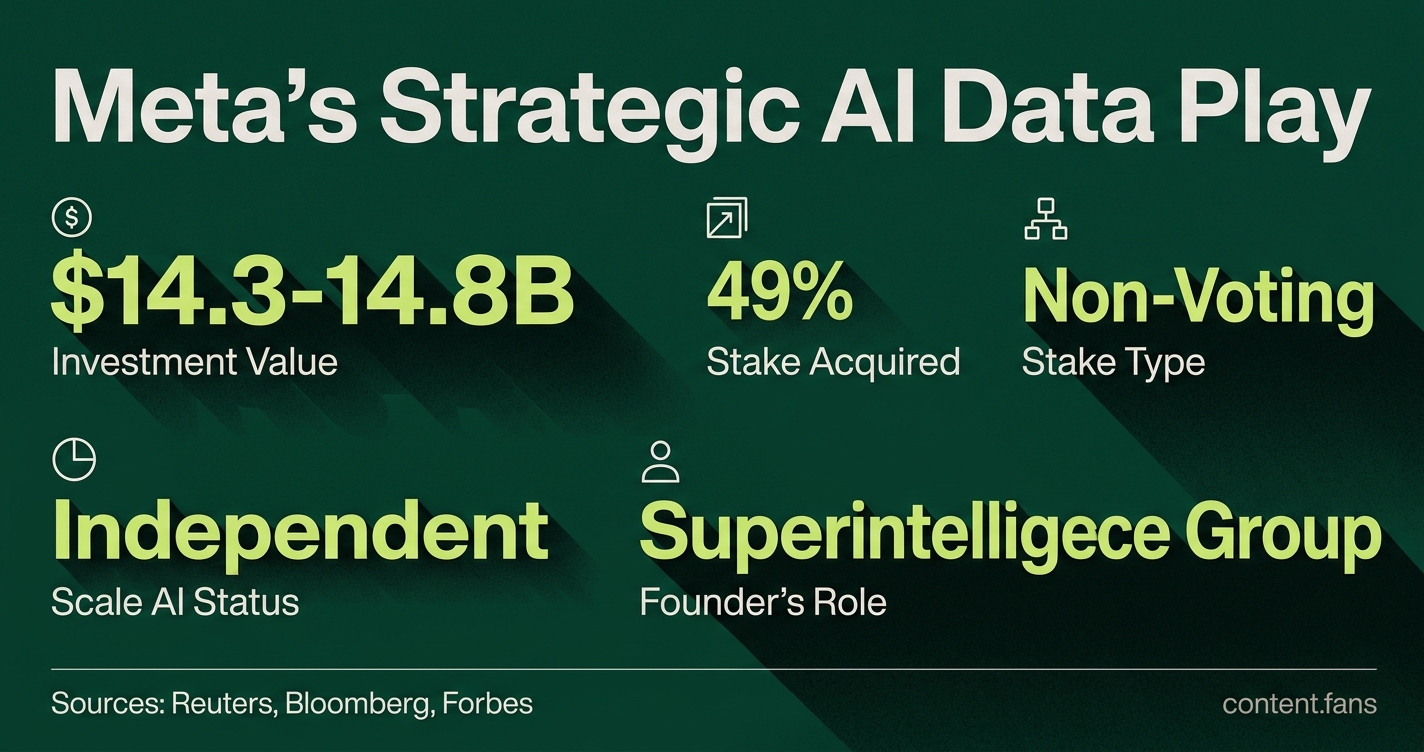
As part of the deal, Alexandr Wang has transitioned from his CEO role at Scale to a new position within Meta, reporting directly to Mark Zuckerberg in a unit focused on superintelligence research. This non-voting stake structure allows Meta to avoid a full regulatory takeover review while still integrating Scale's valuable human-in-the-loop data infrastructure with its own model development goals. The market's reaction was immediate, with a Bloomberg report noting a "customer demand spike" for alternative data providers as rival AI labs moved to reduce their dependency on Meta-linked services.
Why high-quality data matters in AI development
According to industry reports, while earlier AI advancements were driven by sheer computational scale, many analysts now suggest the primary bottleneck has shifted to the availability of high-quality, curated training data. Scale AI excels in this domain, specializing in Reinforcement Learning from Human Feedback (RLHF) workflows. These processes are crucial for training models to follow complex instructions, reduce factual errors (hallucinations), and adhere to safety policies. Meta's investment is widely seen as a strategic move to build a "data moat" around post-training model quality, as noted by Forbes.
Key capabilities Meta gains:
- A significant number of active annotators who deliver multimodal labels across text, image, and video
- Versioned evaluation suites used by frontier labs for safety and policy alignment
- RLHF pipelines that pair reward modeling with continuous preference collection
- Workflow software that routes ambiguous samples to expert reviewers in minutes
Competitive responses and market pressure
The industry realignment began almost immediately, with Google reportedly terminating its contracts with Scale AI just weeks after the deal was announced. In response, smaller data annotation providers in India and Eastern Europe began marketing their "vendor-neutral" RLHF offerings to capture displaced customers.
Market trackers have already observed an increase in annotation prices, signaling limited short-term capacity outside of Scale AI's ecosystem. This pressure is expected to accelerate industry investment in synthetic data generation, which is then refined with targeted human validation. For Meta, this tighter vertical integration offers a distinct advantage, allowing for faster corrections of model weaknesses and more rapid alignment updates for its open-weight Llama model series.
Unanswered questions
Several key details of the transaction remain undisclosed. According to industry reports, it is unclear whether the payment is structured as cash, equity, or a combination tied to performance milestones. Furthermore, Alexandr Wang's official title and specific responsibilities at Meta have not been fully clarified beyond his leadership role in the superintelligence group. Finally, there is limited visibility into how Scale AI will balance serving its external customers while its largest financial partner, Meta, is also a primary client.
What is clear is that access to premium human feedback data has become a decisive strategic asset in the generative AI race. Meta's investment in Scale AI is a powerful signal that control over the data pipeline - not just computational power - will likely determine the leaders in the next wave of AI model development.
What exactly did Meta buy with the Scale AI deal?
Meta acquired a 49% stake in Scale AI in a roughly $14.3 billion deal. Through this structure it gains preferred access to Scale's industry-leading data-labeling, RLHF pipelines, and human-in-the-loop evaluation services that most frontier AI labs currently rely on. The deal also brought Scale founder Alexandr Wang into Meta to steer its broader AI strategy.
How will this change Meta's large-language-model roadmap?
Vertical integration of high-quality training data is expected to shorten feedback loops between model weaknesses and dataset refinements, improve alignment safety through richer RLHF data, and reduce vendor bottlenecks that rivals still face. According to industry reports, Meta's engineering teams should be able to iterate on foundation-model releases faster and with stronger post-training evaluation than competitors who must still contract multiple external suppliers.
Why did Google reportedly stop working with Scale AI soon after the announcement?
Google interpreted the partnership as a loss of neutrality: Scale had become a data provider partly controlled by a direct rival. According to industry reports, this immediate exit triggered a customer demand spike at Scale's competitors as other labs raced to diversify their own data-vendor portfolios, according to Bloomberg.
What is Alexandr Wang's role at Meta today?
Alexandr Wang stepped down as Scale CEO and now reports directly to Mark Zuckerberg inside a new group informally called Meta Superintelligence Labs. His charter is to operationalize Scale's human-feedback expertise inside Meta's research stack, while retaining a board seat at Scale to preserve strategic continuity.
Are data-labeling costs about to rise across the industry?
According to industry reports, the consensus is yes. With Meta locking in premium capacity and rivals scrambling for alternative suppliers, annotation prices are already increasing significantly. Many labs are reportedly offsetting this by investing in heavier AI-assisted pre-labeling and synthetic data paired with tighter human validation, trends that according to industry reports dominate planning roadmaps cited by multiple market reports.