
Merchkit, Pixyle AI Unveil New AI Catalog Enrichment Features
Serge Bulaev
Commerce teams may use AI to improve product catalogs, which appears to raise conversions and lower manual work. A small pilot on selected product categories is suggested before rolling out to all products, to check if AI enrichment really helps. Early results from some companies suggest possible gains like better search results and time savings. The process includes normalizing data, generating better descriptions, tagging products, and checking results, with humans reviewing uncertain cases. If the pilot shows at least a 5 percent improvement in conversion, teams might expand to more products and keep using feedback to improve the system.

Commerce teams are using AI catalog enrichment to boost product catalog performance and drive growth. Early adopters see significant conversion increases and reduced manual effort, according to industry reports from companies like NVIDIA and Adobe. This guide provides a framework for moving from a small-scale pilot to achieving sustained catalog improvements.
Starting with a small pilot program de-risks the investment by validating performance uplift on a targeted slice of SKUs before scaling across the entire product assortment.
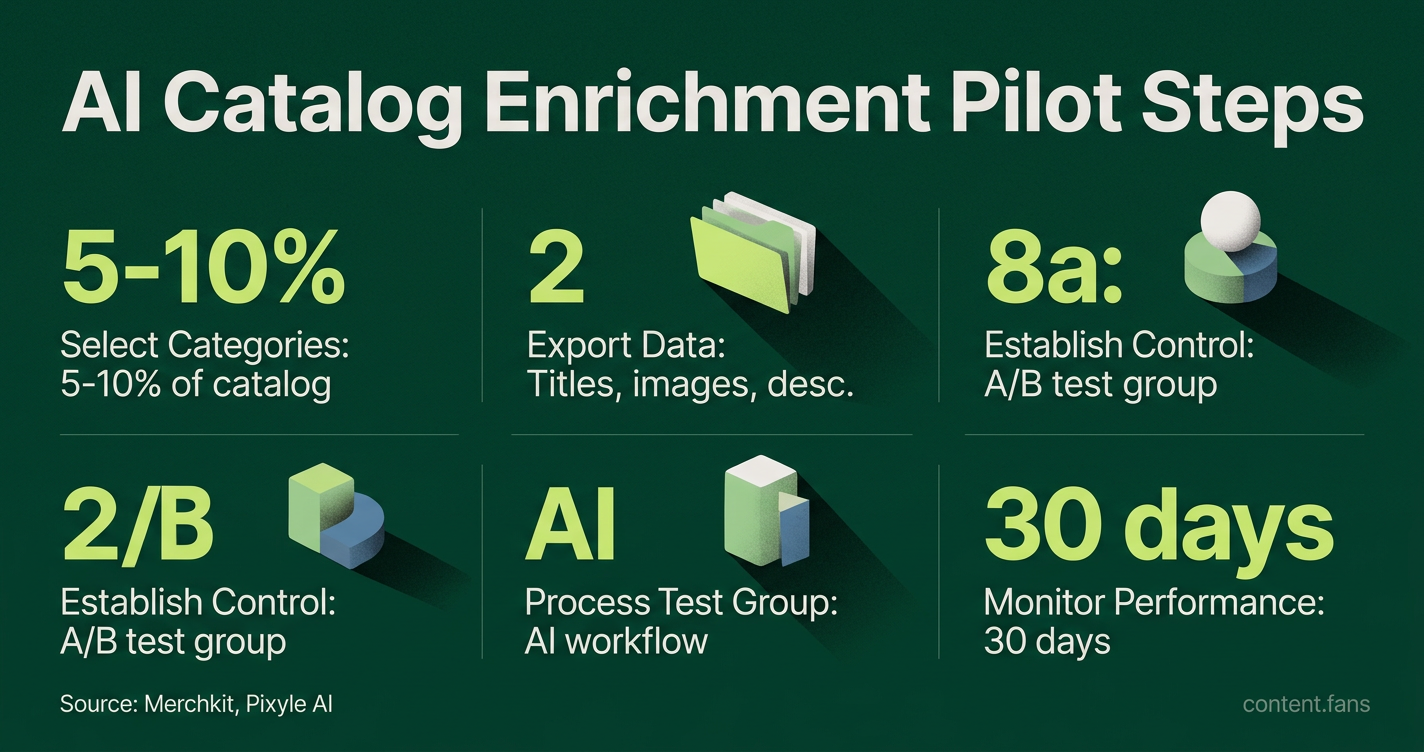
How to Launch an AI Enrichment Pilot Program
An effective AI enrichment pilot involves selecting high-traffic product categories, exporting raw product data, and establishing a control group. The test group data is then processed through an AI workflow, with performance metrics tracked against the control group for a set period to validate impact.
- Select Pilot Categories: Choose top revenue-generating categories, covering approximately your highest-performing SKUs (typically 5-10% of your catalog).
- Export Product Data: Compile a raw data export including titles, attributes, images, and current descriptions.
- Establish a Control Group: Designate a portion of the SKUs to remain unchanged for A/B testing.
- Process the Test Group: Feed the remaining SKUs into the AI enrichment workflow.
- Launch and Monitor: Publish the enriched content and track performance metrics against the control group for 30 days.
Choosing the Right AI Catalog Enrichment Tools
The tool market includes AI-native enrichment platforms, traditional Product Information Management (PIM) systems, and feed syndication services. For end-to-end enrichment and publishing, platforms like the Merchkit platform process data from various sources to produce channel-ready listings. Enterprises focused on governance often select Salsify or Akeneo, whereas fashion retailers may prefer tools like Stylitics or Adobe Commerce for detailed style tagging. Key evaluation criteria include total cost per SKU and the availability of model confidence scores to streamline human review.
Key Stages of an AI Enrichment Workflow
- Normalization: Map source fields to a unified schema and standardize units of measurement.
- Generation: Employ large language models (LLMs) to write optimized titles, bullet points, and product descriptions.
- Tagging: Automatically extract attributes from product images and text.
- Taxonomy Mapping: Assign each product to its correct location in your site taxonomy and relevant channel categories.
- Validation: Send low-confidence outputs to a human review queue before publishing.
For effective human-in-the-loop (HITL) review, maintain a dedicated queue that prioritizes brand-sensitive or high-risk fields. Combining model confidence scores with business rules ensures human reviewers focus their efforts on the most critical SKUs.
Measuring Success: Core KPIs for Catalog Enrichment
- Catalog Coverage: The percentage of SKUs processed by the AI.
- Operational Efficiency: Time-to-approval per SKU.
- Content Quality: The description completeness score.
- Discoverability: Search impressions and the zero-result search rate.
- Revenue Impact: Conversion rate lift compared to the control group.
Industry reports indicate that companies implementing AI for catalog enrichment have seen significant improvements in operational efficiency and conversion rates, though specific metrics vary by implementation.
Scaling from Pilot to Full-Scale Rollout
Once the pilot demonstrates significant impact - such as meaningful conversion improvement or a measurable drop in zero-result searches - proceed with expanding coverage to other high-priority categories. Communicate the rollout schedule using a backlog calendar to align merchandising, SEO, and marketing teams. Implement a continuous feedback loop by sampling enriched products for quality assurance and feeding corrections back into the model.
A mature enrichment program integrates seamlessly into daily content operations. New supplier feeds are automatically processed through the enrichment pipeline, and events like seasonal changes or new regulations can trigger re-enrichment across the catalog. This sustained effort leads to comprehensive attribute coverage, faster channel compliance, and lasting improvements in product visibility.
How should commerce teams prioritize SKUs when starting AI catalog enrichment?
Start small and high-impact. Many pilot programs choose a significant portion of SKUs that either drive the majority of revenue or sit in categories with low completeness or weak discoverability.
- Prioritize flagship products, new launches, and long-tail items that previously required heavy manual work.
- One apparel retailer ran a pilot on women's dresses and sneakers first, demonstrating ROI before scaling further.
Which AI tools are best for catalog enrichment?
The current landscape for commerce teams includes:
| Use case | Leading tools |
|---|---|
| End-to-end owned-catalog enrichment | Merchkit - ingests CSV, PIM, Shopify, ERP inputs; writes SEO-ready copy, attributes, and channel listings downstream |
| Enterprise catalog governance | Akeneo or Salsify - strong taxonomy & multi-channel syndication |
| Fashion-specific attributes | Stylitics or Adobe Commerce - auto-tags fabric, color, pattern, style at SKU level |
| Bulk content generation | Hypotenuse AI - fills missing data and generates publish-ready copy from images |
| Feed management & marketplace compliance | Feedonomics - ensures SKUs meet Amazon, Google, Walmart rules |
Teams typically pair one specialist enrichment engine with a PIM or feed tool to keep governance and publishing in sync.
What does a rollout framework look like?
A common approach:
Phase 1 (Pilot)
- Scope: Limited SKUs in one category
- KPIs: Catalog coverage, reasonable review time per item, minimal blocking errors
Phase 2 (Expand)
- Scope: Significant portion of catalog
- KPIs: Improved listing speed, high auto-approval rates after confidence tuning, uplift in impressions
Phase 3 (Scale)
- Scope: Full catalog or multi-market rollout
- KPIs: Conversion lift benchmarked against non-enriched control group, reduction in manual tagging hours
How do you build an effective "human-in-the-loop" review layer?
Baseline rules that reduce risk without slowing growth:
- Route by risk - send only brand-sensitive, high-revenue, or low-confidence attributes to humans
- Set confidence thresholds - auto-approve above high model confidence levels, queue the rest
- Define micro-tasks - reviewers see single attributes (e.g., "fabric," "care instructions") rather than whole listings
- Measure regularly - track review time per SKU, error rate, and human-model agreement
- Feed corrections back - every edit trains the next model cycle, reducing manual reviews over time
What metrics prove enrichment is working?
Common benchmark categories:
- Catalog health: attribute coverage, taxonomy accuracy, completeness score
- Operational speed: time-to-approval per SKU, cost per enriched item
- Discovery performance: search impressions for enriched SKUs, zero-result search rate
- Revenue: conversion rate uplift, add-to-cart rate, revenue per customer
- Content cost: manual hours saved, cost reduction in content operations
Use a simple before/after A/B test: keep a portion of SKUs untouched, measure conversion delta to validate the business case for full rollout.