
LLM Cost Optimization Tools See 26% CAGR, Enterprises Target Savings
Serge Bulaev
The market for LLM cost optimization tools may grow at about 26 percent each year between 2026 and 2034, with enterprises making up most of the purchases. This suggests companies want more than simple reports; they seek real-time controls and tools that cut AI costs before charges happen. Demand appears to be rising because cloud use and new pricing models make AI costs hard to predict. Best tools often include features like batching, caching, predictive analytics, and usage limits. There are early signs that automated tools may soon be able to manage spending and enforce budgets without human help.

As enterprises struggle with escalating AI expenses, the market for LLM cost optimization tools is surging, with projections showing a 26.7 percent CAGR between 2025 and 2035 LLM cost optimization market. This rapid expansion, part of a broader AI FinOps market experiencing significant growth according to industry reports, signals a critical shift in enterprise needs. Companies are moving beyond simple dashboards, demanding powerful runtime controls to proactively manage and reduce AI costs before they impact the bottom line.
Why Demand for LLM Cost Control Is Rising
The increasing adoption of cloud services, complex multi-model AI architectures, and opaque pricing models have made AI inference costs highly unpredictable and a significant line item on P&L statements. Consequently, enterprises are moving away from reactive monthly reports, prioritizing platforms that offer real-time visibility, predictive forecasting, and automated cost-saving actions.
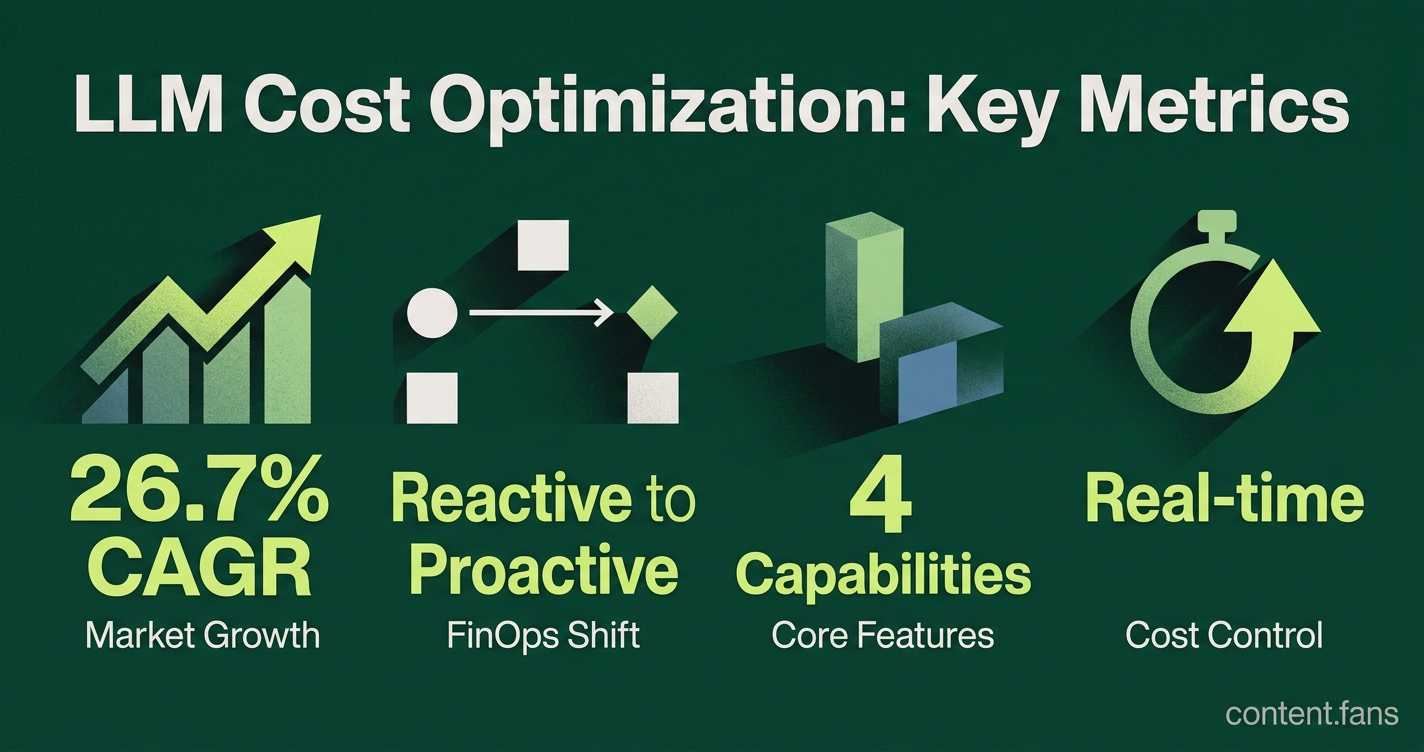
LLM cost optimization tools provide enterprises with real-time control over their AI spending. By monitoring API calls, caching frequent queries, and routing tasks to the most cost-effective models, these platforms actively reduce token consumption and prevent budget overruns, shifting financial governance from reactive reporting to proactive management.
While established cloud FinOps vendors like Apptio Cloudability, Flexera, and Spot by NetApp focus on infrastructure, a new class of GenAI-specific tools from providers like nOps, Weights & Biases, and Moesif offers targeted solutions for tracking token usage and guiding model selection nOps tooling list.
Core Features of a Best-in-Class Platform
Leading platforms that secure enterprise budgets consistently deliver four critical technical capabilities to transition from passive observability to active cost control:
- Batching: Groups non-urgent requests to minimize overhead and reduce latency-related costs.
- Semantic Caching: Reuses previous prompts and responses for similar queries, directly cutting down on redundant token usage.
- Predictive Analytics: Forecasts future token consumption based on historical data, providing early warnings about potential budget anomalies.
- Quota Enforcement: Implements hard spending caps and usage limits per team, project, or workflow to prevent overages.
Top-tier solutions also incorporate intelligent model routing, a gateway feature that directs simple queries to less expensive models while allocating premium, high-cost models for complex reasoning tasks.
The Emergence of Automated Cost Remediation
The market is evolving toward fully automated remediation. Advanced FinOps suites are deploying AI agents or 'spend bots' capable of independently pausing idle GPU clusters or downgrading services that exceed budget. Prototypes in platforms like Coupa Compose and Finout's AI Agent Suite can already execute complex cost-saving workflows without human intervention. This trend points to a future where policy engines operate directly within the request path, enforcing budgets and triggering optimizations automatically.
Startup Opportunity: Delivering Measurable ROI
For startups, the GenAI cost control sector is appealing due to its immediate and quantifiable return on investment. Industry reports suggest that combining model routing with semantic caching can deliver significant token expenditure reductions, with savings visible in the next billing cycle. A successful go-to-market strategy often involves starting with clear usage attribution dashboards and then layering on automated optimization features, which provides a distinct advantage over the descriptive-only tools offered by cloud providers.
Navigating the Vendor Landscape
The competitive field is segmented into three primary categories:
- Cloud FinOps Platforms: Focus on optimizing underlying cloud infrastructure.
- GenAI Gateways: Specialize in prompt efficiency, model routing, and caching.
- Revenue-Side Optimizers: Aim to protect profit margins rather than directly cutting IT costs.
When evaluating solutions, stakeholders should prioritize tools that provide per-request telemetry, integrate with billing APIs, and can enforce spending limits before an invoice is finalized. Platforms lacking these proactive controls often fail to deliver sustainable value.