
Linux Foundation Launches OpenSharing to Standardize AI Data Exchange
Serge Bulaev
The Linux Foundation has launched the OpenSharing project to create a standard way for teams to exchange AI models and data. OpenSharing may help organizations share assets without building custom connectors, and its built-in metadata could make audits easier and help with trust. Experts suggest this protocol addresses some technical barriers, but full regulatory alignment might need more work. Early adoption seems focused on simple uses, and more details about contributions and integration should come soon. Whether OpenSharing succeeds may depend on ongoing community cooperation and how well it fits with privacy and risk efforts.

The Linux Foundation launched OpenSharing to standardize AI data exchange, a new open-source project announced with initial code contributions from Databricks. According to the foundation's press release, OpenSharing provides a vendor-neutral protocol for sharing AI models, datasets, and agent skills across research teams, cloud services, and on-premises systems without custom integrations. Described as an extension of Delta Sharing, OpenSharing expands interoperability across multiple open table formats, including Apache Iceberg, and is designed to reduce fragmentation and improve portability. At launch, OpenSharing was announced as a Linux Foundation project, and Databricks said managed OpenSharing services were available from Everpure, MinIO, and Qumulo. This focus on practical deployment suggests a rapid path to adoption.
Why metadata sits at the center
OpenSharing establishes a universal protocol for exchanging AI models and data across different platforms. By embedding governance metadata like licenses and provenance directly into the shared assets, it aims to eliminate the need for custom connectors, streamline audits, and improve trust and reproducibility in collaborative AI workflows.
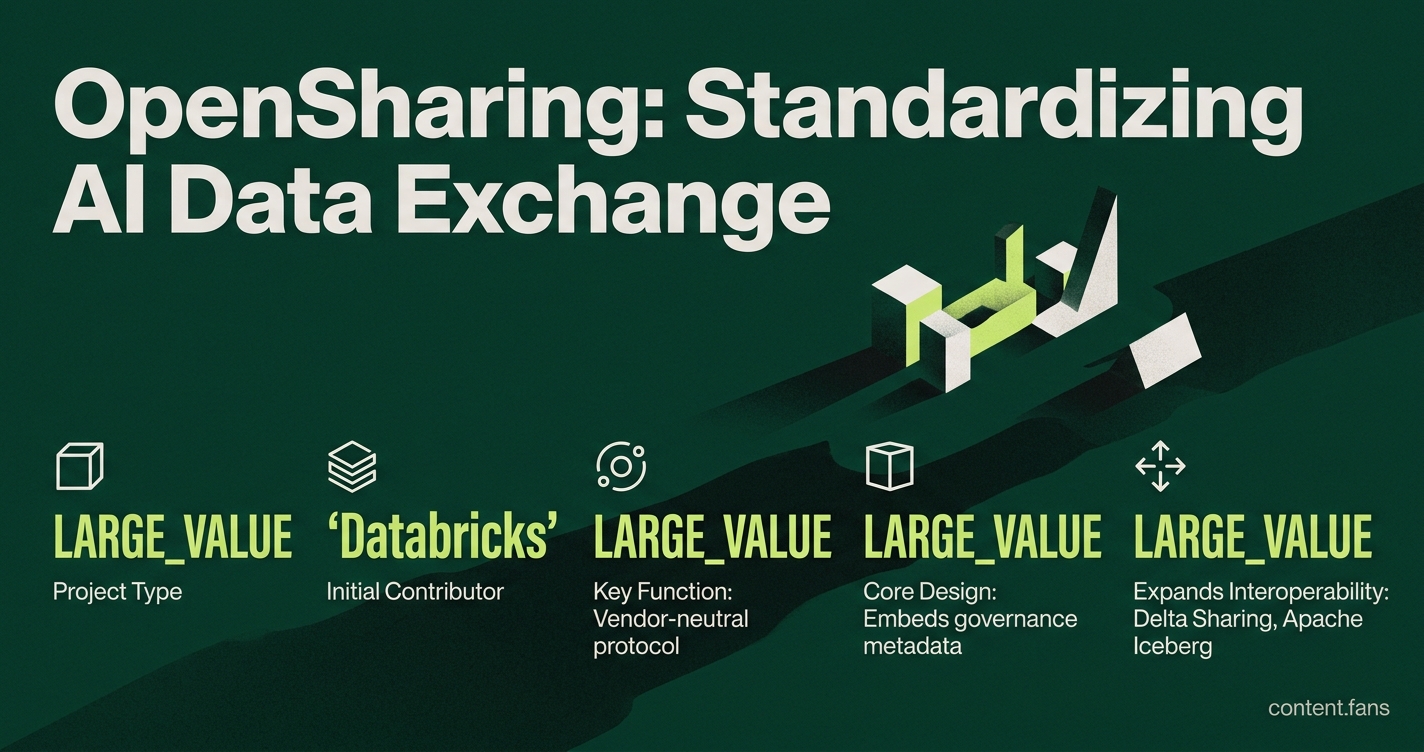
The protocol's core design embeds governance metadata - such as licenses, provenance, and risk labels - directly into each exchange package. This approach is intended to simplify audits and enhance reproducibility, particularly in regulated industries. Standardized metadata could enable model marketplace users to easily compare assets based on training data or bias testing results. CEIMIA's January 2026 report proposes phased roadmaps for AI interoperability and emphasizes coherence infrastructure, standards development, certification, and interoperable architectures, but it does not mention OpenSharing or a unified schema/REST API. However, achieving full regulatory alignment will depend on future community contributions. The Linux Foundation is currently drafting a governance charter, with details on contributions expected shortly.
Potential impact on federated learning and marketplaces
Infrastructure fragmentation often leads to vendor lock-in and slows adoption of federated learning, a hurdle that OpenSharing's standardized packaging can lower. Researchers note that common formats linked to regulations like the EU AI Act could be the catalyst for moving federated learning into mainstream enterprise use. If OpenSharing aligns with industry AI management standards, organizations could potentially exchange encrypted model updates with full provenance across multi-cloud environments without translation layers.
Model marketplaces are similarly constrained, as buyers require auditable proof of data boundaries and security before trusting external models. While OpenSharing's common asset package simplifies discovery and comparison, its rigorous documentation requirements could raise the cost of listing high-risk models. Consequently, analysts predict initial adoption will focus on low-risk applications like text classification, with high-stakes sectors like healthcare and finance awaiting mature certification standards.
Early adoption signals
- Initial code and spec: Available through the Linux Foundation
- Supported formats: Delta Sharing table, Apache Iceberg REST Catalog
- Managed service partners: Everpure, MinIO, Qumulo
According to the Linux Foundation, community meetings will determine the release cadence and governance structure. The project's success hinges on its open governance model, a critical factor where previous proprietary exchanges have failed. Long-term viability will likely depend on aligning with ongoing initiatives in AI risk management and privacy-preserving technologies.
What is OpenSharing and why did the Linux Foundation create it?
OpenSharing is a new open, vendor-neutral protocol announced by the Linux Foundation to standardize how organizations share AI assets and data across platforms and cloud environments. By extending the existing Delta Sharing ecosystem and adding support for Apache Iceberg and other open table formats, the project aims to replace proprietary marketplaces and custom integrations with a single, community-governed standard that embeds licensing, provenance and governance metadata directly into every model, dataset or agent skill. Linux Foundation announcement
How does OpenSharing improve collaboration and reproducibility?
Standardized exchange formats make it dramatically easier for research institutions, vendors and enterprises to share models and datasets without worrying about format mismatches or hidden licensing conflicts. Because the protocol preserves full lineage and governance metadata, teams can re-run experiments, audit changes and verify compliance across different stacks, reducing what the Linux Foundation calls "friction in collaborative AI workflows". Early partners such as Everpure, MinIO and Qumulo already offer managed OpenSharing services that allow on-premises storage without data movement, speeding up federated learning and regulated-industry deployments. IT Brief coverage
What technical hurdles does OpenSharing aim to solve?
Industry reports identify several main blockers to interoperable AI data sharing:
- Fragmented APIs and heterogeneous data formats that lock teams into single-vendor stacks
- Semantic inconsistency where the same field means different things across platforms
- Security, privacy and compliance gaps when data crosses clouds or national borders
- Legacy systems that cannot expose modern metadata or lineage endpoints
OpenSharing tackles these issues with common data/API standards, standardized metadata contracts, shared governance rules and containerized modular architectures that let any platform publish or consume AI assets through the same REST endpoints.
How will this standard affect federated learning and model marketplaces?
Standardized AI assets are expected to accelerate federated-learning adoption by providing interoperable client-server protocols, secure aggregation bundles and auditable model cards that map directly to EU AI Act and NIST AI RMF requirements. For model marketplaces, the uniform descriptors lower transaction costs and increase buyer trust, because every listing carries standardized evidence of training-data boundaries, privacy guarantees and performance on non-IID datasets. The available sources do not verify a 44.3% CAGR for the federated-AI market through 2034, and they do not substantiate OpenSharing as a cross-vendor portability protocol driving that forecast. IBM ICML position paper Market.us report
Where can I start using or contributing to OpenSharing today?
The Linux Foundation has made the project available under open-source licensing, and the repository includes example connectors for Delta Sharing and Apache Iceberg REST Catalog endpoints. The foundation states that "more information on how to contribute or integrate the protocol will be available soon", so interested teams should:
1. Access the project repository
2. Follow the getting-started docs to spin up a local registry
3. Publish a small dataset or model to test cross-platform read/write
4. Join the mailing list for governance and roadmap updates
Early adopters in finance and healthcare are piloting no-movement sharing via on-premises partners such as Qumulo or MinIO, so regulated data can stay inside corporate firewalls while still participating in the broader OpenSharing ecosystem.