
LinkedIn updates Post Analytics with new In-Network and Out-of-Network Reach metrics
Serge Bulaev
A new report suggests that while most marketing leaders see artificial intelligence as very important, many still use it only for specific, simple tasks. Budgets for AI in marketing appear to be growing faster than companies' ability to use AI well. Only about 30 percent of organizations may be ready to fully use AI tools, even though many want to lead in this area. LinkedIn has added new metrics that show creators how much of their post reach comes from inside or outside their network. Overall, progress in using AI, spending, and changing workflows does not seem to be happening at the same speed.

LinkedIn is updating Post Analytics with new In-Network and Out-of-Network Reach metrics, giving creators deeper insight into content discovery. This change arrives as industry reports suggest a growing disconnect between marketing AI budgets and actual organizational readiness, highlighting a key challenge for CMOs.
How big is the "Marketing Gap"?
The marketing AI gap is significant: while many CMOs report major AI transformation, a significant portion admit to using it only for isolated tasks. New research from BCG indicates a small fraction of marketing teams have redesigned workflows to fully orchestrate and scale artificial intelligence across their function.
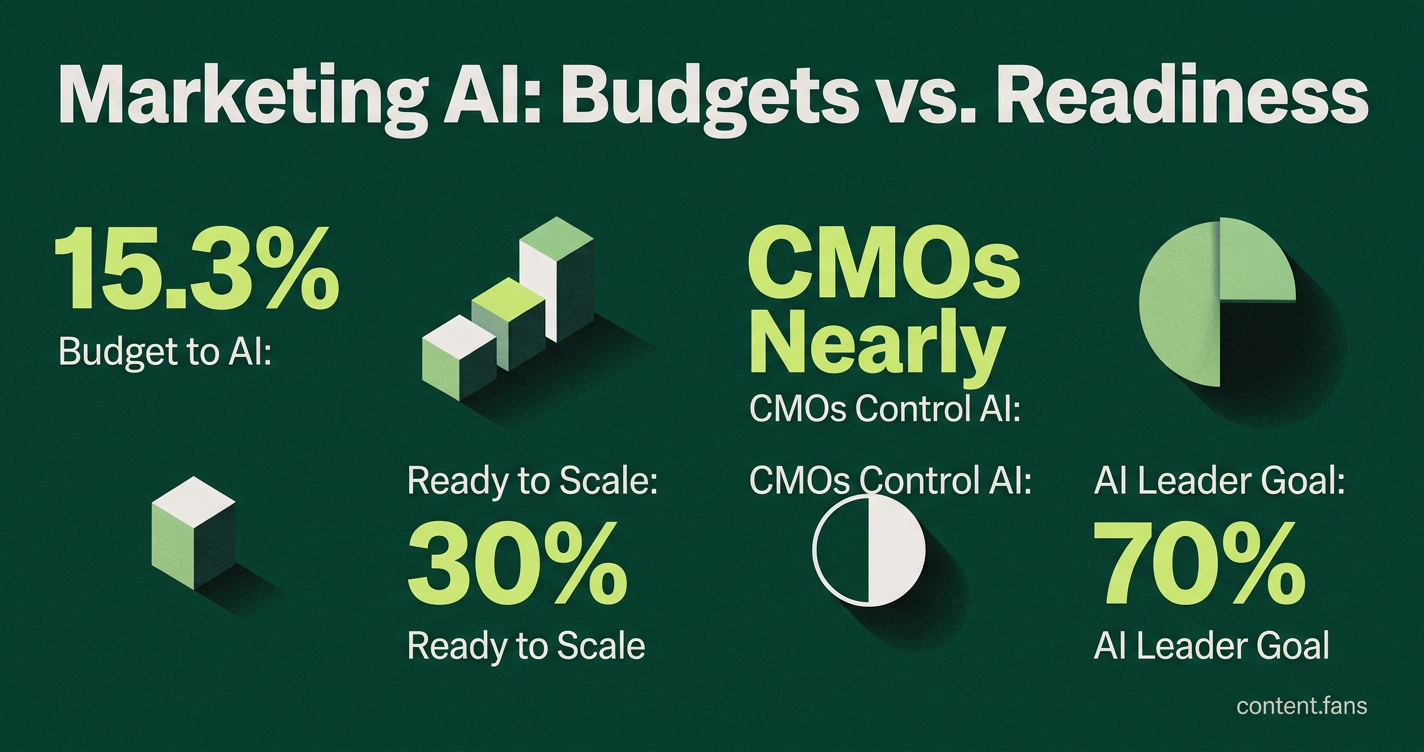
A new report from Boston Consulting Group details this disconnect. Although an overwhelming majority of CMOs describe their function as undergoing significant AI transformation, many concede they still use generative AI merely as an assistant for isolated tasks. BCG frames this as the "Marketing Gap," warning that only a small percentage of leaders have successfully redesigned teams for true AI orchestration. The study also notes that nearly half of marketing chiefs now control AI investment decisions, shifting power from the CEO or board. Read the full analysis in the official BCG press release.
Budgets accelerate faster than readiness
Data from the Gartner 2026 CMO Spend Survey reinforces this trend. Marketing leaders now allocate an average of 15.3% of their total budget to AI, yet only 30% believe their organizations are mature enough to scale these tools. This readiness gap persists even as 70% of CMOs list "becoming an AI leader" as a critical goal. According to Gartner, AI-ready companies gain an early advantage by investing more (21.3% of budget) and maintaining larger marketing-to-revenue ratios.
Key Statistics at a Glance
- 15.3% of Marketing Budgets: The average portion now allocated to AI initiatives, according to Gartner.
- Growing Trend: Many CMOs admit their AI use remains at the task-assistant level, according to industry reports.
- Increasing Reach: A growing number of posts on a typical LinkedIn feed now come from outside a user's network.
These figures illustrate a clear misalignment: while AI budgets are expanding and platforms like LinkedIn are broadening content reach, the operational changes required to capitalize on these shifts are lagging.
What exactly are the new In-Network and Out-of-Network Reach metrics?
LinkedIn now splits every post's total impressions into two distinct buckets:
- In-Network Reach: the share of views that come from your 1st-degree connections and people who already follow you.
- Out-of-Network Reach: the share of views that come from users who are neither connected to nor following you; they discover the post through the feed algorithm, reshares, search, hashtags, and other surfaces.
The percentages are displayed right under Impressions > Discovery Section inside each post's analytics dashboard.
Why did LinkedIn add these two numbers?
The rollout aligns with LinkedIn's reported shift from a Social Graph model (who you know) to an Interest Graph model (what topics you care about). Industry observations suggest significant changes in feed composition:
- LinkedIn feeds have reportedly shifted toward showing more content from users outside your direct network.
- A growing portion of posts users see in the feed now comes from people they have never connected with or followed.
The new metrics let creators measure how well their content is rewarded by the updated recommendation engine.
How can I use the split to improve content strategy?
- High In-Network % (70 %+) - your existing followers are engaged, but the algorithm is not picking the post up for broader discovery. Test tighter topics, more shareable angles, or richer media.
- High Out-of-Network % (60 %+) - the content is clearly resonating with strangers. Replicate the format, tone, and hashtags; these posts are prime candidates for ad boosting or follow-up series.
Track the ratio over time: moving from lower to higher Out-of-Network Reach on similar posts generally signals strong topical authority growth.
Are the metrics available to every user?
The feature has begun rolling out and is becoming visible globally on individual post analytics for personal profiles and Company Pages. If you do not yet see "In-Network / Out-of-Network" under Impressions, check again in the coming days; LinkedIn is pushing it out in waves.
Will the new numbers replace other metrics?
No. Impressions, clicks, reactions, and CTR remain unchanged; the two new percentages simply live under Impressions as a drill-down. They complement rather than replace existing KPIs, giving you a clearer picture of audience expansion without losing sight of classic engagement signals.