
Leaders: Adopt AI for Growth, Not Just Cost Cutting
Serge Bulaev
Akshay Cherian suggests that leaders should use AI to help their businesses grow, not just to cut costs or jobs. He warns that focusing only on saving money may increase fear and resistance among employees, while aiming for growth appears to make adoption easier and more successful. Industry data suggests companies are prioritizing productivity and revenue growth when investing in AI. Cherian recommends setting clear, small goals and involving supportive employees early. He argues that treating staff fairly and aiming high may help companies get better and quicker results from AI.

According to recent guidance from strategist Akshay Cherian, leaders must strategically adopt AI for growth, not just for cost-cutting. He argues that framing artificial intelligence as a growth engine rather than a redundancy tool is critical for lowering employee resistance and driving successful adoption. The most effective executives shift the conversation from headcount reduction to scaling operational capacity, enabling teams to meet rising demand without inflating payroll.
Raising ambition beats trimming payroll
Cherian's analysis identifies two common failure modes for AI adoption: passive "wait and see" approaches and investments focused solely on trimming labor costs. The former risks obsolescence, while the latter invites a backlash that erodes trust. He advocates that leaders should aim to "scale the business without scaling headcount." This growth-oriented stance is supported by industry data; executive surveys indicate that many large-cap executives are prioritizing productivity and revenue growth over cost savings in their AI budgets.
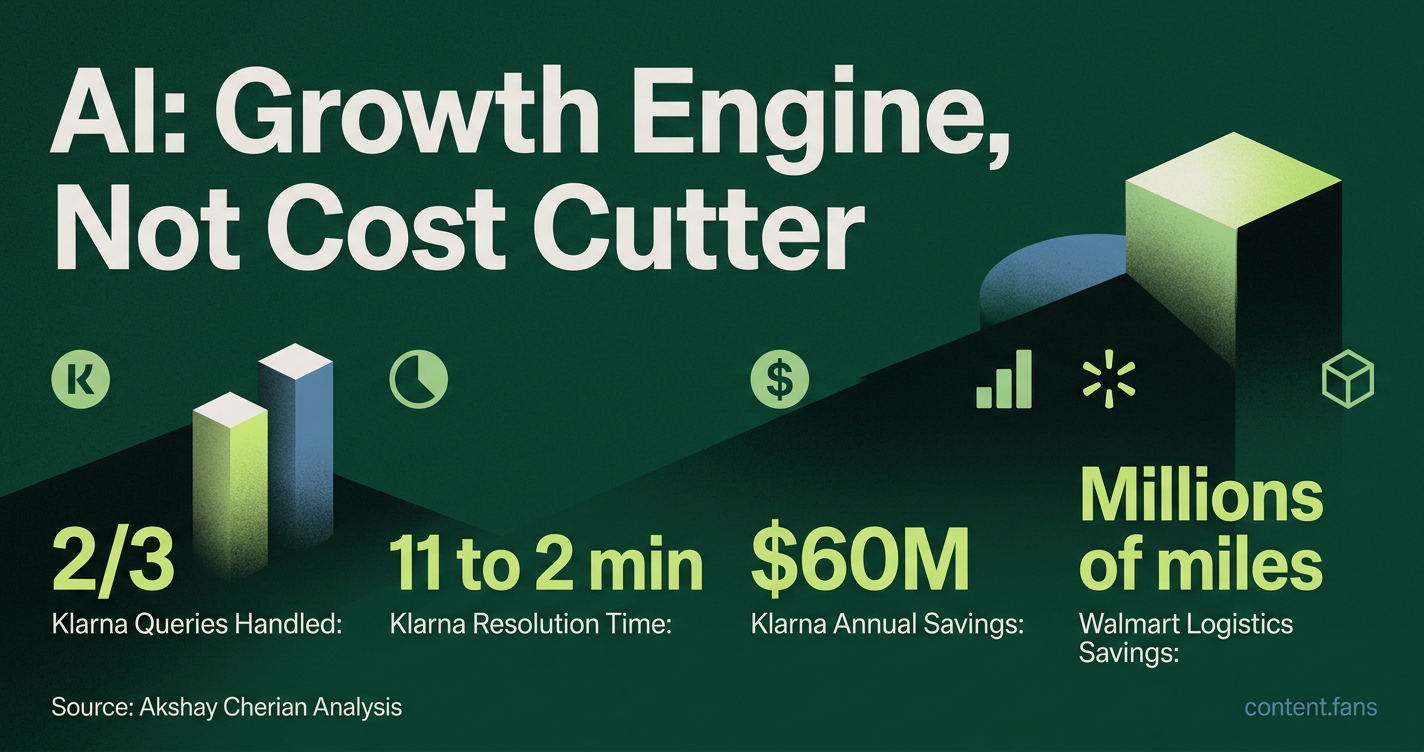
Business leaders should frame AI adoption as a tool for strategic growth and enhanced productivity. This involves focusing on scaling capacity to meet new demand, rather than simply reducing headcount. By prioritizing revenue generation and empowering employees, companies can foster a culture of innovation and achieve higher ROI.
Operationalizing an AI Growth Strategy
Cherian outlines three core habits for putting this high-ambition strategy into practice:
- Engage Champions: Identify and involve enthusiastic employees in the AI design process from the beginning.
- Set Clear Goals: Establish three to five measurable objectives for AI agents to achieve within a three-year timeframe.
- Empower Staff: Position AI as a tool to eliminate repetitive work, freeing employees to concentrate on high-value strategic tasks.
The success of this approach is evident in real-world results. Klarna's AI agent has handled approximately two-thirds of customer service queries, reducing resolution times from 11 to 2 minutes and yielding an estimated $60 million in annual savings according to the company's official announcements. Similarly, Walmart has reported significant supply-chain AI improvements, including millions of miles saved in logistics operations.
Measuring progress without over-promising
To track success effectively, Cherian advises using small, verifiable metrics over broad, sweeping declarations. For example, Bank of America's "Erica" agent successfully resolves a high percentage of routine customer queries quickly. This kind of incremental tracking highlights clear wins and helps identify bottlenecks early. A direct comparison reveals why the narrative framing is so critical:
| Narrative | Likely employee reaction | Documented outcome |
|---|---|---|
| Cut jobs | Fear, sabotage (significant resistance reported) | Fragmented pilots, slow ROI |
| Handle growth | Curiosity, advocacy from change champions | Faster adoption, improved ROI |
Avoid the trust spiral
Focusing on cost-cutting can create a "trust spiral." Cherian cites survey data warning that companies planning layoffs for AI non-adopters often suffer from a fractured workplace culture. Experts agree that poor change management, not technology failure, is the primary driver of AI project delays. Therefore, leaders must prioritize workforce integration with the same rigor as model selection. Cherian offers a simple test: "If your AI narrative does not excite your best salesperson, rewrite it." His data-backed counsel confirms that a strategy of ambition is a much safer bet than one of austerity.
What are the two biggest traps leaders fall into when adopting AI?
Ignoring AI entirely (or betting that human labor alone will remain competitive) and focusing only on cutting headcount with agents are the two failure modes Akshay highlights. Recent surveys show that a significant portion of enterprises are struggling despite heavy AI investment, and a key reason is that many companies are considering layoffs for employees who "can't or won't adopt AI." The result is a two-tier workplace and employee resistance that stalls real change.
How should leaders reframe the AI conversation with employees?
Stop saying "We're implementing AI to improve efficiency." Start saying "We're scaling the business without scaling headcount - AI lets two people do the work of five so we can handle the growth that's coming." When the narrative shifts from cost-cutting to growth, resistance drops and teams begin to see opportunity rather than threat.
Where is the real ROI coming from?
Recent surveys indicate that only a minority of organizations report significant ROI from generative AI and AI agents. However, companies like Klarna have reported substantial AI-driven efficiency gains in customer service, while Walmart has achieved significant supply chain improvements through AI optimization. Salesforce's Agentforce platform has shown strong growth by resolving a high percentage of cases autonomously. The pattern: revenue growth and productivity gains, not simple labor reduction.
What small, practical steps can leaders take right now?
- Identify change champions early - the people who help build the solution become the loudest advocates.
- Start with micro-experiments (one workflow, one team) and measure.
- Run 3 - 5 workshops and codify high-impact objectives that agents must fulfill over the next three to five years. Akshay's guidance is straightforward: "Small habits drive AI adoption in teams."
How can companies avoid the "AI elite vs. layoff" trap?
Most AI failures trace back to organizational readiness, not model performance. Enterprises succeed when they embed agents in redesigned workflows and give every employee a path to skill-up rather than move out. When leaders treat agents as growth enablers first, employee-buy-in, governance alignment, and measurable KPIs follow naturally.