
Late-Stage VC Firms Pour Billions Into Space, Infra Startups
Serge Bulaev
Late-stage venture capital appears to be rising sharply for space, observability, and infrastructure startups. Investors may be focusing on companies with hard-to-replicate capacity and long-term contracts, which could lower their risk. Big funding rounds, like those for Impulse Space and Supabase, seem to fit a wider trend of more money going into companies that control important infrastructure. Some risks remain, such as the chance for lower returns if growth slows or if the companies stay private longer. Analysts suggest that only the strongest companies in these sectors are likely to get more funding in the near future.

Late-stage VC firms are funneling billions into space, observability, and infrastructure startups, signaling a strategic shift towards capital-intensive sectors. Recent mega-rounds for companies like Impulse Space, Supabase, and Coralogix underscore this trend. This pattern aligns with market data showing significant growth in late-stage U.S. deal value and venture-growth investments. Industry analysts note investors are increasingly focused on valuing scarce resources like launch slots and compute power over simple software products. This highlights a renewed appetite for companies controlling key infrastructure bottlenecks.
Drivers Behind the Surge of Mega Late-Stage Rounds Across Space, Observability, and Infra
Investors are targeting companies with hard-to-replicate physical or digital infrastructure. They are paying a premium for scarce capacity, such as satellite launch access or high-performance compute, and are drawn to the revenue visibility offered by long-term enterprise contracts in these stable, capital-intensive sectors.
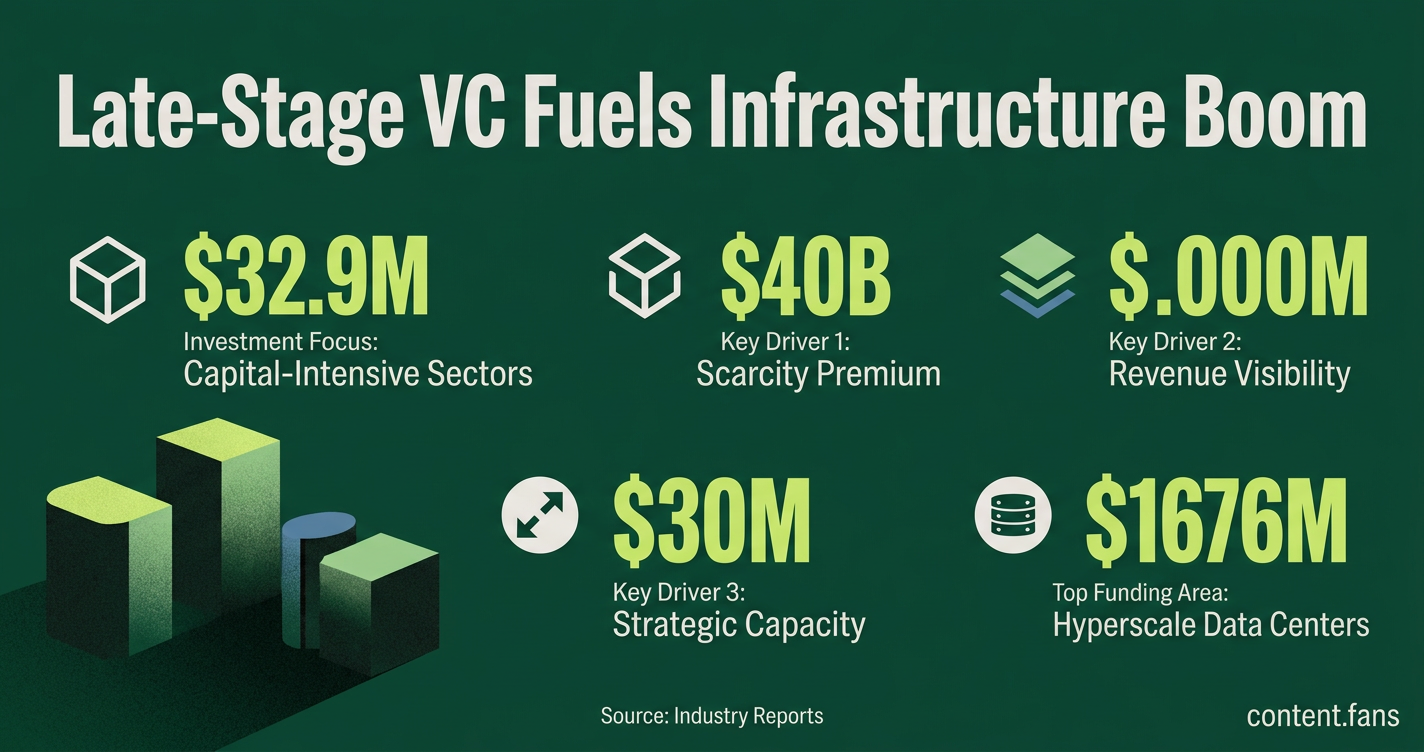
- Scarcity Premium: Sectors like space and high-performance data require large, fixed investments. Investors are willing to fund larger rounds for companies with hardware or compute capacity that is difficult for competitors to replicate.
- Revenue Visibility: The presence of multi-year enterprise contracts provides predictable revenue streams that reduce perceived investment risk.
- Strategic Capacity Engineering: Many recent funding rounds function as strategic moves to secure critical resources like raw materials, foundry capacity, or cloud GPUs in anticipation of future shortages.
Where the Money Is Flowing
Industry reports indicate significant funding activity across several key subsectors:
- Space launch and propulsion companies are securing substantial rounds to expand manufacturing and propulsion capabilities
- Serverless database providers are raising capital to build additional regional infrastructure and expand compliance offerings
- Observability platforms are attracting investment to extend AI-driven analytics and add compliance modules
- Cloud & data infrastructure companies are raising multi-billion rounds to finance hyperscale data centers and sovereign-cloud deployments
The trend extends to cloud infrastructure, where major funding rounds for hyperscale data centers reinforce a key theme: the largest checks are flowing to foundational layers that support and safeguard demanding AI workloads.
Talent and M&A Implications
This funding surge directly impacts M&A and talent acquisition. According to industry reports, acquirers are prioritizing teams and technical capabilities over pure revenue. With substantial funding, these late-stage startups can compete with big tech for top talent, potentially reducing near-term acquihires. However, analysts suggest that while the current AI capital expenditure wave may temporarily divert M&A funds, it could lead to more significant strategic acquisitions later as private market valuations stabilize.
Risk Lens for Investors
Despite the investor enthusiasm, these mega-rounds are not without significant risks. Industry analysis highlights that many deals include downside-protection terms that can heavily dilute common shareholders if growth projections are not met. Key risks for investors include:
- Down-Round Exposure: A slowdown in enterprise adoption could expose companies to future funding rounds at lower valuations.
- Compressed Exit Multiples: High entry valuations may lead to smaller relative returns upon exit.
- Delayed Liquidity: Large cash reserves allow companies to remain private longer, extending the timeline for investor returns.
- Capital-Stack Mismatch: Using venture capital to fund assets that are better suited for traditional project financing can create structural inefficiencies.
Outlook for Future Funding Conditions
The concentration of capital is becoming more pronounced. Industry data shows late-stage deals comprise a significant and growing portion of total venture capital, representing a substantial increase year-over-year. This trend has intensified recently, with billions invested across a small number of mega-rounds. Consequently, the funding bar is rising for startups not operating in the core space and infrastructure sectors. Going forward, analysts are monitoring two key indicators: the average length of enterprise contracts and lead times for critical resources. The trajectory of these metrics will determine if the mega-round trend can be sustained without creating a valuation bubble.
Why are late-stage investors throwing nine-figure checks at space and dev-infra startups?
Capital is chasing scarce "plumbing" instead of apps.
Recent data shows significant growth in U.S. late-stage and venture-growth deal value, but the number of deals has remained relatively flat, so money is pooling in a handful of hard-to-build layers: AI compute, cloud capacity, regulated rails and orbital logistics. Investors say openly they are pricing capacity, not code. When GPUs, clean-room fabs or launch manifests are the bottleneck, owning the bottleneck is more lucrative than owning the app that sits on top.
Does this mean M&A exits will speed up - or slow down?
Short-term freeze, medium-term feast.
Industry analysts note that the AI-infrastructure super-cycle can crowd out M&A budgets today, but strategics who skipped recent funding rounds will likely acquire winners in the coming years. Reports indicate that acquirers increasingly buy teams plus stacks, with some calling this trend "acqui-hire plus infrastructure financing". In space, industry observers see the same late-stage concentration potentially flipping venture-backed builders into strategic M&A targets once demonstration missions finish. Translation: a well-funded startup can stay private longer, but when it finally sells it may sell at a premium.
What happens if valuations outrun revenue?
Down-round risk is real and rising.
Industry reports suggest recent late-stage valuations remain below historical peaks outside the AI-adjacent cohort, so any round reaching substantial valuations represents faster growth than typical sector medians. Investment analysts warn that compressed return profiles mean investors need favorable exit windows to generate returns. Heavy preference stacks and ratchets common in space and infra deals can significantly impact founders and early employees if growth slips. In short, a high valuation can become a liability if the orbital lane, certification schedule or enterprise sales cycle slips by even a quarter.
How does this reshape hiring?
Specialist talent is the real acquisition currency.
Industry guides show acquirers explicitly shifting to "buy rather than build" for launch-ops, DevOps and chip-validation teams. Market observers expect frontier-sector acquirers to pay premiums for specialized engineers that late-stage rounds just spent significant capital to retain. If you're a propulsion-software lead or a CUDA-aware ML-ops engineer, your cap-table may be under pressure, but your career prospects remain strong.
Should early-stage founders cheer - or fear - the mega-round headlines?
Use the barbell, don't fight it.
Industry data shows late-stage capital accounting for a significant and growing portion of all venture dollars, while seed activity remains busy. That creates a barbell market: lots of seed formation plus a few giant growth rounds. If you build in orbit-adjacent hardware, dev-infra or regulated data stacks, consider partnering with established players for later-stage rounds, but maintain realistic early-stage valuations. The same scarcity that lifts companies to massive valuations can impact your funding trajectory if your long-term forecast can't bridge the gap between market hype and technical execution.