
Kilpatrick unveils AI's Anti-Gravity harness and persistent memory roadmap
Serge Bulaev
Logan Kilpatrick has shared a new plan for AI development that has three parts: persistent memory, an agent harness called Anti-Gravity, and a future where the model manages itself. He suggests teams should focus on setting up memory and context before choosing an AI model. Kilpatrick says the Anti-Gravity harness connects different tools and uses safety checks, while new memory systems may help agents remember important things and forget unneeded details. He predicts that in about a year, models may start to handle their own organization, and this could change what gives companies an edge in AI. This could change what gives companies an edge in AI.

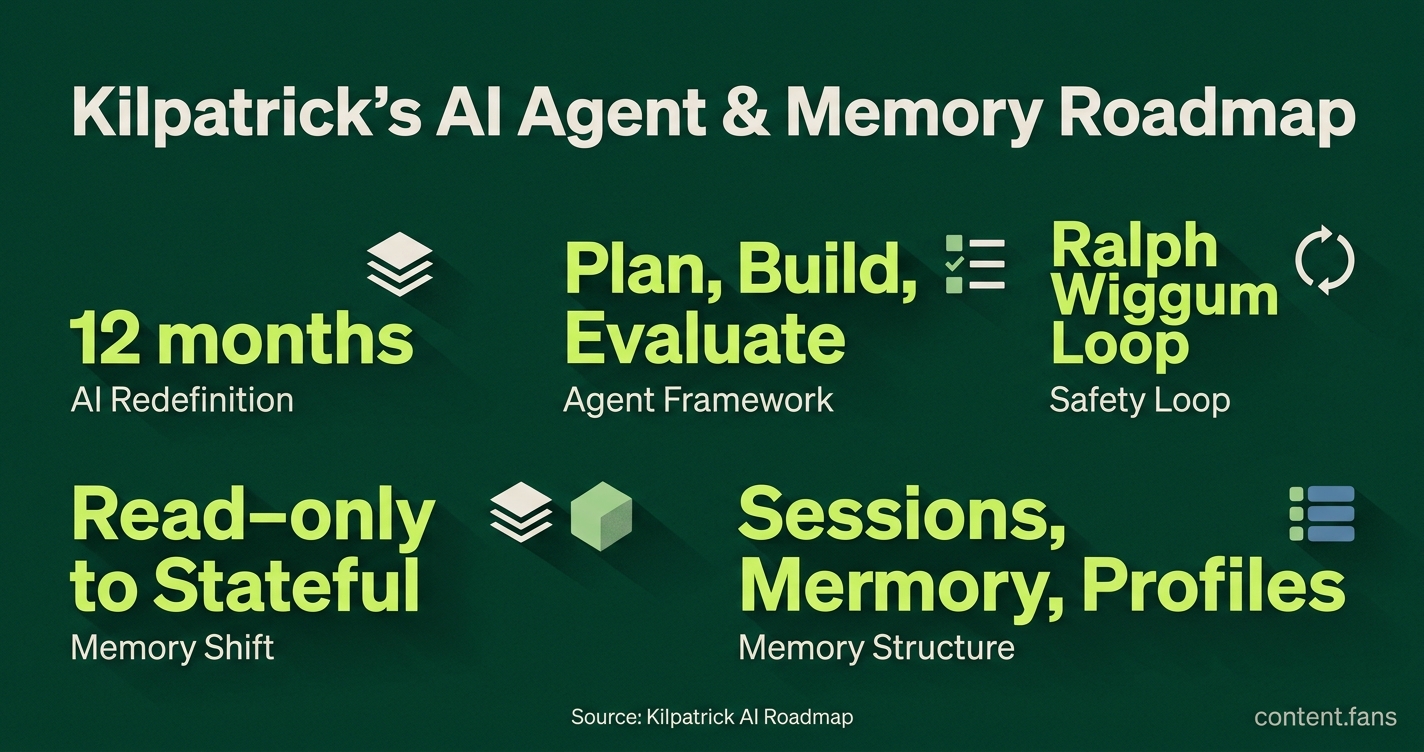
Logan Kilpatrick has unveiled a pivotal roadmap for the next phase of AI, centered on an agent framework and a strategy for persistent memory. This three-part plan charts a course toward an end-to-end future where AI models absorb their own orchestration scaffolding, a shift he predicts will redefine competitive advantage within approximately 12 months.
A core tenet of this strategy is prioritizing infrastructure over model selection, advising teams to establish context and memory layers first. The agent framework acts as the connective tissue for services like Search, Gemini, and Cloud, using three specialized agents (Plan, Build, Evaluate) to manage tasks. It includes a critical safety loop using the Ralph Wiggum Loop, an iterative AI development methodology for prompt repetition, to ensure tasks are fully verified before completion Sequoia Capital podcast. This framework is supported by systems for long-term data storage and dynamic, stateful updates.
From Retrieval to Persistent Memory
Persistent memory represents a shift from read-only data retrieval to stateful systems that learn and evolve. Unlike standard retrieval, this architecture allows AI agents to build a durable understanding of interactions over time, selectively remembering key information and forgetting irrelevant details to improve long-term performance.
Kilpatrick frames this evolution as a move beyond read-only retrieval to stateful storage that adapts over time. The memory architecture employs temporal chaining to link events and hierarchical consolidation to prune outdated facts. Production agents using these approaches have shown significant improvements in operational efficiency according to industry reports.
A practical split emerges inside agent development frameworks:
- Sessions for short-term state
- Memory systems for durable knowledge
- Profiles that gate what gets remembered and when it is forgotten
This structure mirrors the three-tier taxonomy (episodic, semantic, procedural) noted in independent research on agent memory.
AI Agent Frameworks and Long-Running Agents
Modern AI agent frameworks are designed to coordinate tool calls, code execution, and verification across diverse runtimes. This infrastructure enables agents to operate for extended periods, shifting the focus from a model's raw capability to the "builder's ambition." The framework manages checkpoints, code commits, and task retries until verification loops grant approval. As Kilpatrick notes in his Stork.ai interview, mandatory security primitives like fine-grained permissions and verifiable logs are essential before these agents can access production data.
Teams experimenting with long-running agents often start with a limited action set - calendar edits, document drafts, and simple code fixes - then widen the scope as memory accuracy improves. Early adopters report that selective retention prevents memory bloat; the agent ignores transient chat jokes while persisting confirmed travel bookings.
When the Model Eats the Harness
Industry experts outline a three-phase evolution in AI architecture: the current state with separate models and orchestration frameworks, a "native digestion" phase where models begin to internalize coordination capabilities, and a final stage where orchestration is fully integrated into the model itself. This projected timeline directly influences technology purchasing decisions. Once orchestration becomes a native function, competitive advantage will likely shift from raw model size to the quality of proprietary context graphs and sophisticated memory strategies.
Developers planning for that shift keep attention on:
• Context ingestion pipelines that expose structured slices of user data.
• Memory validation suites that measure staleness, privacy compliance, and causal retrieval accuracy.
• Sandboxed execution layers that limit an agent's blast radius during self-directed tasks.
This roadmap positions these investments as insurance against a fast-moving model landscape. The emphasis on framework design today prepares codebases for a near future where orchestration could live inside the model itself.
Kilpatrick's roadmap offers product and engineering teams a practical framework for navigating AI's next phase - one defined by persistent memory, autonomous agents, and systems that operate end-to-end across workflows. His guidance pairs naturally with emerging perspectives on self-improving models, helping teams anticipate architectural priorities rather than simply reacting to model releases.
What are AI agent frameworks and why do they matter for AI agents?
Modern AI agent frameworks represent the vision for connective infrastructure that binds AI capabilities across products. Rather than treating each interface - Search, Gemini, Cloud, AI Studio - as separate, this unified infrastructure enables them to function as coordinated agents rather than isolated tools. The framework orchestrates actions through CLIs, SDKs, web interfaces, and IDEs using three specialized agents (Plan, Build, Evaluate) rather than one monolithic system. Critical safeguards like the Ralph Wiggum Loop provide iterative verification layers that prevent premature task completion. This matters because it shifts the burden of capability from raw model intelligence to builder ambition - the framework provides endurance while the model provides reasoning.
How do advanced memory systems differ from standard retrieval systems?
Advanced memory architectures mark a decisive break from simple RAG approaches. Where traditional systems retrieve static information, these systems implement stateful, evolving memory that actively updates based on new experiences. Key innovations include selective retention (determining what deserves long-term storage versus what should fade), associative routing (automatically connecting related concepts), temporal chaining (linking events across time to understand causation), and hierarchical consolidation (abstracting specific experiences into general principles). For implementation, developers can use structured storage for user preferences alongside unstructured memory systems for distilled conversation facts - giving developers granular controls through memory profiles that determine what gets remembered and what is ignored.
What does "the model eats the harness" mean for future AI architecture?
This phrase captures the predicted three-phase evolution for how foundational models will absorb external scaffolding. Phase 1 (current) keeps model and orchestration separate, with frameworks coordinating tool calls. Phase 2 brings "native digestion" where general models adapt to work natively with any environment. Phase 3 sees tool calling, code execution, and environment interaction become native model capabilities rather than external plugins. The implication is significant: the "scramble for the best model" may have a limited shelf life. Once models absorb this scaffolding, competitive advantage migrates to context quality, memory strategy, and builder ambition rather than model scale alone.
Why does Kilpatrick advise against picking the model first?
For teams building end-to-end systems, Kilpatrick recommends prioritizing infrastructure before model selection. The context layer must expose structured slices of the personal graph, and the memory strategy must implement advanced memory patterns. Only after these foundations are solid should teams evaluate which model best serves their specific workflow. This reflects a broader industry reality: persistent memory systems are experiencing significant growth, yet current systems still face challenges with accuracy on long-term memory tasks in complex scenarios. Teams that establish strong memory architecture will outcompete those chasing marginal model improvements.
How do long-running autonomous agents change product development timelines?
The roadmap anticipates agents shifting from hours to weeks of autonomous operation - the move to "long-running agents." This transforms product development from discrete interactions to continuous presence, with agents sitting across Gmail, Calendar, Drive, Docs, and Chrome to anticipate needs before explicit requests. The engineering implication is significant: rather than optimizing for single-turn quality, teams must design for state persistence, failure recovery, and graceful degradation over extended horizons. While LangGraph and AutoGen offer significant productivity gains through better orchestration, state management, and reduced development time, reported benefits vary by use case and include faster prototyping and efficient production scaling, suggesting substantial advantages for teams that master this architecture.