
OpenAI pivots to "personal AGI" superapp, pauses video model
Serge Bulaev
OpenAI appears to be shifting its main focus to building a single "personal AGI" superapp that combines tools like ChatGPT, Codex, and Atlas. The company may pause its work on video models like Sora to concentrate on creating an agent that knows users, remembers their preferences, and can act on their behalf. Research suggests this unified agent could make digital tasks much faster and easier by remembering context and handling actions across email, code, and browsing. OpenAI's new approach may bring changes to how people use technology, with more focus on outcome and less on learning software. Some estimates suggest these unified agents might help companies improve customer satisfaction and increase revenue, but these benefits are still uncertain.

OpenAI is strategically pivoting toward a "personal AGI" superapp, a move that signals a major shift in its product direction. This new focus on a unified agent that combines tools like ChatGT and Codex involves pausing development on its Sora video model to concentrate on creating a persistent, context-aware assistant that acts on a user's behalf.
What is OpenAI's "Personal AGI" Vision?
OpenAI's new direction centers on creating a 'personal AGI' superapp that serves as an 'endpoint application' for experiencing AGI, integrating coding, browsing, and ChatGPT into a single interface. Instead of users learning to navigate complex software, a persistent AI agent will work in the background to understand context and execute tasks across email, code, and web browsing. The goal is to unify discrete tools like ChatGPT, Codex, and Atlas into a single desktop "superapp" that functions as a general operating layer, as detailed in a note.com transcript.
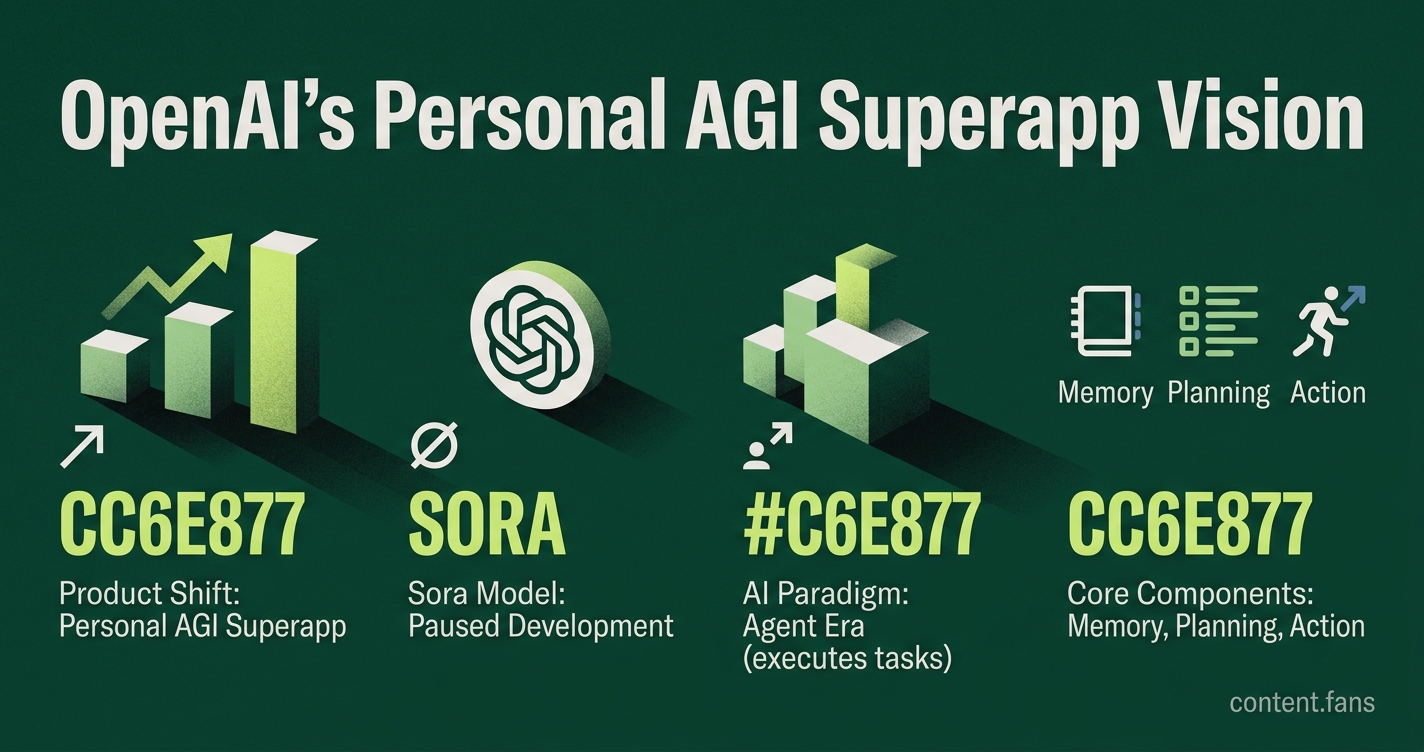
OpenAI's strategy involves consolidating tools like ChatGPT into a single superapp. This prioritizes creating a personal AI agent that autonomously performs tasks for the user, representing a strategic shift away from developing separate applications like the Sora video model.
This marks a transition from the chatbot paradigm of answering questions to an "agent era" where AI executes tasks. This vision of an AI that can truly do things for you is what industry leaders describe as a "personal AGI" - an agent that knows the user, remembers preferences, and acts autonomously.
Why Was the Sora Video Model Paused?
OpenAI is reallocating resources to build this unified agent layer. OpenAI paused Sora video generation temporarily due to overwhelming user traffic, server capacity issues, or coordinated leaks by artists protesting compensation, not because of technology branch incompatibility. This strategic bet suggests OpenAI believes that controlling the reasoning layer will yield stronger long-term network effects than adding new media generation capabilities. While AI leaders discuss the value of inference, no public record confirms specific statements about inference being "the most valuable software category."
Key Technical Pillars for Unified Agents
According to industry research, agent design typically involves memory, planning, action, and safety, though these are not necessarily the exclusive requirements for merging chat and agent systems:
- Memory: Maintaining persistent context across sessions and tools while protecting user privacy.
- Planning: Using reasoning loops to break down high-level goals into autonomous, executable workflows.
- Action: Gaining the ability to control digital tools and, eventually, physical devices.
- Safety: Implementing protocols, such as an Objective-Validation Protocol, to route high-risk actions for human oversight.
While the potential is significant, current primary barriers to AI adoption include lack of skilled professionals, lack of vision among leaders, high costs, and issues with explainability, trust, and data governance.
Impact on User Experience and Product Design
The concept of 'intention design' exists in AI discourse, where users state their desired outcomes and the agent determines the necessary steps. This change has significant implications for product development:
- Outcome-Oriented Design: Product teams are embedding AI as core infrastructure rather than as an add-on feature.
- Anticipatory Assistance: Unified systems can interpret signals to act proactively without explicit user commands.
While unified agents may improve performance, specific performance metrics vary widely across implementations and use cases. This shift aligns with broader industry moves toward autonomous and predictive customer experiences.
Market-Wide Ripple Effects
This strategic pivot by a major player like OpenAI reflects a wider market trend. Research from firms like Salesforce suggests that product teams across industries are now designing for outcomes rather than features. As AI becomes more integrated into workflows, some analysts believe brands are increasingly defined by their AI rather than traditional identity elements. The quote 'I want no product, I want the result' is widely attributed to user sentiment in the tech industry, reflecting the desire for results-focused AI assistance rather than traditional software interfaces.