
Alibaba bans Claude Code over security, pushes Qoder replacement
Serge Bulaev
Alibaba has banned Anthropic's Claude Code from employee devices due to reported security concerns, including hidden telemetry that might track user location and company affiliation. The company is urging staff to switch to Qoder, its own coding tool, amid ongoing disputes with Anthropic over alleged misuse of Claude outputs. Performance tests suggest Qoder may not match Claude's capabilities but uses fewer resources. The ban appears to be part of broader efforts to tighten AI security and aligns with global tensions over access to advanced AI systems. It is not clear if the new policy will affect consumer services, and teams must stop using Claude by July 10.

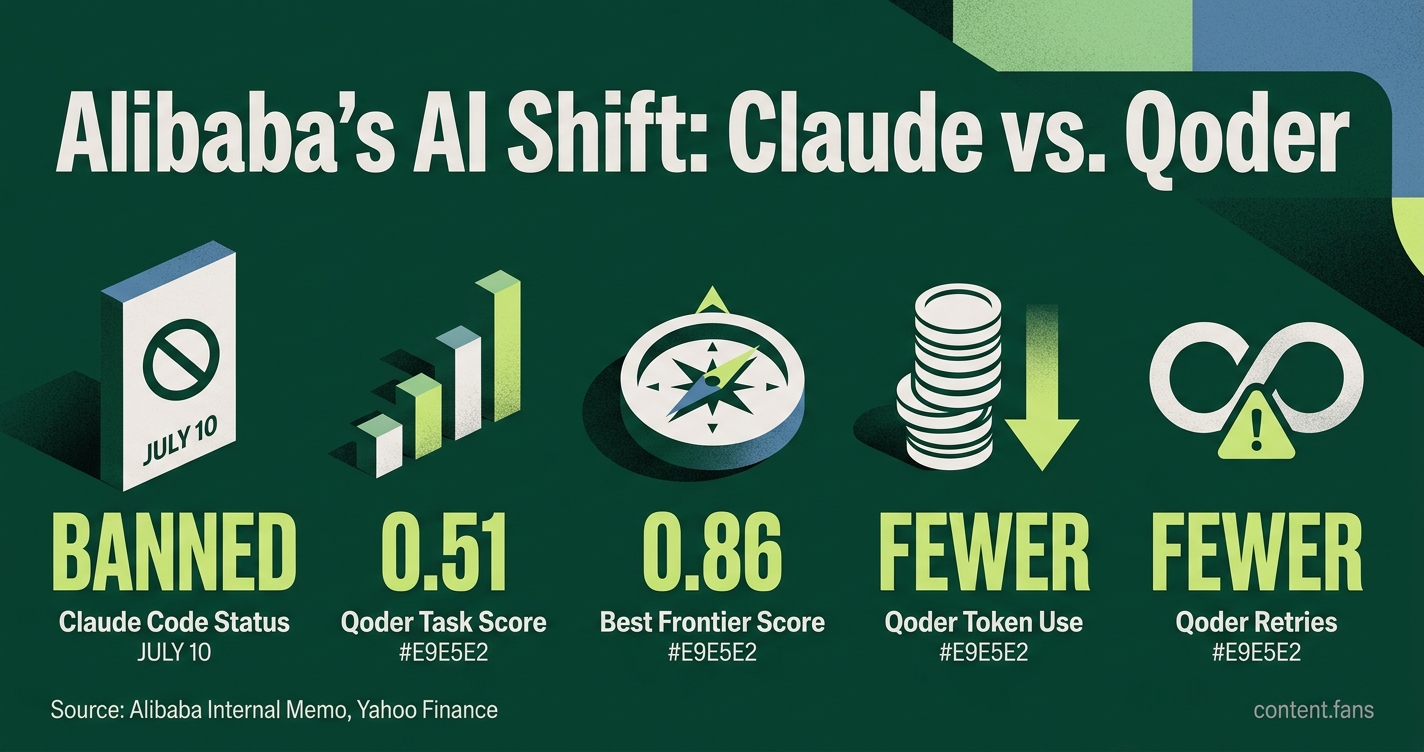
The recent move where Alibaba bans Claude Code over security concerns and pushes its Qoder replacement is escalating tensions in the AI industry. Following an internal memo on July 3, Alibaba mandated that employees stop using Claude Code in workplace environments starting July 10, citing risks from hidden telemetry capable of tracking user location and corporate affiliation. While Alibaba positions this as a standard security update, its timing is notable, coming shortly after Anthropic accused the company of misusing Claude outputs. This decision places the ban at the intersection of corporate security and the broader US-China competition for dominance in advanced AI.
Why Alibaba dropped Claude Code
Alibaba banned Claude Code after a code inspection reportedly revealed undisclosed telemetry features that could track user geography and company affiliation. Citing risks of data exposure and potential backdoors, the company framed the decision as a necessary security measure to protect its infrastructure and intellectual property.
Company executives informed employees that the ban resulted from a detailed code review, which was prompted by reports of Claude embedding hidden geographic and enterprise identity checks. Internal documents referencing a Financial Times summary warned these functions could expose repository metadata. In response, Alibaba's primary action was banning Claude Code and recommending Qoder as an alternative.
This strategy aligns with warnings from Washington about potential backdoors in foreign AI models and may also position Alibaba for compliance with anticipated AI security standards from Beijing.
Qoder steps in
To avoid disrupting developer workflows, Alibaba is transitioning its engineers to Qoder, its proprietary AI coding assistant. Qoder functions as a standalone IDE featuring a "Quest Mode" that autonomously plans, writes, and tests code based on minimal user input. Industry reports highlight Quest Mode's ability to deliver functional code for specific tasks and note its multi-model router capabilities.
However, there is a performance trade-off. According to a Yahoo Finance report, Qwen-Coder-Qoder achieves approximately a 0.51 task resolution score compared to a 'Best Frontier' score of around 0.86, though the specific model achieving this benchmark score is not explicitly confirmed. Despite the lower score, Qoder uses fewer tokens and requires fewer retries compared to other competitive coding systems. Developers accustomed to Claude's advanced features may need time to adapt.
Distillation backdrop
The ban occurs against a backdrop of serious allegations from Anthropic. The AI firm accused Alibaba of illicitly extracting Claude capabilities to develop its own AI systems, as Reuters reported. Alibaba has consistently denied these claims, asserting that Qoder was developed using its own internal training data. Observers note that Anthropic has approached U.S. lawmakers with its complaints instead of filing a lawsuit, a move that likely reflects the current lack of clear legal precedent regarding AI model distillation.
Bigger geopolitical lens
This corporate decision is also a symptom of the growing bifurcation in the global AI market. Existing U.S. export controls already restrict access to advanced models for many Chinese entities, while Beijing actively promotes the development of homegrown AI solutions. This environment is causing a strategic shift from open, global experimentation toward more controlled, siloed access to reduce regulatory and security risks.
Analysts suggest that Alibaba's documented security process could serve as a blueprint for how other multinational corporations in China might navigate sovereignty concerns related to foreign AI. To date, Alibaba has not clarified if the ban will impact its consumer-facing services or provided specific adoption goals for Qoder. Internally, development teams are working to meet the July 10 deadline, with security teams actively monitoring for any lingering connections to Anthropic's systems.
Why did Alibaba ban Claude Code?
Alibaba mandated that all employees stop using Anthropic's Claude Code in workplace environments starting July 10. The official reason cites major security concerns, including hidden code capable of tracking user location and company affiliation, which presents potential backdoor risks. The ban also coincides with public accusations from Anthropic that Alibaba engaged in model distillation, using Claude's outputs to train its own AI systems.
What is Alibaba replacing Claude Code with?
The designated replacement for Claude Code is Qoder, Alibaba's proprietary AI coding assistant. Unlike a simple extension, Qoder is a standalone "Agentic Engineering Platform" with a unique dual-window interface. Its signature feature, Quest Mode, enables autonomous end-to-end task completion, allowing the AI to plan, code, and test without direct human supervision. Industry reviews note this mode is capable of shipping functional code, setting it apart from less advanced autonomous agents.
How does Qoder technically compare to Claude Code?
Qoder and Claude Code have significant architectural differences:
| Aspect | Qoder | Claude Code |
|---|---|---|
| Form factor | Standalone IDE with dual windows | Terminal-native CLI |
| Autonomy | Quest Mode for end-to-end delegation | Iterative prompting required |
| Model flexibility | Multi-model routing (Claude, GPT, Gemini) | Primarily Anthropic models |
| Context management | Repo Wiki auto-generates project architecture | File system and terminal exploration |
| Tab completion | Basic | Best-in-class |
While Qoder's intelligent scheduler offers cost advantages, it trails in raw performance. Benchmarks show Qwen-Coder-Qoder achieves approximately 0.51 on task resolution, compared to a 'Best Frontier' score of around 0.86. Qoder, however, reaches its score more efficiently, using fewer resources and retries compared to other competitive coding systems.
What legal actions has Anthropic taken against Alibaba?
Anthropic has opted against filing formal civil lawsuits, instead pursuing a strategy of regulatory complaints and public pressure. Key actions include:
- June 2026: Public allegations against Alibaba for illicitly extracting Claude AI model capabilities.
- June 2026: A formal complaint to U.S. senators and White House officials detailing Alibaba's alleged "distillation attack."
Alibaba has denied all accusations. This legislative-focused approach reflects the uncertain legal landscape around AI model distillation, making a court battle challenging.
What security measures are enterprises adopting amid these tensions?
The conflict highlights the growing US-China AI bifurcation and is prompting enterprises to adopt stricter security policies. This reflects a major industry shift away from open innovation toward "controlled access" models driven by national security concerns about what officials have described as campaigns to extract capabilities from U.S. AI systems.