
Meta's AI Agent Rollout Faces Delays, Costs Billions
Serge Bulaev
Meta's rollout of AI agents is facing delays and very high costs, with spending projected between $115 and $135 billion in 2026. Research suggests that fewer than 25 percent of companies testing AI agents have managed to put them into regular use, mainly due to problems with old systems and integration challenges. It appears that doing well on AI benchmarks does not always mean the agents will work well in real business situations. CEO Mark Zuckerberg said progress is happening "slower than expected," which may be because of the time needed for better integration, safety, and management tools. The report suggests that teams focusing on detailed checks, such as tracking task completion and errors, may keep their AI agents running longer.

The challenges facing Meta's AI agent development, marked by complexity and substantial investment, are a stark reminder that the race for production readiness is far different from the race for benchmark supremacy. Enterprises are discovering that high model scores say little about whether an AI agent can survive real-world traffic or secure budget approval.
Early research reveals that a significant portion of organizations experimenting with agents struggle to scale them to production, despite public model scores trending upward. The primary obstacle is system integration, with many enterprise teams citing friction with legacy APIs as a main blocker.
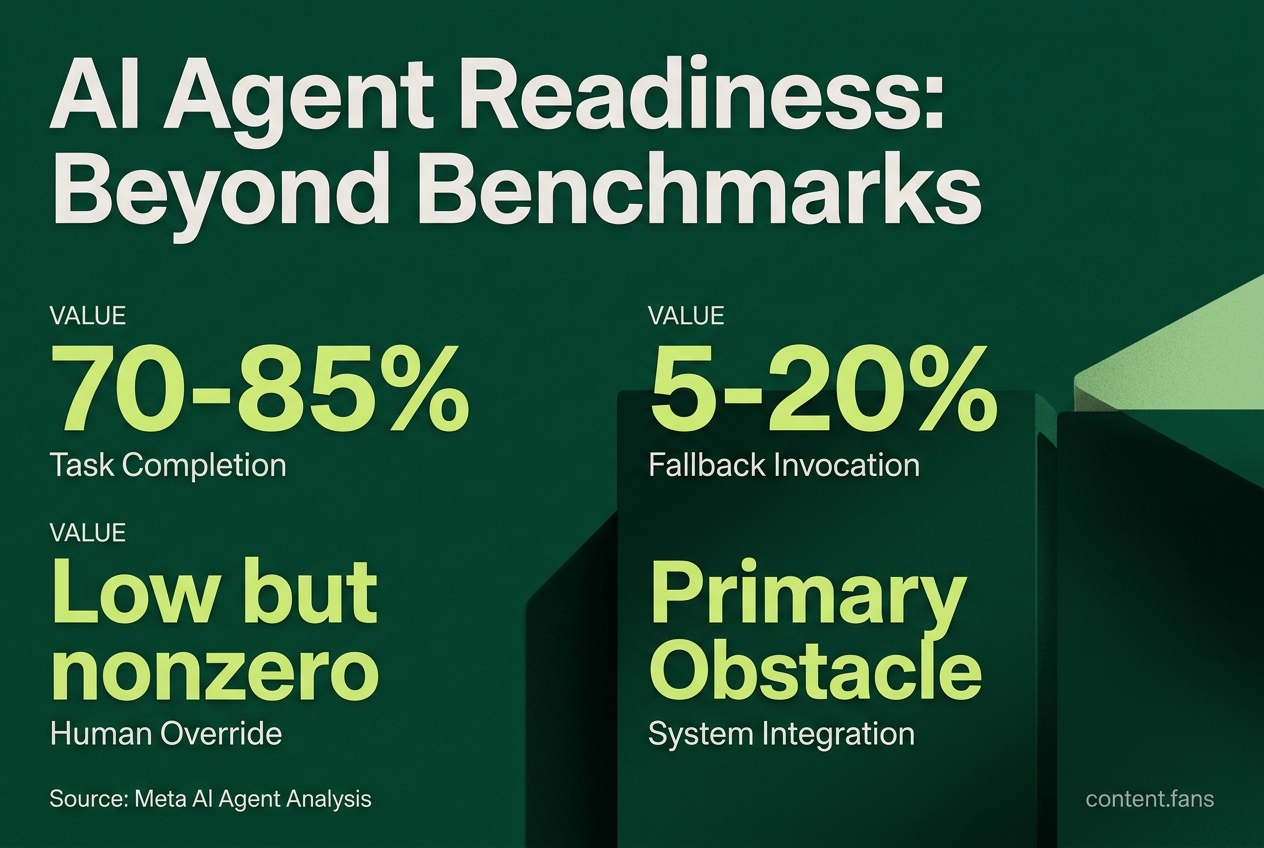
The core issue is this: Benchmarks validate a model's potential, but true product readiness depends on robust infrastructure, comprehensive safety tooling, and clear organizational alignment. The following sections explore this critical gap between demo and deployment.
From Sandbox to Reality: Why Demos Mislead
AI agents often fail in production because demo environments don't replicate real-world complexities like API rate limits, system timeouts, and inconsistent data formats. An agent's success on clean benchmarks offers no guarantee it can handle the messy, unpredictable nature of live enterprise systems and user traffic.
- Idealized Environments: Demos typically omit rate limits, internal validation protocols, and session timeouts. Agents that excel in these sandboxes often fail when faced with real-world constraints, like a CRM rejecting a malformed ID.
- The High Cost of Hallucination: A "confident hallucination" is more damaging than a simple error. Industry analysts report that agents fabricating database queries can trigger cascading data issues, frequently requiring human intervention after autonomous operations.
- Compounding Errors: A minor inference error at the beginning of a process can propagate and magnify through a tool chain, a pattern that reportedly affects many agent projects after their initial showcase.
Product Readiness Metrics Beyond Leaderboard Scores
| Metric | Healthy band | Signal |
|---|---|---|
| Task Completion Rate | 70-85 percent | End-to-end value without intervention |
| Human Override Rate | Low but nonzero | Early warning of quality decay |
| Fallback Invocation | 5-20 percent | Balance between caution and overconfidence |
| Automation Rate | Rising with steady quality | Budget justification for operations |
Expert analysis warns that a fallback rate below five percent may indicate silent hallucinations rather than genuine excellence. Furthermore, teams implementing automated evaluations on every prompt change show higher success rates in maintaining live agents over extended periods.
Meta's Investment Illustrates the Immense Resource Requirements
Meta's financial filings reveal the scale of the challenge. The company has made substantial investments in AI infrastructure and development. This surge is linked to the development of agentic commerce tools and advanced AI capabilities. To support these initiatives, Meta has restructured its workforce, reducing roles in some areas while significantly expanding its AI engineering teams.
While Meta aims to deploy advanced AI agents for commerce applications, CEO Mark Zuckerberg has acknowledged that development timelines face challenges. This highlights how complex integration, governance, and observability requirements can affect project schedules, even for a tech company with advanced models and custom hardware.
Practical Checkpoints for Buyers and Builders
- Verify with Live Data: Test an agent's Task Completion Rate against live, real-world data, not sanitized test suites.
- Inspect Boundary Architecture: Ensure every write, send, or API call is validated against explicit policy controls to prevent unintended actions.
- Demand Auditability: Require detailed logs that explain any divergence between an agent's planned actions and its actual execution for effective incident review.
- Track Override Rates: Monitor the human override rate regularly. A sudden spike is a leading indicator of systemic issues.
Adhering to these checkpoints aligns with the best practices of teams that successfully maintain agents in production over extended periods. It confirms that the true product race is won through disciplined engineering, robust metrics, and cross-functional governance - not just the latest benchmark headline.