
Kearney Study: 38% of CEOs See AI Hype, Prioritize Data Readiness
Serge Bulaev
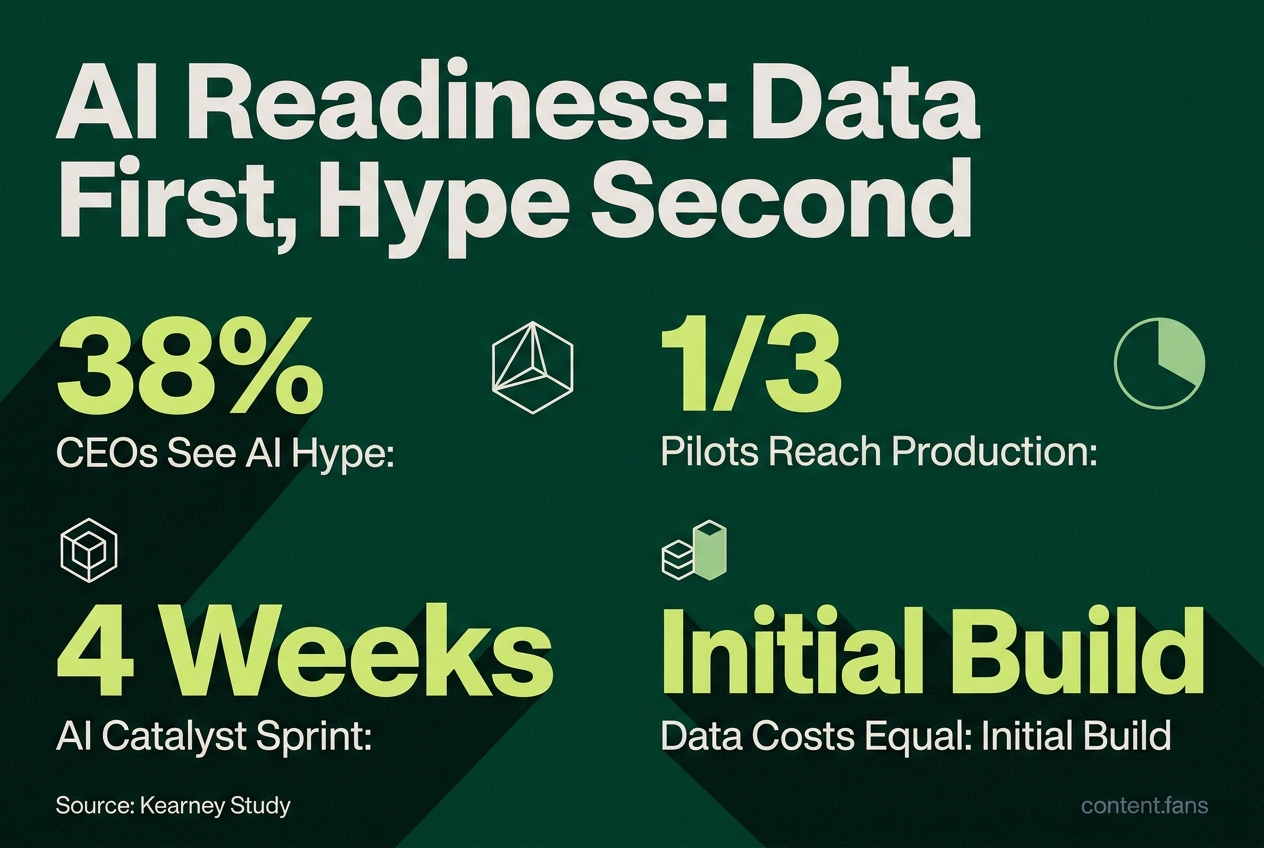
Kearney's study finds that 38% of CEOs believe there is still hype around AI and are focusing their budgets on careful rollouts instead of spending freely. The research suggests that companies get better results when they adopt AI in small, measured steps and make sure their data is clean and organized first. It appears that ongoing costs for data and maintenance can be as high as the initial setup. The study also recommends testing AI projects with clear goals before investing more money. While 62% of CEOs see AI as transformative, most think that real value only comes when data is reliable and workflows are improved.

While many executives are racing to scale artificial intelligence, a new Kearney study reveals 38% of CEOs view AI as still holding some degree of hype. Kearney's materials emphasize data readiness as a key pillar for AI success, with leaders finding the greatest threat isn't lagging behind, but over-investing in dazzling technology while core data pipelines and workflows remain unprepared. This data-first approach helps leaders translate caution into smarter funding decisions.
Adopt a Fast-Follower Mindset to Calibrate Velocity
CEOs are tempering their AI enthusiasm due to the high risk of over-investing in technology before data and workflows are solid. Kearney's research indicates that prioritizing data readiness and adopting a phased, 'fast-follower' approach leads to more consistent and cost-effective outcomes than immediate, large-scale deployments.
Kearney urges firms to replace an "all or nothing" leap with a fast-follower approach. Industry reports suggest that organizations using phased adoption achieve more consistent results than those launching enterprise-wide deployments. Pacing investments through smaller, validated steps reduces sunk-cost risk while maintaining a competitive pace.
Secure Foundations: Prioritize Data First, Tools Second
The consultancy's Are you AI ready? framework emphasizes a Total Cost of Ownership perspective, covering data preparation, model maintenance, and talent. The report notes that ongoing data curation and upkeep costs often equal or exceed initial build fees, making TCO analysis critical for determining if an initiative can achieve payback. Industry leaders like Ataccama and Accenture echo this, outlining non-negotiables like data catalogs, column-level lineage, and a shared business glossary as essential foundations.
Validate Value with Hypothesis-Driven Pilots
To prove value before committing significant capital, Kearney uses a four-week "AI Catalyst" sprint. This method tests a use case cheaply by defining a time-boxed pilot with a clear audience and business metric. According to Astrafy, with only a third of pilots reaching production, these clear decision gates are essential. An initiative only scales if its primary metric improves by a target percentage while all guardrails remain intact.
Use Stage-Gate Financing to Move from Pilot to Scale
A stage-gate review asks three critical questions: Did the pilot hit its target metric? Can leadership fund the full TCO for scaling? Is the integration plan fully defined? If the answer to any question is no, the investment is paused or pivoted. Linking funding to these gates ensures capital flows to proven, high-impact initiatives rather than fashionable tech demos.
Why CEOs Are Tempering AI Enthusiasm with Data Readiness
While 62% of CEOs in Kearney's study see AI as transformative, they recognize its value is only unlocked by trustworthy data and re-engineered workflows. This pragmatic view champions disciplined pacing, rigorous data quality standards, and measurable pilots, ensuring that AI budgets expand in lockstep with demonstrated returns.
What is the "AI hype" CEOs are worried about, and why does Kearney single out over-investment as the biggest threat?
38 % of CEOs now admit that AI carries "some degree of hype", according to Kearney's 2025 CEO study. The fear is not about the technology failing, but about sinking capital into large-scale builds before use-cases have been proven. Kearney's research shows that organisations taking a "fast-follower" approach avoid significantly higher sunk-cost exposure than those rushing into enterprise-wide roll-outs. The consultancy therefore recommends treating every major purchase decision as a Total Cost of Ownership (TCO) exercise that includes training, monitoring and eventual re-tooling costs.
How does Kearney propose executives validate AI value before scaling?
Kearney prescribes a four-week "AI Catalyst" sprint that tests a single, measurable hypothesis such as: "If we apply generative search to Tier-1 support tickets, first-response time will drop 20 % within 30 days without increasing escalation rates." Only when the pilot demonstrates both operational improvement (≥ target %) AND guardrails remain intact does the initiative pass to the next stage-gate. Think of it as Plan-Do-Check-Act in miniature: each gate either releases more budget or kills the project before sunk costs accumulate.
What does "data readiness" actually look like according to industry best practices?
According to industry reports, the bar for data readiness is versioned, product-grade data rather than raw dumps. Leading enterprises now:
- Catalog every table and column with ownership assigned to a named Data Product Owner
- Run column-level lineage and freshness SLA checks on every CI/CD build
- Maintain a semantic glossary so that AI models and humans reason with the same business terms
Industry benchmarks suggest that companies treating datasets as versioned products significantly reduce rework for AI features within months of implementation.
Which metrics matter inside a hypothesis-driven pilot, and which belong to scale decisions?
Kearney insists on two tiers of metrics:
| Pilot Metrics (4 - 8 weeks) | Scale Metrics (post-gate) |
|---|---|
| Leading indicator: 30 % lift in post-sale email engagement | Lagging KPI: 2 % churn reduction worth $800 k ARR |
| Guardrails: support ticket volume and error rates | Integration readiness: TCO including maintenance and model drift monitoring |
By separating what must be proven immediately from the eventual business case, executives avoid the "success theatre" that plagues a significant portion of pilots that never reach production.
How should organisations decide when to stop, iterate, or fully fund an AI initiative?
Each pilot ends with a decision gate based on pre-approved thresholds:
- Stop: primary metric misses target OR any guardrail breaches its limit
- Iterate: metric shows partial gain but risk profile is acceptable
- Scale: metric exceeds target AND leadership has pre-committed budget for TCO
Kearney's clients that codify this rule increase the share of pilots reaching production substantially while simultaneously cutting aggregate AI spend, because weak ideas are retired early instead of limping through endless refinement cycles.