
JPMorgan Chase, PwC Adopt AI to Cut Hours, Boost Productivity
Serge Bulaev
Many big companies like JPMorgan Chase and PwC are using AI to try and save time and help workers be more productive. They are following a plan with three phases: starting with leaders using AI first, then changing how work is done, and finally, making bigger changes to company structure. Some reports suggest AI tools may save employees several hours a week and improve how fast work gets done. There still appears to be worry about safety and fear of failure, but firms with open communication and testing may have better results. The changes might also lead to fewer managers and new ways of rewarding employees.

Global firms like JPMorgan Chase and PwC adopt AI using a clear, three-phase playbook: Foundation, Systematic Redesign, and Structural Evolution. This strategic framework helps leaders implement AI through measurable actions that build credibility, reshape workflows, and ultimately, rethink the entire organizational structure while managing risk.
Phase 1 - Foundation: Leaders Model Usage and Pick Credible Pilots
Successful AI adoption begins with leadership modeling its use and launching credible pilot programs. This foundational phase focuses on strategic integration over tactical additions, with executives committing to daily AI use and appointing 'Agent Champions' to lead small, focused test projects that demonstrate clear business value.
According to industry reports, technology executives are ensuring AI pilots align with broader business strategy, emphasizing "strategic integration over tactical addition." To build credibility, senior leaders model daily AI use and empower domain "Agent Champions" to lead targeted pilot programs.
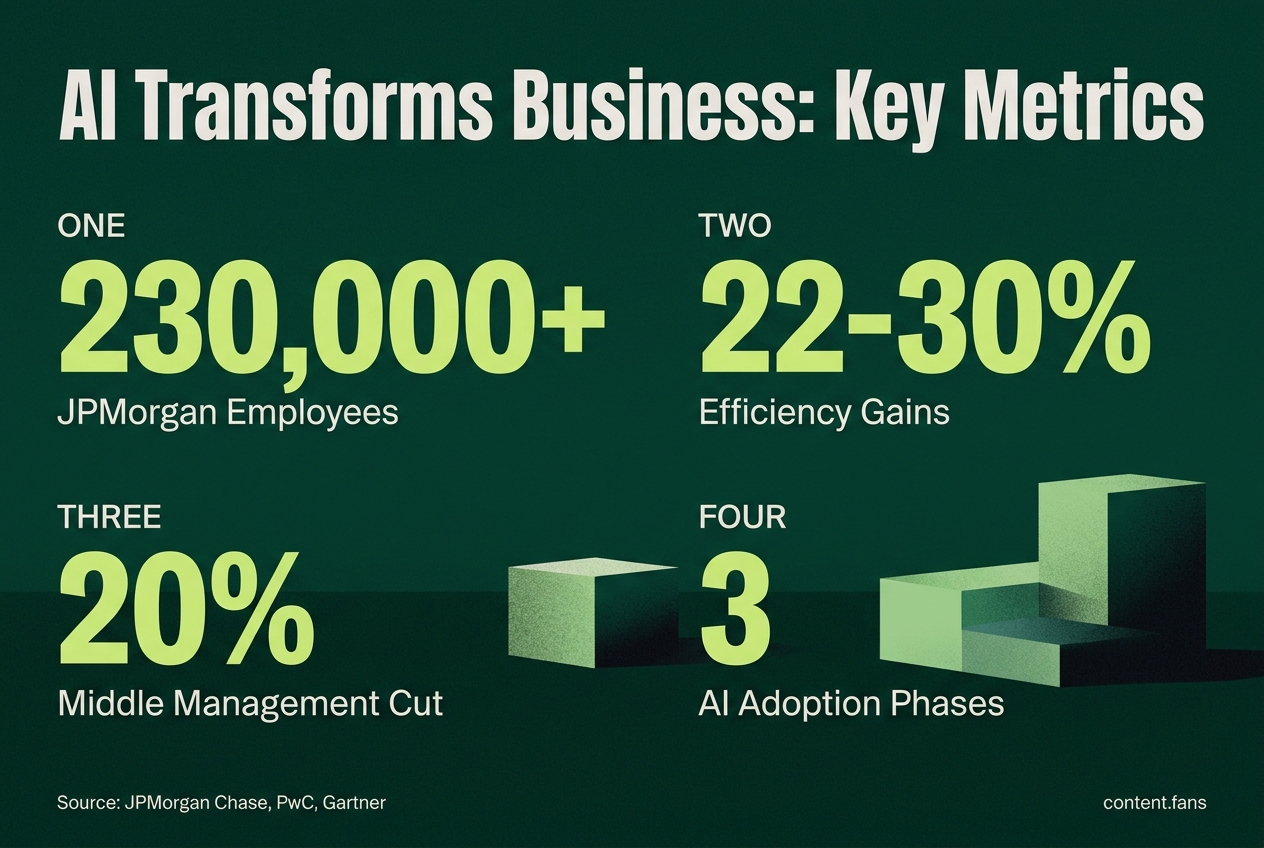
The financial services sector provides a different scale. JPMorgan Chase rolled out its proprietary LLM Suite to more than 230,000 employees globally, with early data showing efficiency gains of about 22 - 30% on certain administrative and operational tasks. To underscore its commitment, the bank publicly targeted significant leadership usage within the first month.
Phase 2 - Systematic Redesign: Workflows, Documentation, and Safety
Successful pilots pave the way for systematic process redesign. PwC provided a significant portion of its workforce with an internal chatbot and code modernization tools, integrated into an "Agent OS" to allow for human oversight. Similarly, according to industry reports, global banks are redesigning their lending workflows, achieving substantial reductions in manual processing time and credit approval times.
This phase hinges on psychological safety. The MIT Technology Review article highlights the importance of psychological safety for AI project success, emphasizing the need to overcome fear of failure. Organizations that foster transparency, encourage questions, and provide sandbox environments for testing achieve higher and more sustained adoption rates.
Phase 3 - Structural Evolution: Flattening, Rewards, and Fluency
Gartner predicts that through 2026, 20% of organizations will use AI to flatten their organizational structure, eliminating more than half of current middle management positions. Early examples are already bringing this trend into focus:
- At UPS, an automation system reduced agent handling time, shifting managers from monitoring tickets to coaching escalation strategy.
- BMW's generative AI assistant empowers non-technical staff to build small apps, promoting cross-functional collaboration without adding management layers.
- Progyny's HR team is evolving compensation by shifting incentives from hours worked to outcome-based leverage, a potential blueprint for future reward systems.
Quick reference metrics
| Playbook stage | Illustrative organisation | Reported outcome |
|---|---|---|
| Foundation | JPMorgan Chase | 22-30% efficiency gains on certain tasks |
| Redesign | Global bank (BCG case) | Significant productivity gains in lending |
| Evolution | Essex Property Trust | Substantial data-task productivity after upskilling |
These examples show the playbook's phases often overlap, with pilots, culture, and structural changes iterating concurrently. Organizations that set public leadership usage goals, document workflow changes, and prioritize psychological safety are best positioned to scale their AI initiatives responsibly and effectively.
What concrete steps mark Phase 1 of a credible AI transformation?
Start with visible leadership usage: top teams aim to run a significant portion of their daily tasks with AI within 30 days.
Next, nominate Agent Champions - respected middle managers who become the go-to coaches for a 6-8-week pilot pod that tackles a single high-value workflow.
Once the pod proves the concept (e.g., faster report turnaround or fewer hand-offs), the metrics are reviewed and only then is broader funding released.
How did JPMorgan Chase and PwC validate their Phase 1 pilots?
- JPMorgan Chase gave more than 230,000 employees access to its LLM Suite, achieving 22-30% efficiency gains on certain administrative and operational tasks.
- PwC rolled out an internal AI chatbot to a significant portion of its staff and saw the same pattern: routine drafting and data look-ups became faster, freeing analysts for judgment-heavy work.
Both firms treated these numbers as a Phase 1 checkpoint before investing in deeper workflow redesign.
Why is psychological safety a non-negotiable in Phase 2?
Industry reports suggest that many leaders believe psychological safety has a measurable impact on AI initiative success.
When employees feel safe to challenge or refine the AI output, teams report faster adoption within six weeks.
Leaders foster this by communicating roll-out rationale, giving AI-readiness training, and celebrating failed but data-rich experiments.
What structural changes define Phase 3?
Traditional pyramids are being replaced by flatter, AI-augmented networks.
- Gartner predicts that through 2026, 20% of organizations will use AI to flatten their organizational structure, eliminating more than half of current middle management positions, letting agents handle status updates and routine approvals.
- Rewards pivot from hours worked to leverage: outcomes achieved per human hour.
- Cross-functional fluency becomes the norm; a product marketer, AI engineer and finance analyst may sit in a short-lived pod that dissolves once the metric is delivered.
How should a company decide when to scale AI?
Scale only after every pilot delivers validated metrics - typically a significant reduction in cycle time or manual effort and a clear story of improved employee experience.
Both JPMorgan Chase and PwC waited for employee usage to reach substantial levels and error rates to drop before adding new use-cases, ensuring each leap rested on proven ground.