
Investors Adopt Hybrid AI Stacks, Blend LLMs and Finance Platforms
Serge Bulaev
Investors are starting to use both general large language models (LLMs) and finance-specific platforms together, but picking the right tool for each task can be unclear. Studies suggest general LLMs like GPT-4o may have about 47% accuracy on finance questions, while platforms like AlphaSense could offer more reliable and easier-to-check data. A combination approach seems to work best: use LLMs for flexible tasks and finance platforms for trusted sources. Adoption of AI agents in finance appears to be growing but is still cautious due to data and oversight challenges. Experts recommend keeping humans in charge of final decisions and using clear steps to manage risks and trace responsibilities.

For modern investment firms, building hybrid AI stacks that blend general large language models (LLMs) with finance-specific platforms is becoming standard practice. While frontier models like GPT-4o and Claude 3.5 are now essential, choosing the right layer of the stack for each research task can be opaque. This guide provides a practical, source-backed framework for matching tool to task, assessing total cost, and implementing robust human oversight.
Horizontal LLMs vs. Finance-Tailored Platforms
Recent benchmarks highlight the performance trade-offs. A 2025 study on live research workflows found that even a top OpenAI model achieved just 46.8% accuracy on financial questions, at an average cost of $3.79 per query (arXiv paper). In contrast, platforms like AlphaSense offer curated data and templates to minimize verification effort, arguing that general models lack access to embedded premium content (AlphaSense comparison).
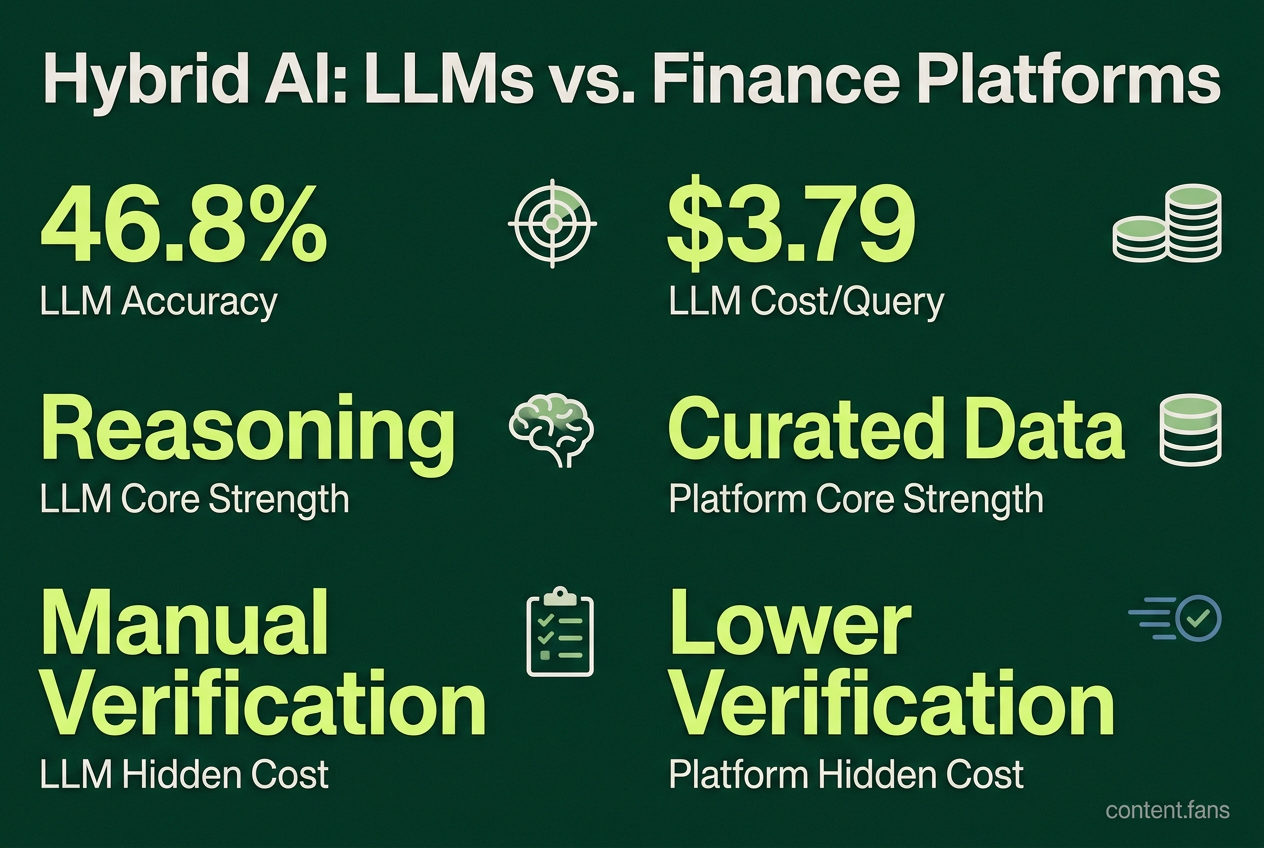
A hybrid AI stack combines general large language models (LLMs) like GPT-4o for flexible tasks like drafting and summarization with finance-specific platforms such as AlphaSense for reliable data retrieval and source citation. This layered approach leverages the reasoning power of LLMs alongside the verifiable, curated data of specialized tools.
The evidence points toward a clear hybrid pattern:
- Use a general LLM for summarizing, drafting, and scenario analysis when latency and flexibility matter.
- Use a finance platform for source retrieval, monitoring, and audit-ready citation.
- Blend the two when the team needs both broad reasoning and traceable data.
| Dimension | Claude / OpenAI | AlphaSense |
|---|---|---|
| Core strength | Reasoning and synthesis | Curated finance data, repeatable workflows |
| Median research accuracy | Variable; 46-50 percent on realistic tasks | Higher when tasks hinge on premium sources |
| Visible cost | Low per query | Subscription-based, higher upfront |
| Hidden cost | Manual verification | Lower verification burden |
Agentic Workflow Adoption Curve
The adoption of agentic AI is accelerating, though firms remain cautious. According to industry reports, a growing number of investment firms are implementing agentic AI solutions, with adoption rates increasing significantly over recent quarters. Many organizations are now piloting agents, with a smaller but notable portion already using them in production. Full-scale rollouts are primarily gated by data integration and governance hurdles.
Decision Criteria Table - Modern AI Stack for Investors
| Criterion | Why it matters |
|---|---|
| Accuracy & citation | Benchmarks show meaningful gaps in raw LLM reliability; premium data narrows the gap |
| Latency | Trading desks may accept higher cost for faster answers |
| Domain depth | Curated finance platforms embed broker notes and call transcripts |
| Auditability | Tamper-evident logs support compliance reviews |
| Total cost | Factor visible query fees plus human verification time |
Building Risk Controls with Human Oversight
Industry best practices consistently emphasize staged workflows where AI drafts, humans validate, and senior reviewers approve high-impact decisions. Leading firms recommend "challenge-and-response" approvals to record intent and rollback plans, while experts note that logs of human-AI disagreements help trace responsibility.
A compact oversight blueprint:
- Define autonomy tiers for each research step.
- Trigger escalation when uncertainty, concentration, or novelty exceed thresholds.
- Log prompts, outputs, edits, and approvals in an immutable system.
- Sample and back-test a portion of low-risk outputs every quarter.
- Feed post-mortem findings back into prompt libraries and governance rules.
This layered approach may indicate the safest path to capturing AI acceleration while preserving fiduciary accountability.
What exactly is a "hybrid AI stack" for investors?
A hybrid AI stack combines three complementary layers:
- Horizontal LLMs such as OpenAI and Claude for broad reasoning and drafting
- Agentic workflows that orchestrate multi-step research tasks without human babysitting
- Finance-specific platforms like AlphaSense that deliver source-grounded data and repeatable workflows
Rather than betting on one tool, teams wire the layers so each covers the others' blind spots. A typical flow is:
AlphaSense surfaces the latest broker notes → Claude summarizes key take-aways → an agent updates your model and flags any assumptions for human review.
Benchmark evidence shows OpenAI models still score only 46.8 % accuracy on realistic finance tasks, highlighting why the stack, not the model, matters.
How do accuracy and cost really compare between LLMs and specialized platforms?
| Dimension | OpenAI / Claude | AlphaSense |
|---|---|---|
| Accuracy on finance tasks | 46.8 % (best frontier model) | Strong when retrieval uses curated filings, transcripts, broker research |
| Cost per query | ~ $3.79 | Higher platform fee, yet reduces manual source hunting |
| Citation reliability | Limited unless paired with retrieval | Built-in source traceability |
| Break-even point | Cheap for ad hoc brainstorming | More efficient when verification labor would exceed platform fee |
Industry observations suggest that when analysts spend significant time stitching and validating data per request, specialized platforms often prove more cost-effective once hidden verification costs are considered.
Where are agentic workflows actually being used today?
- A growing number of asset managers and PE firms have AI agents in live production, with adoption accelerating rapidly
- Early wins cluster in:
- Earnings-season prep (auto-pull filings, build first-draft notes)
- Thematic screening (agents scan 10-Ks, flag ESG red-flags)
- News & filing monitoring (agents push alerts only when new data hits pre-set thresholds)
- Adoption still gated by data integration and governance: many firms are still piloting while others remain in exploration mode
What risk controls are proving effective?
Top firms follow the stage-gate-log model:
- Stage the work into sourcing → screening → thesis → human review
- Gate risk with tiered reviewers (junior for drafts, senior for trades > $5 mm)
- Log every prompt, output, edit, override in a tamper-evident trail
Additional safeguards seeing wide uptake:
- Double-model sanity check - run the same task in Claude and GPT-4o; escalate on divergence
- Version-lock prompts so rollbacks are possible when market regimes shift
- Human-in-the-loop fatigue monitor - track override rates weekly; if too low, widen agent autonomy, if too high, tighten gates
How do I choose the right mix for my team?
Start with the job, not the tool.
| Use-Case | Lead Layer | Human Check |
|---|---|---|
| Quick earnings call summary | Claude | 2-minute skim |
| Deep-dive on new IPO | AlphaSense + Claude | Senior analyst |
| Daily news watchlist | Agent | End-of-day sample audit |
Decision checklist:
- Data scope needed - premium transcripts → AlphaSense
- Explainability required - client-facing memo → human final sign-off
- Experiment budget - low-stakes brainstorming → LLM only
Teams that mix sources show significantly faster research cycles without new headcount, according to industry reports.