
Investment Firms Adopt AI to Automate Research, Keep Humans In Loop
Serge Bulaev
Investment firms are starting to use AI to make research faster, but they still keep humans in charge of final decisions. AI may help with tasks like summarizing documents, sorting large lists, and searching data, but analysts check and approve the results. Different tools have different strengths, so firms might use a mix of them. Best practices suggest that every AI output should be reviewed by a person, especially for important decisions. Firms measure things like speed, mistake rate, and user happiness to decide if new AI workflows are ready for regular use.

Leading investment firms adopt AI to build research workflows that sharpen analyst judgment and reduce error. By embedding language models into screening, deep research, and monitoring, teams can automate repetitive work while ensuring analysts retain control over all final decisions. The common pattern is clear: AI accelerates document-heavy tasks, while human analysts provide validation and final approval.
What is a phased adoption approach for AI in investment research?
Start small, prove value, then scale. Most leading firms now treat AI like any new product launch: a low-risk pilot, followed by iterative rollout. This approach minimizes disruption and builds trust in the new workflows. A typical playbook looks like this:
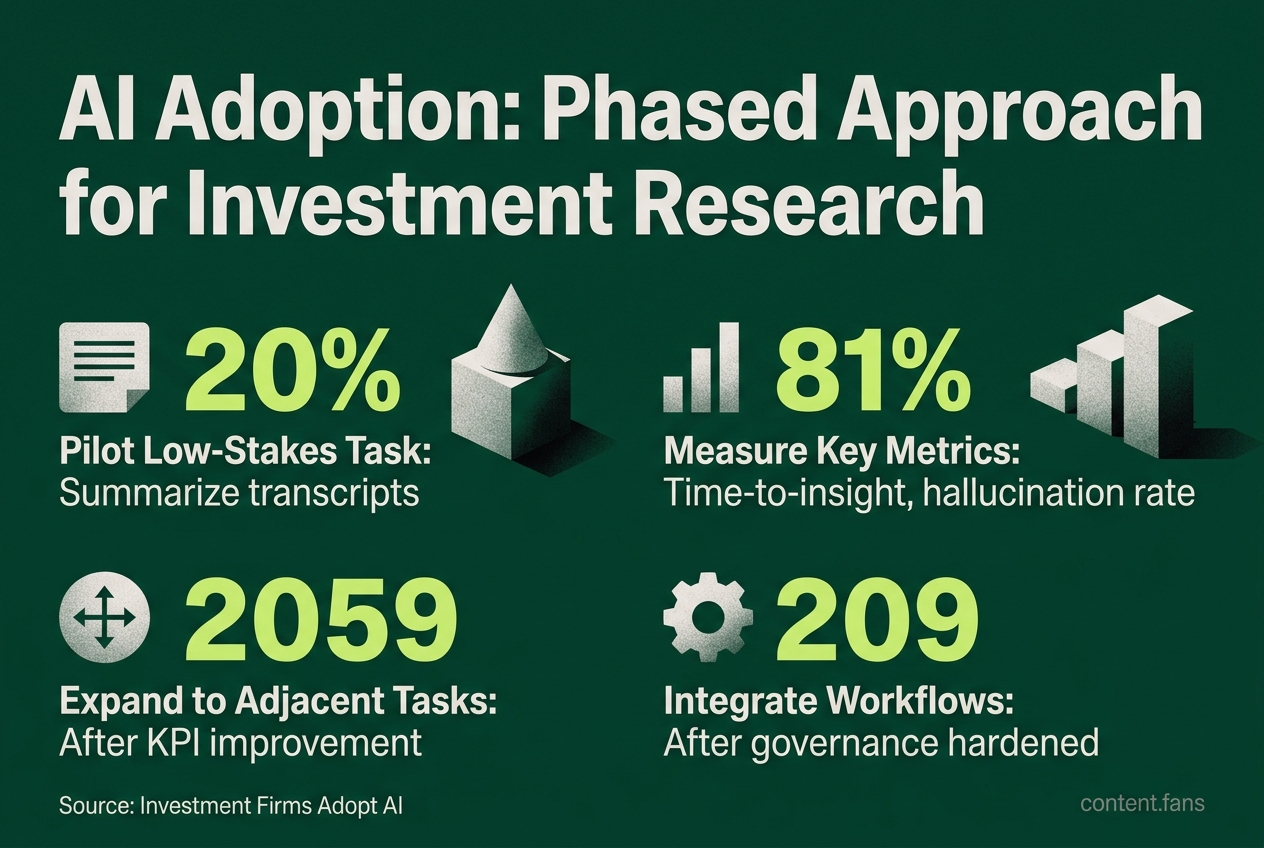
- Pilot a single, low-stakes task like summarizing earnings transcripts or company filings. Case studies show another quick win is pre-screening large investment universes using criteria-based agents, as described by the CFA Institute.
- Measure key metrics like time-to-insight and hallucination rate against human benchmarks.
- Expand to adjacent tasks only after KPIs show significant improvement.
- Integrate into daily workflows only after governance, prompts, and audit trails are fully hardened.
By sequencing the rollout, firms like T. Rowe Price have moved from experimentation to direct workflow integration without interrupting live investment processes.
Which tools should we use for which research tasks?
Match the tool to the task by considering the required depth of domain-specific content versus model flexibility. The dominant pattern is a mixed stack:
- AlphaSense - Best for discovery and sourcing. Its enterprise-grade corpus of curated broker research, expert call transcripts, and filings with sentence-level citations is ideal for regulated environments where data provenance is critical.
- OpenAI (GPT-4) - Best for drafting and complex reasoning. Its strengths in coding and long-context synthesis make it the top choice for drafting analysis or orchestrating workflows when you already have proprietary data.
- Claude - Best for long-document analysis. A large context window excels at processing entire 10-K or ESG reports in a single pass.
- Multi-agent frameworks - Best for orchestration. These systems route tasks between specialized tools (e.g., AlphaSense for sourcing, GPT for synthesis) to create a seamless end-to-end process.
Industry reports confirm this pattern: using AlphaSense for market intelligence and supplementing with OpenAI/Claude for custom writing and coding.
How do we keep humans "in the loop" without slowing everything down?
Use risk-tiered checkpoints that match the level of human oversight to the potential impact of the decision.
| Risk Tier | Human Action Required | Example Task |
|---|---|---|
| Low | Spot-check | AI-drafted earnings note summary |
| Medium | One-click approve with rationale | Sector-screening output |
| High | Full review + documented sign-off | Portfolio rebalance recommendation |
| Critical | Committee review + rollback plan | Research published externally to clients |
To preserve speed while ensuring safety, implement smart tooling:
- Auto-escalation rules: If an output exceeds a materiality threshold, the task is automatically routed to a senior analyst.
- Audit-ready logging: Every prompt, retrieval source, model version, and reviewer action is timestamped and immutable for compliance.
- Fail-safe timeouts: High-risk items can be set to auto-deny if a designated reviewer does not act within a specified timeframe (e.g., 90 minutes).
These controls help firms maintain high velocity while achieving low override rates on AI-assisted work.
What metrics prove AI is actually working?
Track four core KPIs and review them quarterly to measure performance and guide iteration. Set traffic-light dashboards to flag when any KPI slips beyond its predefined target band.
- Speed: Time-to-insight (minutes from data ingestion to analyst-ready summary).
- Industry reports show significant improvements vs. baseline.
- Accuracy: Hallucination rate (verified false statements per 100 sentences).
- Leading firms are achieving low single-digit error rates.
- Coverage: Analyst capacity uplift (the number of companies a single analyst can follow effectively).
- Many firms report substantial capacity increases after implementation.
- Satisfaction: Analyst Net Promoter Score (NPS) on the AI tools.
- High satisfaction scores are often the threshold for moving a tool into full production.
How do we handle hallucinations and compliance risk?
Implement a three-layer defense to manage the risks of inaccurate outputs and ensure regulatory compliance.
- Pre-Run Filters: Automatically block prompts that request prohibited information, such as forward-looking price targets or non-public data.
- Runtime Retrieval Checks: During generation, match every cited source against a trusted internal data lake (or a platform like AlphaSense) and flag any missing URLs or timestamp mismatches.
- Post-Run QA: Combine automated and human checks after the output is generated.
- Automated fact-checking against filings and consensus data.
- Human "red-team" reviews where analysts attempt to find vulnerabilities through prompt injection, bias exploitation, or adversarial questions.
Firms that embed a compliance checklist (e.g., source date, citation validity) into their process report improved regulatory compliance outcomes.
What does an AI-powered workflow look like in practice?
A typical AI-augmented workflow for analyzing a company's earnings report follows five distinct steps:
- Step 1 - Data Ingestion: The system automatically ingests a new company filing into a vector database, making its content searchable.
- Step 2 - Automated Drafting: An AI agent retrieves the most relevant sections and drafts an initial 200-word summary with key figures.
- Step 3 - Human Validation: An analyst fact-checks all data, adds qualitative judgment and market context, and formally approves the content.
- Step 4 - Logging and Distribution: The system logs the entire workflow lineage for compliance and pushes the analyst-approved note to the internal research portal.
- Step 5 - Continuous Monitoring: An automated job is set to re-check the company for subsequent filings, triggering the workflow again when new information becomes available.