
Inflowave unveils 6-step workflow for human-led AI content creation
Serge Bulaev
Inflowave introduced a 6-step workflow that may help companies combine AI speed with human expertise in content creation. The guide suggests using mostly human judgment, with AI supporting drafting and idea generation. Teams are encouraged to clearly frame assignments, use AI for drafts, and then have experts review and improve the content. There are required checks for facts, brand voice, ethics, and compliance, plus documentation for governance. The process appears to keep the benefits of AI while making sure the final content is expert-led and credible.

This guide provides a 6-step workflow for human-led AI content creation, helping professional services firms balance AI speed with expert credibility. By keeping humans at the center of the process, teams can accelerate content production without sacrificing the authority and trust that win complex deals.
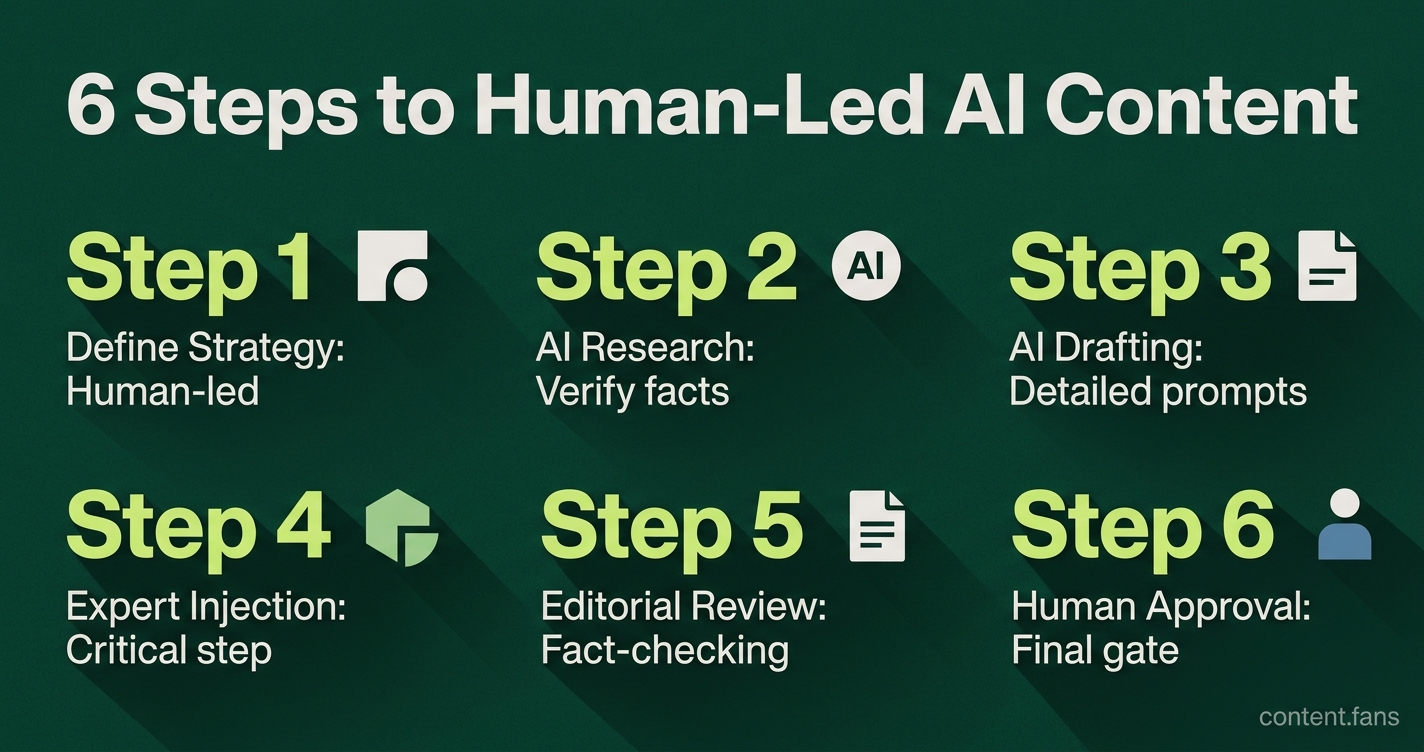
The 6-Step Workflow for Human-Led AI Content
Based on implementation frameworks from leading B2B organizations, this is a proven approach for balancing speed with credibility.
Step 1: Define Strategy (Human)
The workflow for human-led AI content creation involves a six-step process. It begins with human strategy and AI-assisted research, followed by AI drafting. Subject-matter experts then inject proprietary insights before a final human editorial review, compliance check, and approval, ensuring quality and governance at every stage.
Before any AI tool is used, a human strategist must define the content's angle, audience, and unique insight. This foundation prevents generic outputs that dilute brand positioning and authority.
Step 2: AI-Assisted Research & Outline
AI can accelerate the research phase by analyzing SERPs, competitor content, and internal knowledge bases to generate structured briefs and outlines. However, humans must verify all facts - every statistic, claim, and citation requires confirmation from a primary source to ensure accuracy.
Step 3: AI Drafting
With an approved brief, AI can generate a first draft from detailed prompts that include:
- Brand voice guidelines and terminology
- Specific audience pain points
- Proprietary frameworks
- Required evidence and source types
Step 4: Expert Layer Injection (Human)
This is the most critical step for establishing credibility. Subject-matter experts (SMEs) must manually enhance the AI draft by adding:
- First-person experiences and client anecdotes
- Proprietary data and anonymized case studies
- Nuanced commentary that challenges conventional wisdom
- Direct quotes from internal thought leaders
This layer is non-negotiable. The core principle is that AI accelerates; it does not decide.
Step 5: Editorial & Compliance Review
A human editor performs a rigorous pre-publication check to verify:
- Voice consistency and brand alignment
- Citation accuracy and source integrity
- Fact-checking to scan for AI hallucinations
- Regulatory compliance (FINRA, SEC, GDPR where applicable)
Step 6: Human Final Approval & Disclosure
Only a human can approve content for publication. This final gate should be managed by an editor who was not involved in the initial prompting. AI can recommend, but a person must decide what is published. Teams must also implement clear disclosure protocols, particularly for audiences in regions with AI labeling requirements.
Real-World Impact: What This Workflow Delivers
Organizations implementing human-led AI workflows report significant improvements in content production efficiency and quality. Professional services firms have seen substantial increases in content output while reducing costs per article. Teams also report improved organic search rankings and social media engagement when combining AI efficiency with human expertise and oversight.
Governance Essentials: The Five Artifacts
Marketing teams must operationalize documentation to meet emerging regulations:
| Artifact | Purpose |
|---|---|
| Human-Review Log | Tracks reviewer, date, and actions for every piece |
| Content Workflow Model Card | Public explanation of your AI-assisted production process |
| Source Attribution Standard | Rules for citations and unverifiable claim flagging |
| AI Disclosure Language | Required wording for regulated jurisdictions |
| Editorial Sign-Off Trail | Record of final approver and timestamp |
Why AI-Only Content Fails in Professional Services
Research indicates that public-facing AI content without significant SME review damages trust, especially in professional services. Skeptical B2B buyers - particularly CISOs, CFOs, and general counsel - can detect generic, unauthoritative language.
Human-led AI models are effective because they reduce drafting time while ensuring senior consultants refine AI output, not just rewrite it. They add proprietary insights that are impossible to source from public data. Cybersecurity firms using this method have transformed vendor-skeptical CISOs into engaged prospects by replacing generic claims with specific, anonymized ROI case studies.
Implementation Checklist
Weeks 1-4: Foundation
- Audit current AI usage and documentation gaps
- Define human-in-the-loop roles by content tier
- Build brand voice guide from best-performing historical pieces
Weeks 5-8: Pilot
- Test 6-step workflow on one content type
- Establish fact-check protocols with primary source requirements
- Create AI disclosure templates
Weeks 9-12: Scale
- Apply five artifacts to all new content
- Backfill review logs for recent content
- Publish Content Workflow Model Card
- Notify customers per disclosure requirements
FAQ
What is human-led AI content creation?
Human-led AI content creation prioritizes human judgment for strategy, tone, and final review, while using AI for drafting and research assistance. This approach ensures efficiency gains never override expert credibility - the model accelerates production without removing human decision-making.
Why must SMEs add an "expert layer" rather than just editing AI drafts?
AI cannot generate first-hand experience, which search engines and B2B buyers prioritize under E-E-A-T (Experience, Expertise, Authoritativeness, Trustworthiness) standards. The expert layer includes specific client examples, proprietary data, and nuanced commentary that only internal experts can provide. Without this layer, content reads as generic and untrustworthy to sophisticated audiences.
What content types require the strictest human oversight?
High-risk content - including regulated claims (financial, health), technical accuracy assertions, and customer-facing thought leadership - demands SME and legal review plus human final approval. Medium-risk content (general marketing) requires brand review and quality assurance. Only low-risk internal communications can proceed with lighter oversight.
How do I prevent AI hallucinations from damaging brand credibility?
Implement mandatory fact-check protocols where every statistic, claim, and quote is verified against primary sources before publication. Do not rely on AI for legal, financial, or technical accuracy. Verify every factual claim - one hallucinated precedent or data point can damage firm reputation.
What documentation must we maintain for AI-assisted content?
Marketing teams need five core artifacts: (1) Human-Review Log tracking reviewer actions, (2) Content Workflow Model Card explaining your process, (3) Source Attribution Standard for citations, (4) AI Disclosure Language for regulatory compliance, and (5) Editorial Sign-Off Trail recording final approvers. These should be maintained for compliance with emerging AI regulations.