
Imperva: Bots Now Account for 51% of Web Traffic
Serge Bulaev
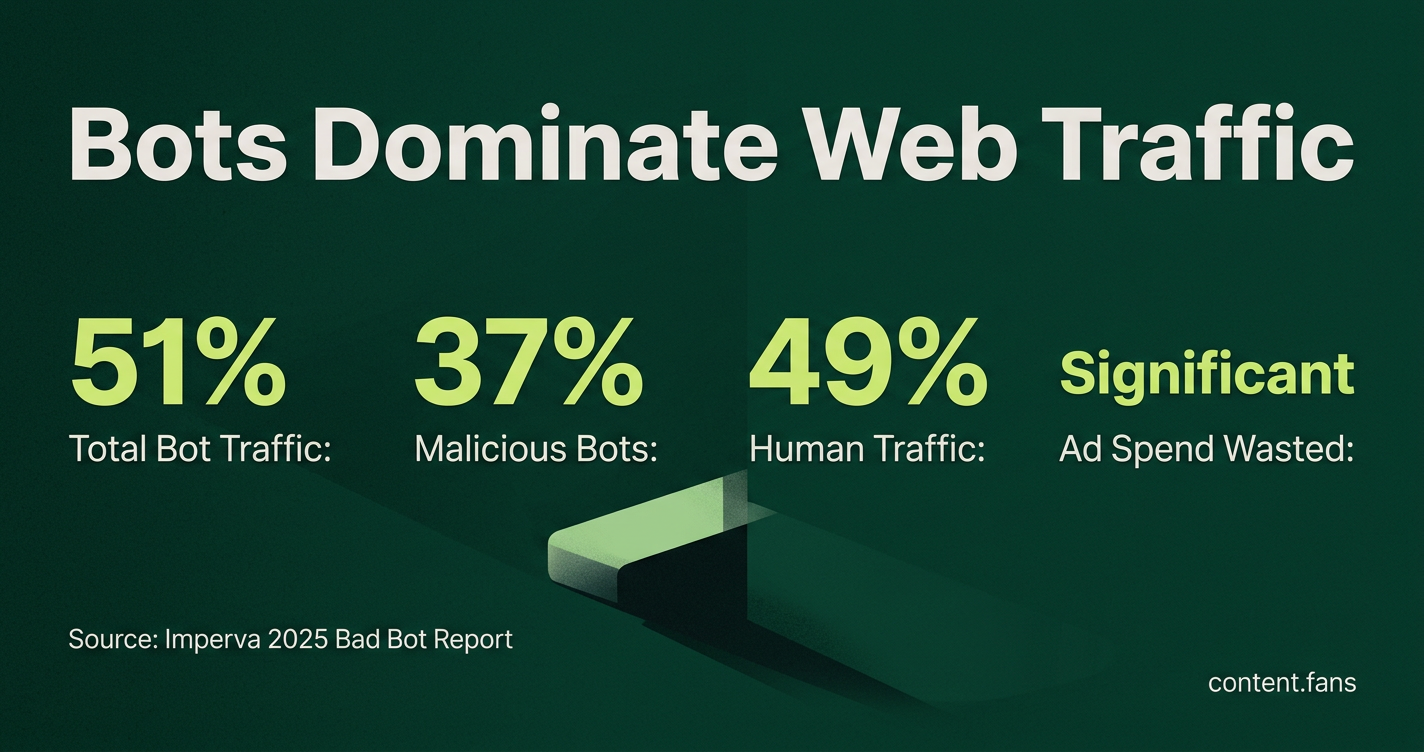
A recent report suggests that bots now make up 51 percent of all web traffic, which means there may be more automated agents online than people. This shift could cause problems for advertisers, since many clicks and views might be from bots and not real customers. About 37 percent of all traffic may come from bad bots that try to scrape or trick websites, and ad fraud might take up 22 percent of ad budgets. Some analytics tools may not be able to tell bots from humans, making website data less reliable. Experts believe new ways to prove a user is human may help, but privacy and security challenges remain.

Imperva's 2025 Bad Bot Report says automated traffic accounted for 51% of all web traffic in 2024, a new majority that fundamentally challenges how businesses measure online activity. According to the report, automated agents have surpassed humans, controlling over half of all global requests linking statistic. This tipping point forces analysts and marketers to question the validity of metrics that once assumed a primarily human audience.
This new reality is critical because bots inflate key metrics like impressions, clicks, and conversions without any real purchasing intent. Consequently, data analysts must now begin any evaluation by first determining what percentage of their traffic is generated by actual human behavior.
What the 51 percent figure means for advertising
The rise of bot traffic directly impacts advertising ROI by inflating performance metrics. Automated agents generate fraudulent impressions and clicks, which wastes ad spend on non-human interactions. This distortion makes it difficult for advertisers to accurately measure campaign effectiveness and attribute conversions to real customer engagement.
The Imperva study further specifies that malicious "bad bots" - designed to scrape, spoof, or defraud - constitute 37 percent of all traffic. Compounding this, industry reports indicate that fraudulent activity consumes a significant portion of all digital ad spend ad fraud figure. Together, these figures reveal significant budget exposure before a single ad is served.
Impressions lose value when bots generate views without purchase intent. When these automated agents also simulate clicks, multichannel attribution models fail, incorrectly crediting a paid, social, or affiliate channel for a conversion that never involved a human. In response, savvy advertisers are tightening traffic validation, implementing real-time session scoring, and deploying independent invalid-traffic (IVT) filters.
Strain on analytics and site performance
Standard analytics platforms like Google Analytics 4 (GA4) depend on client-side tagging, which struggles to identify sophisticated bots. Researchers observe that AI crawlers are often misclassified as "Direct" traffic, obscuring true sources and inflating engagement metrics. On content-rich websites, these automated scrapers can cause artificial spikes in pageviews, scroll depth, and time on page, potentially misleading editorial teams into optimizing for machine-driven trends.
Website infrastructure also feels the strain. Analysis of e-commerce server logs shows that AI crawlers can consume a significant portion of dynamic server resources. This heavy load degrades site speed for actual customers, explaining why many operations teams now reroute non-human traffic to static site versions or block it entirely.
Growing interest in proof-of-personhood
As bots overtake humans online, the need to verify unique human sessions has become urgent. While technologies like biometric tests and cryptographic credentials are still emerging, a promising framework has been proposed by researchers from MIT, OpenAI, and the Decentralized Identity Foundation (DIF). Their concept of reusable "personhood credentials" aims to confirm a user is human without revealing personal identity. Though privacy and spoofing challenges persist, experts advocate for layered defenses combining liveness detection, device attestation, and behavioral analytics as the most effective short-term solution.
Practical checklist for measurement teams
- Implement server-side bot filtering rules that execute before client-side analytics tags fire.
- Conduct weekly reconciliations between analytics tag data and raw server logs to identify discrepancies.
- Isolate content strategy decisions from raw traffic data by filtering or segmenting out automated traffic first.
- Assume any significant, unexplained change in metrics is a bot-related artifact until verified as human activity.
The rise of this automated majority does not make measurement impossible, but it does invalidate any analytics dashboard that operates on the default assumption that all visitors are human. Proactive teams that segment, verify, and cross-reference their data can successfully isolate human engagement from the surrounding automated noise.