
HR adopts behavioral data for adaptive workforce planning, skill mapping
Serge Bulaev
Companies are starting to use behavioral data from digital work patterns, like clicks and meeting times, to help HR plan for workforce changes. Experts say this may let HR spot skill gaps faster and create more adaptive plans. Early studies and examples suggest using this data can improve staffing, cut costs, and boost internal mobility, but privacy and bias risks remain. Experts recommend clear rules and close legal checks to use this data responsibly. Real-world cases appear to show that, with proper safeguards, behavioral data can help HR respond better to changes from AI.

HR's adoption of digital work patterns and predictive skills data is transforming workforce planning, moving from theoretical aspiration to automated execution as companies analyze digital footprints. These traces - including application clicks, meeting schedules, and team collaboration - create what experts call "behavioral work data." AI models analyze digital footprints to generate dynamic skill maps and capacity insights, as noted by sources such as SHRM, Gartner, and AIHR. The primary benefit is faster identification of skill gaps, enabling more adaptive and proactive workforce strategies.
What behavioral signals really show
Behavioral data provides objective insights into how work actually happens, revealing where employees focus their time, which teams face the heaviest workloads, and how collaboration flows. This information exposes operational bottlenecks and skill deployment patterns that traditional HR metrics often miss, enabling data-driven adjustments.
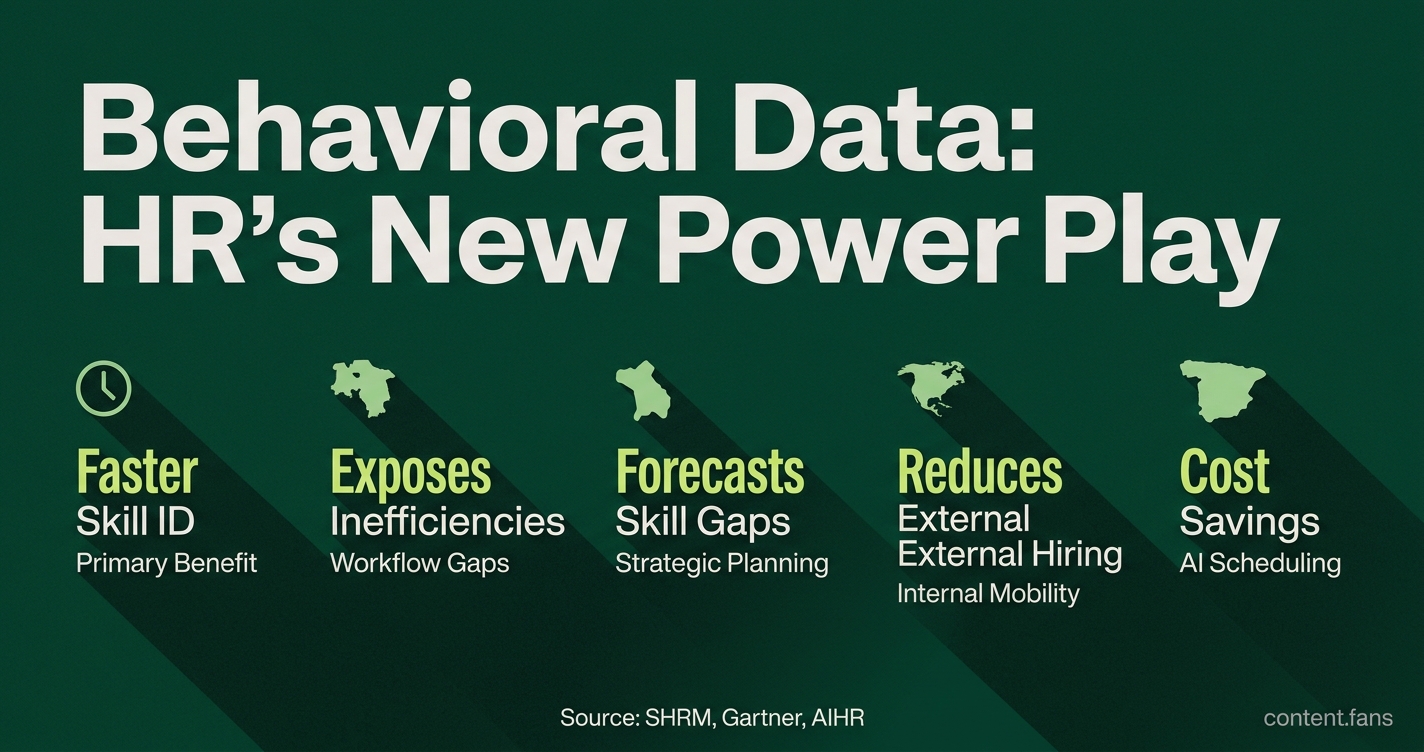
Analysis of these signals has successfully exposed workflow inefficiencies invisible to standard HR metrics, allowing leaders to redistribute tasks and prevent burnout. Furthermore, generative AI analyzes digital footprints to forecast future-critical skill gaps and inform strategic build-vs-buy decisions, as noted by sources such as SHRM, Gartner, and AIHR.
Leading companies are already demonstrating tangible results. Inferring skills from an employee's digital footprint leads to more precise talent acquisition and career mobility models, as supported by general industry research from SHRM, AIHR, and Gartner. Similarly, AI-powered scheduling systems have shown significant cost reductions according to industry reports. These cases illustrate how continuous planning fueled by behavioral data can drive significant cost savings and improve employee retention.
How HR can use behavioral data to thrive amid AI disruption
- Enable Continuous Workforce Planning: Implement autonomous planning systems, as described by Deloitte, that update talent forecasts in real time. This replaces outdated, static annual reviews with a dynamic model of skill supply and demand.
- Optimize Upskilling Investments: Use behavioral insights to identify untapped skills within the workforce. This allows L&D budgets to be precisely targeted at high-potential but underutilized employees instead of generic, company-wide programs.
- Enhance Internal Mobility: Power internal talent marketplaces with behavioral data. For example, companies are successfully accelerating internal role transitions, with many organizations reporting significant reductions in external hiring requirements by matching employees to opportunities based on demonstrated skills.
Guardrails for ethical and legal use
The collection of granular work data introduces significant privacy and bias risks. Legal experts warn that metrics like keystroke patterns or location data could function as proxies for protected characteristics, heightening the risk of discrimination claims. Across the EU, the forthcoming AI Act will classify many HR analytics tools as high-risk systems, mandating strict documentation and human oversight. To use this data responsibly, practitioners must establish a robust governance framework:
- Limit collection to the minimum data needed for the stated goal.
- Provide clear notice on what is captured and how AI will use it.
- Test models for disparate impact before decisions affect pay, promotion, or termination.
- Keep humans in the loop for any high-stakes outcome.
- Set strict retention windows and vendor audit rights.
Building the tech-legal partnership
Operationalizing behavioral analytics demands a strong partnership between HR, IT, and legal teams to manage data pipelines and ensure compliance. Experts believe that establishing cross-functional governance, conducting regular bias audits, and maintaining transparent employee communication are critical for building trust while achieving desired planning accuracy. The business impact is measurable: manufacturing firms have reported significant improvements in staffing accuracy by integrating predictive models into their workforce planning. Such outcomes demonstrate that when governed responsibly, behavioral data provides a distinct competitive advantage in an AI-shaped labor market.
How is behavioral data different from traditional HR metrics?
Behavioral data captures the digital trail work leaves behind - keystrokes, app-switching patterns, collaboration graphs, focus breaks and capacity stretch points. Unlike static HR records (title, tenure, performance rating) this stream shows how skills are actually used in flow. Sources such as SHRM, Gartner, and AIHR call it "the missing layer" that makes hidden workflow bottlenecks visible.
Which decisions get sharper when HR teams layer in these signals?
- Proactive skill-gap closure: Companies can infer real-time proficiency from employee digital footprints and spot shortages years in advance, letting leaders choose build-vs-buy before requisitions hit the street.
- Attrition guardrails: Organizations combine schedule data with behavioral fatigue signals to forecast and prevent unwanted turnover, with many reporting significant labor cost reductions.
- Internal mobility: AI-driven marketplaces suggest moves based on project contributions, not self-nominations, accelerating redeployment without external hires.
Where does competitive advantage actually show up on the P&L?
Manufacturing firms that integrate behavioral signals into monthly planning cycles have shown significant improvements in staffing accuracy, while many organizations have reported substantial reductions in cost-per-hire by targeting only skills proven scarce in collaboration metadata. Deloitte summarizes the edge: "Agentic AI can scan signals in real time and allocate labor faster than rivals stuck on annual headcount plans."
What ethical tripwires come with this data?
Privacy, autonomy and bias dominate current discussions:
- Covert profiling - keystroke cadence can reveal stress or health traits employees never disclosed.
- Function creep - data collected for workflow tips ends up quietly shaping promotion or pay.
- Proxy discrimination - location or chat sentiment may correlate with race, age or union sympathy, creating liability under U.S. and EU employment law.
Guard-rails gaining traction: collect only need-to-know metrics, expose what is measured and why, separate coaching insight from punitive action, and keep humans in the loop for high-impact decisions.
How do HR, IT and Legal operationalize analytics without slowing the business down?
A three-field governance model is emerging:
- HR frames the talent question (turnover risk, skill gap, capacity crunch).
- IT selects tools that minimize data volume and support audit trails.
- Legal drafts bias-testing, retention limits and employee opt-outs aligned with GDPR, the EU AI Act and new U.S. state privacy regimes.
Pilot teams start with anonymized, aggregate dashboards - no individual scorecards - then expand only when baseline metrics prove predictive and fair.