
How Tech Firms Strain Power Grids With Surging AI Demand
Serge Bulaev
Tech firms are using much more electricity as their AI data centers grow, which may be causing stress on local power grids. Planners and utilities appear to be struggling to keep up, and new data centers might need extra equipment and upgrades that are not ready yet. Some cities are trying different ways to deal with the demand, but there is uncertainty about who will pay for changes to the grid. Reports suggest that communities may see higher costs and other impacts, while some areas where data centers are built already face environmental problems. Experts warn that outages at large data centers could affect regional stability, and more studies may be needed to manage these risks.
The massive energy consumption of artificial intelligence is causing tech firms to strain power grids as their data centers proliferate. Grid planners now view these electricity-hungry facilities as a primary driver of industrial demand, with a 2024 Deloitte assessment noting their 24/7 power loads rival those of aluminum smelters. Local networks are already showing instability, with industry reports indicating voltage events have affected data centers in northern Virginia, raising concerns about regional grid stability.
How AI Data Centers Are Driving Unprecedented Load Growth
The surge in AI processing requires vast, concentrated electricity loads that existing infrastructure cannot always support. This unprecedented demand forces utilities to fast-track new generation and transmission projects, while also confronting equipment shortages and multi-year interconnection delays, creating bottlenecks that threaten grid reliability.
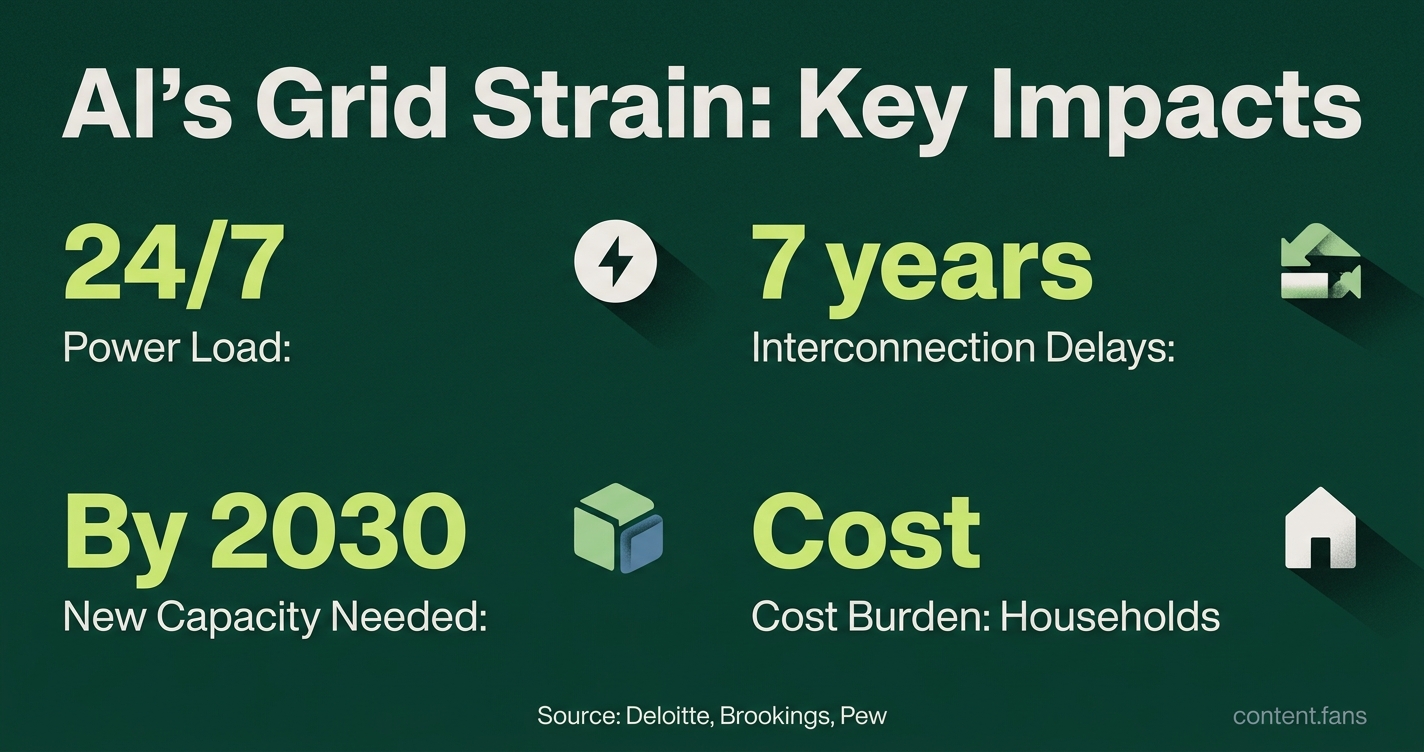
Utilities in major markets like PJM and ERCOT are forecasting steep load growth, with industry reports projecting data centers will consume a significant portion of U.S. electricity in coming years. Deloitte further projects AI-related demand will soar substantially by 2035. This rapid expansion requires new substations, transformers, and transmission lines that are still in planning stages. Compounding the issue are significant interconnection delays, with Deloitte noting queues as long as seven years in some regions. The strain is already visible, as Brookings has flagged overloaded transformers, which face their own supply-chain shortages. In response, some hyperscalers are building private "energy parks" with dedicated renewables and batteries to bypass grid constraints.
City and Utility Responses and Policy Gaps
Cities and utilities are deploying various strategies to manage the influx of data centers:
- Prince William County, Virginia, paused rezoning requests until developers agree to fund a new 500-kV transmission line.
- Mesa, Arizona, required water-recycling commitments before approving two new hyperscale campuses.
- Dallas-Fort Worth suburbs have updated noise ordinances following resident complaints about constant fan hum.
Utilities are also adapting by updating resource plans. According to industry reports, the sector may need substantial additional generation capacity by 2030. Some providers are reclassifying data centers as baseload customers and proposing higher demand charges to fund necessary substation upgrades. However, significant policy gaps remain. Regulatory cases in Georgia and Ohio reveal uncertainty over who should pay for grid expansions. Pew researchers warn that without rules assigning costs to direct beneficiaries, households may ultimately bear the financial burden.
How Tech Giants Are Bypassing the Grid
To secure power and bypass grid delays, hyperscalers are increasingly using large-scale physical power purchase agreements (PPAs). Industry reports describe major tech companies securing substantial solar power capacity for their facilities, representing new benchmarks in corporate renewable energy procurement. With companies like Meta also pursuing multi-gigawatt nuclear contracts, tech giants are now directly shaping the future generation mix. Policy is struggling to keep pace. While battery storage is becoming standard in large PPAs, state interconnection rules often still consider it optional. Furthermore, federal policy changes like the One Big Beautiful Bill Act have inadvertently incentivized developers to prioritize data center projects over community solar initiatives.
Local Burdens: Community and Environmental Impacts
The arrival of data centers brings mixed outcomes for host communities. A Consumer Reports analysis found that while construction provides temporary jobs, permanent positions are limited, and nearby households often face higher electricity prices and increased traffic. Water consumption is another major concern, as The Lincoln Institute warns that water-cooled facilities can severely strain aquifers, especially in drought-prone areas. Furthermore, environmental groups have identified a troubling trend of siting these facilities in already overburdened communities. The World Resources Institute mapped a significant portion of U.S. data centers in census tracts with above-average environmental stressors, leading to calls for cumulative-impact reviews before project approvals. Recognizing these high stakes, planners and utilities are conducting new reliability studies to model the regional impact of potential large-scale data center outages.
How rapidly is AI-driven demand pushing electricity loads?
U.S. grid operators now treat AI data centers as a system-level planning category, not a niche industrial load. Industry forecasts show data-center demand could reach substantial levels by 2035, representing dramatic growth from current levels (Deloitte analysis). In PJM alone, queued data-center requests could add substantial capacity by 2030 - representing a significant portion of all new conventional generation expected in the same window. Virginia data centers have faced multi-year grid connection delays, but the cited sources here do not confirm the claimed July 2024 60-facility trip or a 1,500 MW surplus.
What are the main bottlenecks utilities face?
- Generation: Continuous AI workloads need 24/7 firm power, forcing utilities to contract new gas, nuclear, or battery-backed renewables faster than any decade since the 1970s.
- Transmission & Distribution: Existing lines and substations near campus clusters already show harmonic distortions and load-relief warnings.
- Equipment Supply: Transformers and switchgear now carry 12-to-18-month backlogs, slowing every upgrade.
- Cost Allocation: Without policy guardrails, utility commissions may shift upgrade costs onto residential ratepayers, raising bills in data-center-heavy regions (Pew Research).
How are tech firms securing power ahead of the queue?
Hyperscalers are rewriting procurement rules with gigawatt-scale physical PPAs that bypass federal interconnection queues entirely. Industry reports describe major corporate deals for substantial behind-the-meter solar capacity - representing the largest corporate contracts to reach such scale. Similar energy-park models combine on-site generation with battery storage and private substations, creating de-facto mini-grids that no longer depend on public transmission timelines.
Which policy tools are emerging to manage local impacts?
- Additionality mandates: U.S., EU, and India now require PPAs to prove new generation capacity is built, preventing firms from buying existing green certificates.
- Cost-sharing reforms: Some states are debating impact fees that require data centers to pre-pay for grid upgrades and water infrastructure before permits are issued.
- Mandatory storage: Battery Energy Storage Systems (BESS) have shifted from optional to foundational components of new PPAs to smooth variable output (OptenPower briefing).
- Queue prioritization: Grid operators are tightening study rules so that requests larger than 100 MW must submit financial deposits earlier, slowing speculative filings.
What local burdens are communities reporting?
Environmental and social data show concentrated harms in host counties:
- Water: Large AI campuses can use substantial amounts of water daily, directly competing with municipal supplies during droughts.
- Noise & Light: 24-hour cooling fans and diesel backup generators have generated numerous noise complaints in Loudoun County, VA and Mesa, AZ.
- Economic asymmetry: While data centers add construction jobs, permanent employment averages only 30 - 50 positions per campus, yet utility upgrades are financed across entire rate bases (Consumer Reports).
- Environmental justice: A significant portion of new campus proposals target census tracts already above the national median for pollution burden.