
How Enterprises Adopt Auditable AI Agents for Workflow Automation
Serge Bulaev
Enterprises adopting AI agents for workflow automation may face strict requirements for tracking and explaining every action. To build trust, experts suggest using strong policies, detailed logs, and careful expansion. Systems usually involve checking risks, limiting permissions, logging all activity, and reviewing regularly. Reliable systems often use contract-based APIs and phased rollouts, with human checks and rollback steps for high-risk actions. Experts believe these steps help keep automation safe and maintain operator trust.

Adopting auditable AI agents for workflow automation presents a significant challenge for enterprises, as stakeholders demand irrefutable proof for every action. Successful adoption hinges on a strategic combination of robust policy enforcement, comprehensive immutable logging, and a carefully phased expansion, as outlined in emerging governance playbooks from sources like Promethium and the Jetruby platform guide.
The following field guide summarizes contract patterns, control layers, and roll-out tactics that product teams can adopt without slowing velocity.
Designing auditable agents that create work orders and trigger workflows
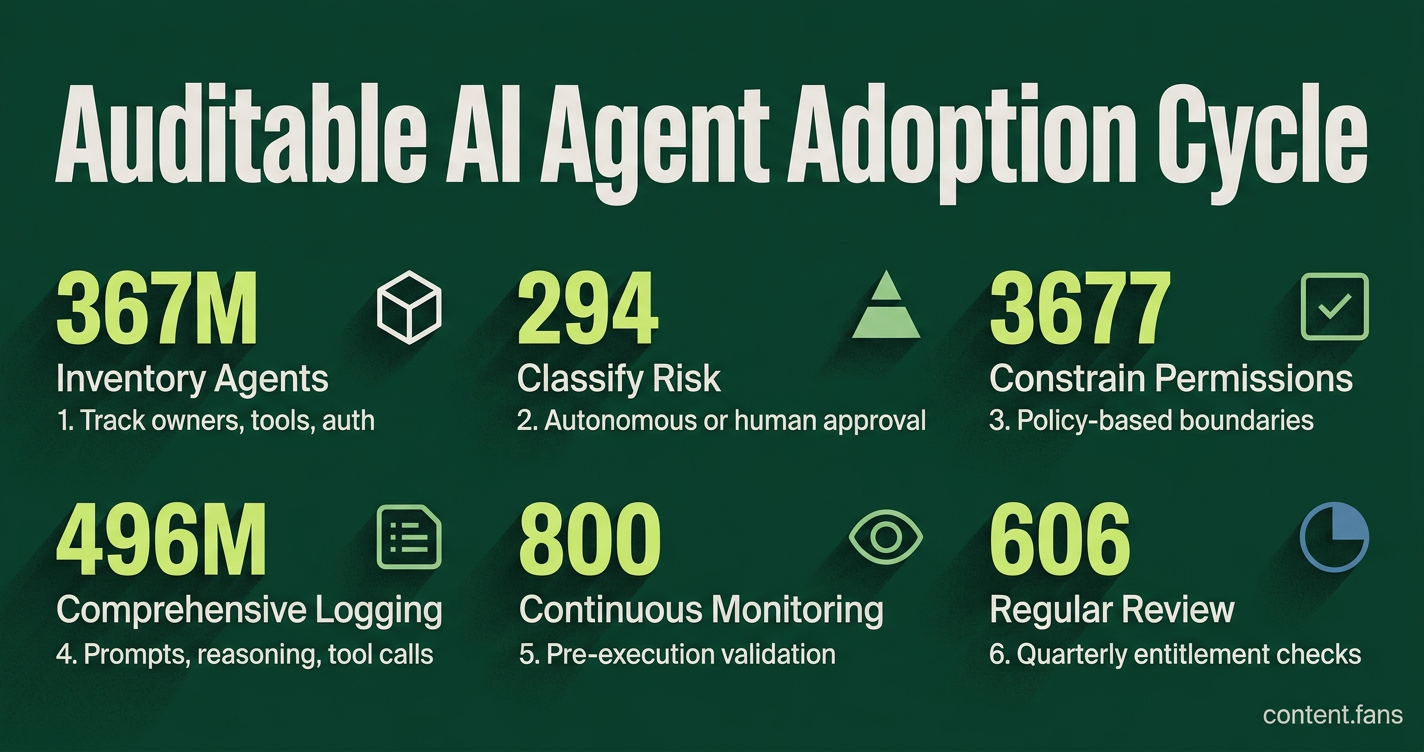
Designing auditable agents requires a systematic governance loop: inventorying all agents, classifying their risk, and constraining permissions accordingly. Key controls include agent registries for tracking and validation pipelines to inspect every proposed action against policy, ensuring no autonomous task exceeds its authorized boundaries.
Expert governance sources agree on a core operational cycle: inventory, risk classification, permission constraints, comprehensive logging, continuous monitoring, and regular review. An enterprise agent registry, for instance, catalogs each agent's owner, tools, and authorization level. This classification determines if an agent can act autonomously or needs human approval. Similarly, validation pipelines are crucial for pre-execution checks on API calls, blocking any action that violates established policies.
A complete audit trail is non-negotiable and must capture the agent's prompts, reasoning steps, tool calls, policy decisions, and version information. Immutable, structured logs are essential for distinguishing traceable automation from opaque failures. Furthermore, experts recommend quarterly entitlement reviews to ensure agent privileges remain aligned with current business risks.
Contract-first APIs for governed work-order creation
For reliable, governed integrations, a contract-first REST design using OpenAPI and JSON Schema is widely adopted in the industry. This approach provides a clear blueprint for interaction. Industry standards like TM Forum specifications can serve as useful reference models for work order management APIs.
Key design choices:
- POST /workOrders to create and return a canonical workOrder object
- GET /workOrders/{id} for retrieval, with PATCH for status or assignment updates
- Lifecycle enums such as created, assigned, in_progress, completed, closed
- Required fields at creation: assetId, locationId, priority, problemDescription
- Extension blocks for CMMS or EAM specific attributes
To prevent implementation drift, contract governance must be automated within CI/CD pipelines using tools for linting, mock servers, and contract testing. Incorporating details like rate limits, error shapes, and version headers directly into the API specification can help reduce integration defects as the system scales.
Safe expansion while preserving operator trust
To safely scale automation while maintaining operator trust, industry playbooks strongly recommend a phased roll-out strategy. This involves piloting agents on a limited process where teams can review alarms and overrides daily, allowing for threshold adjustments before a wider release. Essential safety layers, as noted by industrial AI experts, include network segmentation and strict role-based access control (RBAC).
A staged model often looks like this:
| Phase | Human role | Acceptance check |
| --- | --- | --- |
| Assessment | Validate scope and hazards | Baseline downtime and incident data |
| Pilot | Approve exceptions, observe drift | Shift-level review of alerts |
| Scale | Sign off on standard deployment | KPI comparison across sites |
| Optimize | Review model drift and edge cases | Continuous tuning and retraining |
Continuous feedback loops are critical for capturing operator comments, override statistics, and anomaly alerts. By feeding this data into regular quarterly permission reviews, organizations can achieve faster and safer gains in autonomy.
Operator confirmations and rollback flows
For high-risk workflows, AI agents must support a "staging-and-approve" pathway alongside a fully autonomous one. This allows a governance board to mandate human oversight for any changes impacting financial or safety systems. Effective systems include rollback primitives that can pause an agent, reverse its last transaction, and snapshot its state for forensic analysis.
Sample rollback flow:
1. Agent action fails policy check or triggers anomaly alert.
2. Governance layer issues automated pause and notifies owner.
3. Reconciliation script compares CMMS state with intended work order and applies corrective update.
4. Incident log, prompts, and policy snapshot are forwarded to review queue.
This structured approach to incident response preserves data provenance, limits the blast radius of any failure, and is crucial for building and maintaining long-term operator confidence in automated systems.