
How AI Companies Prepare for Incoming State Regulatory Scrutiny
Serge Bulaev
AI companies may face quick and broad subpoenas from state attorneys general, especially if they make public claims, handle sensitive data, or market to young people. In the first 24 hours, companies are advised to save all related data and map out what information they have. Protecting trade secrets while cooperating with authorities appears important, and this might include marking documents as confidential and limiting what is shared. Companies are also urged to make sure their public claims match technical evidence and to keep strong contracts with vendors. Keeping a ready response package and carefully tracking what is shared may help limit problems and show good management to investors.
As state attorneys general increase their focus on the tech sector, understanding how AI companies can prepare for incoming state regulatory scrutiny is essential. A multistate subpoena can arrive unexpectedly, targeting everything from advertising claims to data governance and protections for minors. This playbook outlines a practical strategy to manage legal exposure, protect commercial secrets, and maintain investor confidence when regulators come calling.
What Triggers a State AG Subpoena?
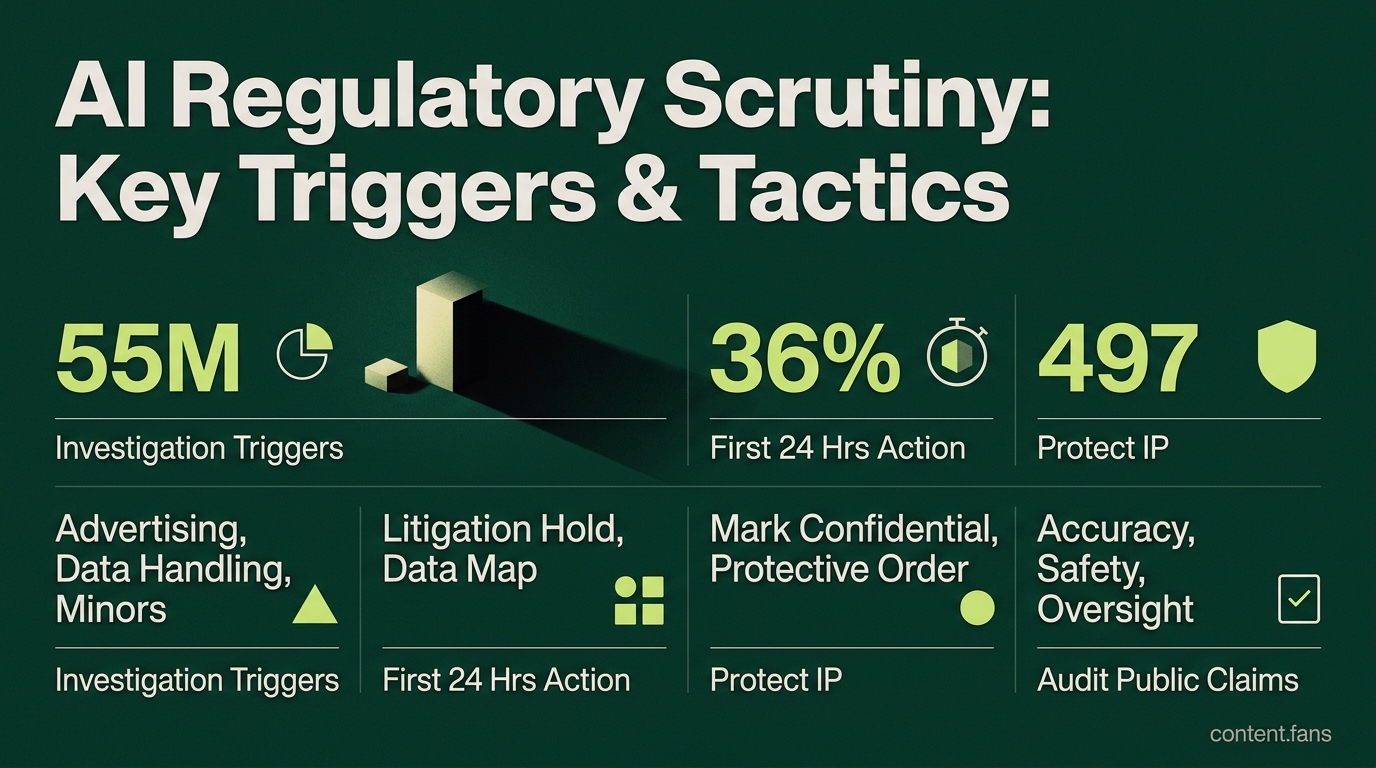
State attorneys general typically launch investigations based on consumer protection laws, targeting AI companies over their advertising, data handling, and safeguards for minors. A subpoena may demand documents on user engagement metrics and health data processing, even without specific AI legislation being in place.
Recent enforcement actions show that regulators don't need dedicated AI laws to act. Reporting from the Wall Street Journal and TechCrunch on a coalition subpoena to OpenAI indicates that demands focused on advertising strategies, user-engagement metrics, and safeguards for young users. This suggests that any AI company making public capability claims, processing sensitive data, or advertising to vulnerable demographics is in a potential target zone.
First 24 Hours: Preservation and Scoping
The AI Policy Desk checklist's first action is to audit public AI claims when facing regulatory scrutiny. Immediately issue a litigation-hold notice to suspend all data deletion protocols across chat logs, model outputs, and marketing files. Within these initial hours, draft a comprehensive data map so legal counsel can negotiate the subpoena's scope and avoid handing over entire training datasets unnecessarily.
Protecting Trade Secrets While Cooperating
Cooperation does not mean surrendering your intellectual property. Subpoenas often demand sensitive documents like model documentation, bias tests, and vendor contracts. Traverse Legal warns that trade secret status depends on proactive measures. Companies should mark materials as confidential, seek a protective order, and redact proprietary information like model weights unless specifically required. This dual-track approach of responsiveness and secrecy helps keep regulators engaged while defending core IP.
Align Public Claims with Technical Evidence
An AI Policy Desk enforcement checklist flags gaps between marketing copy and real-world performance as a recurring trigger for investigations. Founders must audit all public-facing materials - from website pages to sales sheets - that make claims about accuracy, safety, or human oversight. If a claim lacks supporting test data or bias reports, it should be removed or documented before production to limit follow-up demands.
The Importance of Vendor and Customer Contract Hygiene
Weak upstream agreements can amplify subpoena exposure. The AI Policy Desk enforcement checklist (Step 5) requires requesting substantiation documentation from AI vendors, including model documentation, benchmarks, and limitations. Strong contracts create leverage to obtain logs or indemnities when regulators request information outside your direct control.
Building a Standing Response Package
Because state AI laws vary and federal rules are unsettled, the AI Policy Desk checklist recommends designating one AI compliance owner to respond to inquiries within 72 hours. This package should include:
- An inventory of all models, datasets, and deployments.
- A data-retention schedule that meets the strictest state rule.
- Templates for incident response and litigation holds.
- Records of all bias tests, safety evaluations, and consumer disclosures.
Keeping this package refreshed allows a company to assemble a response in days, not weeks, limiting both costs and business disruption.
After Production: Close the Feedback Loop
The process isn't over when documents are submitted. It is critical to maintain a detailed log of everything shared with regulators and conduct an internal review to identify any compliance gaps the subpoena exposed. This feedback loop strengthens governance, prepares the company for potential follow-on requests, and signals strong operational discipline to investors.
What triggers a state attorney general subpoena for an AI company?
A formal demand for documents typically arrives after complaints about advertising claims, data handling, or minor safety. In June 2026, a coalition led by New York subpoenaed OpenAI for records on user engagement tactics, health data flows, and age-gating controls. The bottom line: if your marketing promises "safe for teens" or "bias-tested", keep the proof one click away.
How should an AI startup preserve evidence once a subpoena lands?
Issue a litigation hold within four hours: freeze Slack, e-mail, model cards, and ad creatives. Screenshot every public-facing page before it can be edited. Map which systems hold prompt logs, reinforcement-learning data, or customer PII so counsel can object to over-broad requests without spoliation risk.
Can trade secrets be shielded during production?
Yes. Courts routinely grant "attorneys'-eyes-only" tiers for model weights, vendor prompts, and safety-test code. Negotiate a confidentiality order up front; redact anything that gives a competitor a roadmap to replicate your pipeline. Segregate consumer data from network architecture to limit exposure.
Does a state probe mean federal AI rules are irrelevant?
Not exactly. No comprehensive federal AI statute exists yet, so state laws fill the vacuum. Federal and state regulatory frameworks continue to evolve, so companies should build compliance to the strictest state standard and track regulatory developments regularly.
What internal paperwork should be ready before any subpoena arrives?
Maintain a standing kit:
- dated model inventory
- bias, red-team, and safety logs
- data-retention map
- vendor contracts with IP indemnity clauses
- incident-response playbooks
General counsel should run a mock subpoena drill each budget cycle; investors now score regulatory readiness alongside runway and burn rate.