
House Passes KIDS Act, Requires AI Chatbot Disclosures
Serge Bulaev
The House passed the KIDS Act, which requires AI chatbots to say they are not human and to remind users during long chats. The bill also orders websites with adult content to use strong age checks and makes data brokers get parental consent before selling children's information. The Federal Trade Commission would enforce these rules, and some state laws would be preempted, which supporters say may make compliance simpler. Some people worry about privacy risks from age checks, so the bill directs the FTC to create rules that may reduce how much data is kept. The Senate has not voted yet, and it appears there may still be changes before the bill becomes law.

The recently passed KIDS Act represents a major federal effort to protect children online, combining an updated KOSA with mandatory age verification for AI chatbots and companions and new rules for data brokers.
What the House-approved KIDS Act covers
The KIDS Act requires AI chatbots to disclose they are not human and mandates age verification for users accessing AI chatbots/companions. It also tightens rules for data brokers selling children's information and assigns enforcement to the Federal Trade Commission, while explicitly preserving state registration obligations for data brokers.
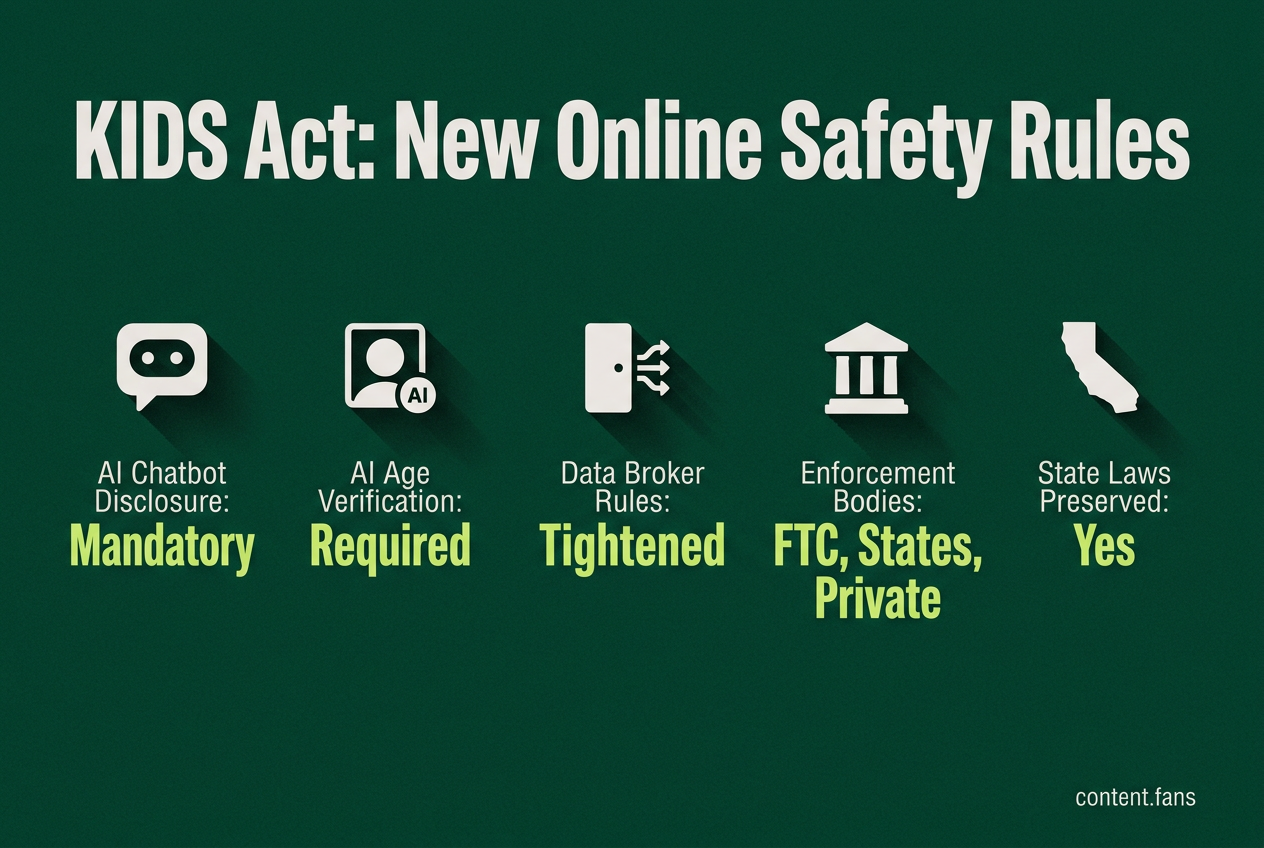
Under the provisions, consumer-facing AI systems must clearly identify as non-human and provide periodic reminders during long interactions. The law also compels AI chatbot and companion platforms to implement age verification systems for user access. Enforcement of these measures falls to the Federal Trade Commission (FTC), state attorneys general, and private plaintiffs. Additionally, the legislation targets data brokers, requiring them to secure verifiable parental consent before selling or sharing minors' data. The KIDS Act focuses on AI chatbot safety, data broker rules, and age verification for chatbot access. The House bill establishes multiple enforcement mechanisms through the FTC, state attorneys general, and private parties, a development detailed by Lawfare Media.
How the Senate debate may unfold
The bill's fate now rests with the Senate, which previously passed its own child safety package that stalled in the House. With the original Senate KOSA bill (S. 1748) now inactive, the focus shifts to the House's KIDS Act (H.R. 7757), though a floor vote has not been scheduled. While the KIDS Act maintains KOSA's "reasonable care" standard, it introduces explicit age verification requirements for AI chatbots and companions - changes intended to address emerging AI safety concerns. However, privacy concerns surrounding age verification persist. To address this, the bill instructs the FTC to develop regulations that limit data retention and support anonymous verification methods, though it is unclear if this will appease civil liberties groups.
Key differences between KOSA and the KIDS Act
- Age Verification: Required for AI chatbots and companions in the KIDS Act; excluded from the original KOSA.
- Enforcement: The KIDS Act authorizes the FTC, state attorneys general, and private plaintiffs as enforcers, expanding beyond the original KOSA framework.
- State Laws: The KIDS Act explicitly preserves state registration obligations for data brokers, whereas KOSA was silent on the issue.
- Scope: KOSA focused on social media, while the KIDS Act broadens coverage to include data brokers and AI chatbot platforms.
- Legal Standard: The KIDS Act establishes specific knowledge standards for age verification requirements.
Next procedural steps
To advance in the Senate, the bill will need 60 votes to overcome a potential filibuster. Ongoing negotiations, particularly concerning the extent of federal oversight of AI chatbots and data brokers, are critical to building that consensus. According to the official Congress.gov bill text, no Senate amendments have been filed, indicating that compromises are likely to emerge during committee markups. However, the compressed legislative calendar of an election year poses a significant challenge, potentially forcing lawmakers to attach the bill to essential, must-pass spending legislation.