
House Bill 2853 Creates Federal Retail Crime Coordination Center
Serge Bulaev
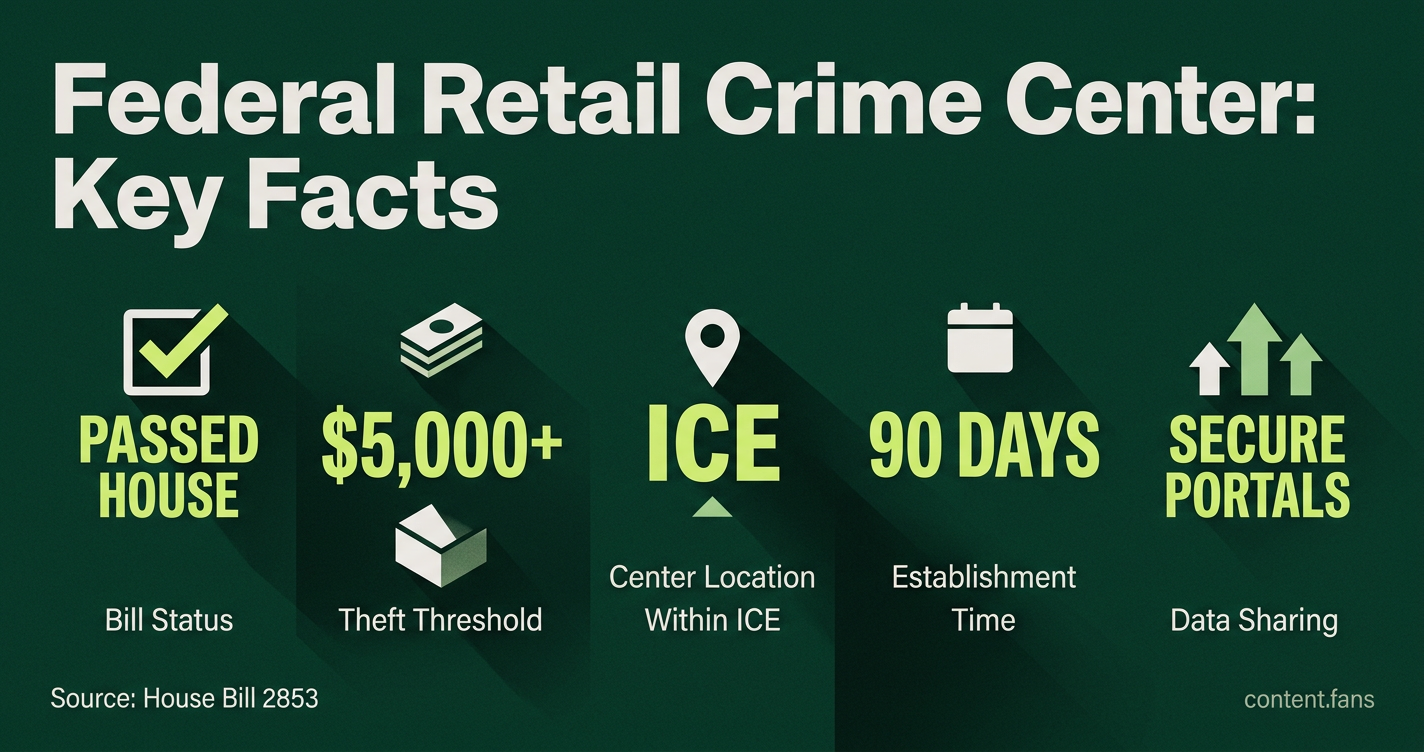
The Combating Organized Retail Crime Act, passed by the House in May 2026, may create a federal center to help law enforcement and retailers work together against organized retail theft. If the law passes, it would require Homeland Security Investigations to set up a new center in ninety days to share information and treat some retail theft as a federal crime when losses are above $5,000. The center would also expand money-laundering rules to include gift cards and prepaid cards. Experts suggest that retailers who prepare now by improving how they collect and share data may adapt faster if the law is approved. While it is not certain the bill will become law, many current practices already help police and stores work together more easily.
Collaboration between retailers and law enforcement is poised to transform with a proposed Federal Retail Crime Coordination Center. As large, multi-state theft crews shift tactics, both public and private sectors are demanding faster, standardized partnership models. A pending House bill illustrates how quickly these joint workflows could evolve.
The Combating Organized Retail Crime Act, which passed the House as H.R. 2853 and is now before the Senate as S. 1404, mandates the creation of this hub. If enacted, the Secretary would direct the Executive Associate Director to establish the Organized Retail and Supply Chain Crime Coordination Center within ICE within 90 days. Its functions, detailed in the CBO analysis, include aggregating intelligence, federalizing theft schemes over $5,000, and expanding money-laundering statutes to cover gift cards.
How retailers can work with law enforcement to combat organized retail crime
Retailers can improve collaboration by adopting standardized data practices. This includes capturing incident details in a consistent format, attaching a police case number, using secure portals for evidence uploads instead of email, and limiting shared data to what is necessary for an active investigation.
According to industry guidance, including the NBCC guidance, retailers should follow these practical steps:
• Complete the Retailer Data Request Form and include the police crime reference number.
• Verify legal basis for disclosure, with police recording shared information on the form as part of an audit trail.
• Upload CCTV, receipts, and statements through a secure evidence portal rather than email.
• Limit shared data to what is necessary for a defined investigation purpose.
• Track outcomes so store teams can refine what they submit.
Retail asset-protection managers find that real-time portals reduce duplicate requests and accelerate suspect identification. Moreover, dedicated intelligence teams can effectively triage retail data to flag offenders causing widespread harm.
Preparing for a national coordination center
To adapt quickly if the center is approved, retailers should invest now in disciplined data governance. Key preparations include mapping ownership of surveillance video, point-of-sale data, and loss reports; drafting Memoranda of Understanding (MOUs) to define response times; and training staff to collect complete incident narratives.
House sponsors state the federal hub will "connect the dots" between cargo theft, store crimes, and online resale markets. This suggests that retailers tagging evidence with shipment numbers, vehicle plates, and storefront links will enable investigators to identify multistate patterns more rapidly.
Several state task forces, such as Washington's ORC unit, already report faster enterprise-level prosecutions by centralizing intelligence. While the bill's passage is not guaranteed, these emerging models offer a credible blueprint for building stronger public-private partnerships immediately.
What exactly would the House Bill 2853 federal retail crime center do once it is created?
The Combating Organized Retail Crime Act (H.R. 2853) would establish the new Organized Retail and Supply Chain Crime Coordination Center within ICE, with the Secretary directing the Executive Associate Director to establish it. Within 90 days of enactment, the center would:
- Aggregate theft data at a national scale, letting investigators connect multi-state incidents
- Issue prosecution packages that bundle evidence, chain-of-custody logs, and suspect trends for federal, state, and local prosecutors
- Share real-time alerts with retail partners to warn of crews crossing county or state lines
- Track financial flows tied to gift-cards, prepaid cards, and online resale platforms to expose money-laundering networks
Congressional summaries note the goal is to pursue the criminal organizers, not just individual shoplifters, because retail crime rings now operate across dozens of jurisdictions at once.
Which retailers are expected to feed intelligence into the center first?
Early adopters are national big-box, grocery, and pharmacy chains with existing loss-prevention data lakes and regional ORC task-force relationships. The National Retail Federation's testimony confirms these companies already upload incident videos, license-plate captures, and suspect photos into secure evidence portals, so onboarding them to the federal platform is expected to be "weeks, not months" once the bill becomes law. Smaller retailers can join through state retail-federation hubs already piloting the same data standards.
What data-sharing best practices should every merchant adopt now to be ready?
- Minimal, targeted uploads - share only the essential data fields tied to an active case: date, time, location, suspect descriptors, and loss value
- Secure upload path - use an encrypted evidence portal (not email) to maintain chain-of-custody
- Crime reference number - include the police report number to prove a legal basis for each file
- Retention clock - tag evidence for automatic deletion after appropriate periods unless a case is still open
- Outcome tracking - request prosecutor feedback on whether the shared intel was useful, helping refine what you collect next time
These steps align with established police guidance and mirror the hub-and-spoke model the future federal center is designed around.
How will the new law change prosecution odds for multi-state gangs?
Current pain point: a $35,000 theft spree split across four counties often results in four misdemeanor cases because no single prosecutor sees the full loss. The coordination center would:
- Aggregate the $35,000 loss into one federal threshold, converting low-level charges into a felony conspiracy case
- Bundle incident files from each store into a single enterprise-level package, making it easier to indict the ring leaders instead of low-level boosters
- Supply forfeiture tools so prosecutors can seize resale websites, storage units, and prepaid-card balances tied to the conspiracy
According to industry reports, centralizing intelligence this way significantly improves conviction rates compared with isolated county filings.
What first actions should loss-prevention teams take today to be "plug-and-play" for the federal platform?
- Standardize incident tags - adopt NIBRS offense codes so every report speaks the same language
- Memorandum of Understanding (MOU) - draft a one-page MOU with your local police specifying who uploads, who reviews, and retention rules (templates from ORC associations are free)
- Front-line training - certify store managers on capturing face, license-plate, and getaway-vehicle footage within the first 45 seconds of an incident
- Legal check - run a Data Protection Impact Assessment to document why you collect, what you share, and when you delete
- Pilot with one partner - pick a regional task-force detective and upload test cases to validate file formats before the federal platform goes live
Completing these steps now means your data will flow into the federal center the day it launches, giving your cases priority attention and faster linkage across state lines.