
HHS Launches Operation Trial Blazer to Speed US Drug Trials
Serge Bulaev
The U.S. Department of Health and Human Services (HHS) has launched Operation Trial Blazer, which may speed up Phase 1 drug trials in the U.S. by about six to twelve months. The plan includes a new pilot program and updated FDA guidelines, and aims to keep early research in the U.S. instead of moving to other countries. The new rules might reduce paperwork and delays, but the program is not open for applications yet. The FDA is asking for public comments and may start taking formal applications after reviewing feedback, possibly as early as mid-2027.

The U.S. Food and Drug Administration (FDA) continues to pursue various strategic initiatives designed to speed up clinical trials in the U.S. While no single comprehensive program has been announced, the agency has been implementing multiple reforms aimed at reducing development timelines and strengthening the domestic research landscape. These efforts address the growing incentive for companies to conduct early-stage research in other countries like China and Australia.
FDA's Ongoing Trial Acceleration Efforts
The FDA has been working on several programs designed to reduce the time it takes to start clinical trials in the U.S. Through various pilot programs and updated guidance documents, these initiatives aim to streamline the regulatory process and reduce development timelines.
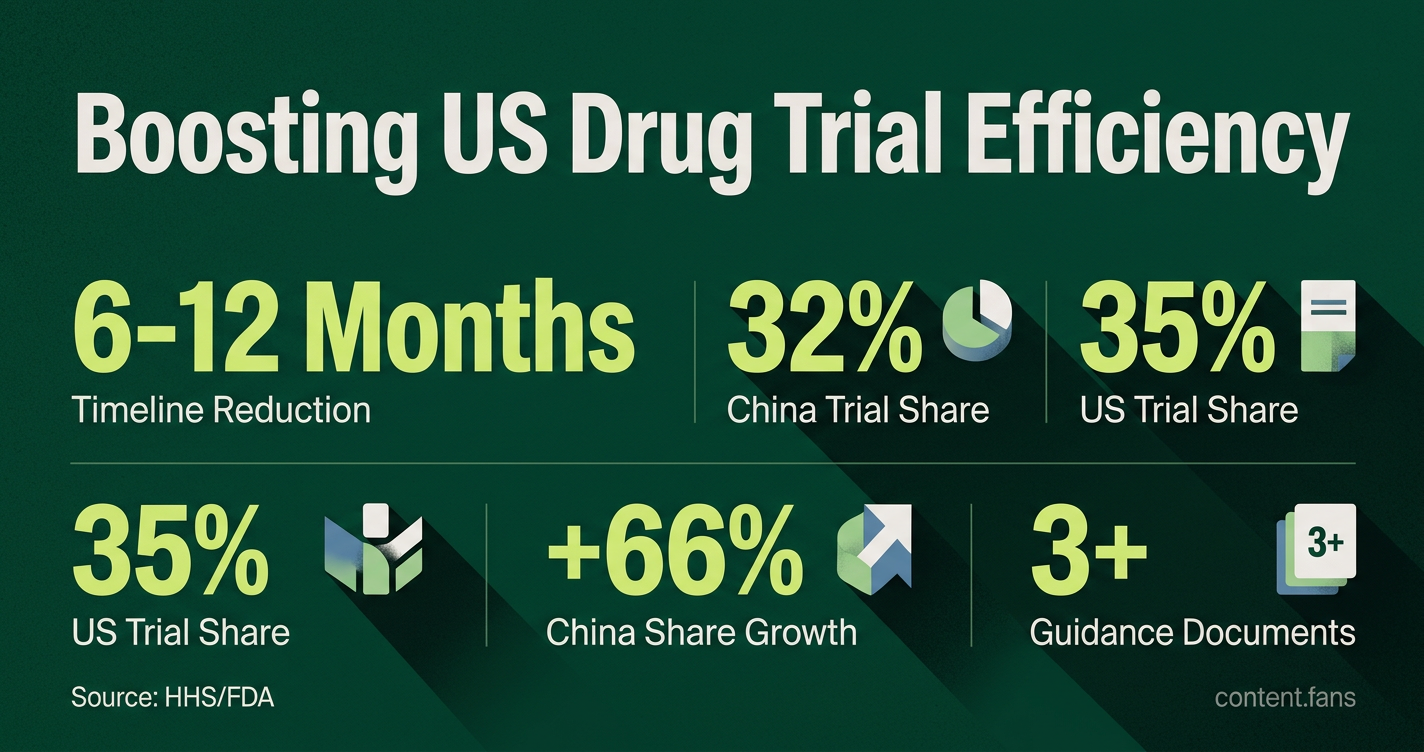
Key components of these efforts include enhanced IND review processes and collaboration with qualified research institutions. The FDA continues to accept applications for Investigational New Drug (IND) submissions while working to improve review efficiency. These iterative processes aim to reduce development timelines by 6-12 months and streamline the review process, though they do not explicitly claim to reduce the risk of clinical holds.
- Time savings: estimated six-to-twelve-month reduction potential in development timelines
- Scope: small molecules, biologics, cell and gene therapies entering first-in-human studies
- Sponsor ownership: companies maintain full IND control while institutions may provide advisory input
Regulatory Guidance for Trial Acceleration
The FDA has released various draft guidance documents aimed at accelerating trial timelines, including:
- Quantitative Systems Pharmacology (QSP): This guidance encourages using modeling to determine the Minimum Anticipated Biological Effect Level (MABEL), reducing reliance on traditional animal toxicology for dose selection.
- Master Protocols: Guidance clarifies how a single umbrella protocol can be used to evaluate multiple drug candidates simultaneously, minimizing sequential start-up delays.
- Phase-Appropriate CMC: This document clarifies that only essential Chemistry, Manufacturing, and Controls (CMC) data is needed for first-in-human studies, potentially saving months of preparation time.
Separately, the oncology-specific Project Optimus guidance, finalized in 2024 and now enforced, tells sponsors to compare several active doses before pivotal studies, moving away from maximum tolerated dose habits.
The Competitive Landscape and Economic Stakes
Officials have positioned trial acceleration efforts as necessary measures to maintain U.S. competitiveness. China's share of global clinical trial starts (all phases) grew to 32% in 2025, nearing the U.S. share of 35%. China's share of the global clinical trial market increased significantly, surging 66% from 2019-2024. These initiatives address regulatory hurdles, such as lengthy wait times for initial FDA meetings that are often absent in other countries. NIH Director Jay Bhattacharya has stated that accelerating domestic trials helps "protect the discovery engine" of the U.S. biotech ecosystem. FDA officials have emphasized that reducing regulatory burden makes the U.S. regulatory path faster and more predictable, a key consideration for investors deciding where to fund clinical trials.
What Sponsors Can Do Now
The FDA has established resources to help sponsors navigate the regulatory process more efficiently. A Phase 1 Contact Center (240-276-9358; Phase1Questions@fda.hhs.gov) and public IND Navigator resources are available for procedural questions. Sponsors can take the following proactive steps:
- Engage with FDA early in the development process to optimize trial design
- Audit current CMC packages against "phase-appropriate" thresholds to identify potential reductions
- Consider modeling approaches under QSP guidance to optimize dose selection
The FDA continues to refine its processes and guidance documents based on stakeholder feedback and emerging scientific approaches. Sponsors may see meaningful improvements in regulatory efficiency as these various initiatives mature and are implemented across the agency's review divisions.