
Groq LPU Benchmarks Show 3-18x Speedup Over Nvidia H100
Serge Bulaev
Groq's LPU benchmarks suggest it may be 3-18 times faster than Nvidia's H100 for certain tasks. Groq also reports up to 10 times better performance per watt and possibly much lower cost per million tokens, though analysts say these savings might depend on the workload. GPUs offer more flexibility and broader software support, while ASICs like Groq's usually support fewer frameworks. Rapid development of chips may reduce wait times but could raise concerns about long-term support. Measuring all results carefully and keeping tests reproducible is important for fair comparison.

Recent Groq LPU benchmarks show a significant 3-18x speedup over the Nvidia H100 for specific AI inference tasks, sparking debate over the future of specialized hardware. While Groq's Language Processing Unit (LPU) promises superior performance-per-watt and lower token costs, GPUs maintain an advantage in software flexibility and ecosystem support. This analysis provides a framework for evaluating these competing technologies, focusing on throughput, efficiency, and total cost of ownership (TCO) to help teams make informed procurement decisions.
Evaluating AI Chips vs. GPUs: A Review Framework
Evaluating AI accelerators like the Groq LPU against general-purpose GPUs requires a balanced scorecard. Key metrics include raw throughput (tokens/second), latency (time-to-first-token), power efficiency (performance-per-watt), and total cost of ownership. The trade-off often comes down to performance versus flexibility and long-term support.
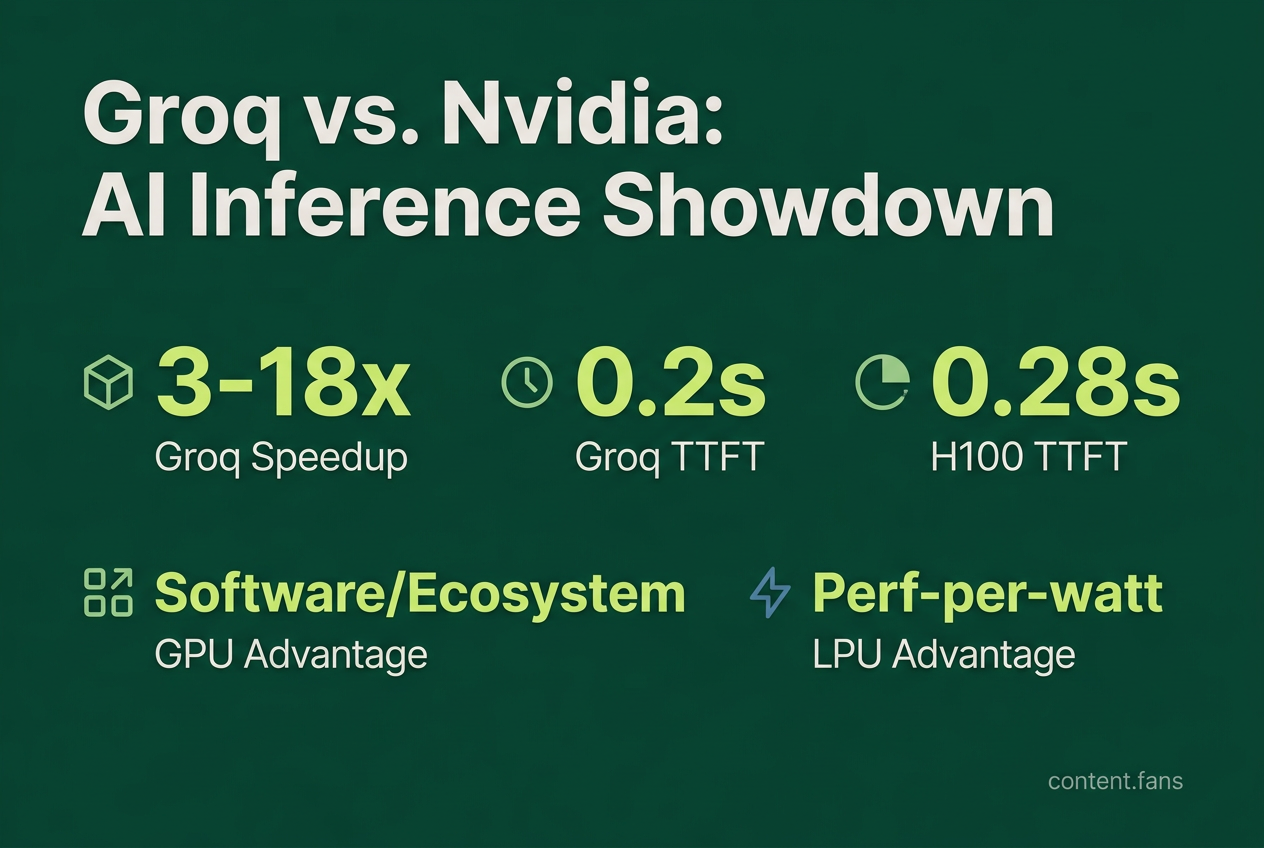
- Throughput and Latency: Measure tokens per second for both user-facing (batch size 1) and optimal batch sizes. For example, Groq TTFT is ~0.2s (80ms median); H100 TTFT is ~0.28s (280ms) or 200-400ms depending on configuration. Capturing both metrics is crucial, as batching can obscure true user-perceived latency.
Analyzing Efficiency and Total Cost of Ownership (TCO)
Beyond raw speed, energy efficiency is a critical factor for large-scale deployments. According to industry reports, specialized ASICs can offer significant performance-per-watt improvements over H100 clusters, while many custom ASIC vendors project substantial cost reductions per million tokens. However, analysts caution that these savings are highly workload-dependent, making it essential to document the specific test scenario, power limits, and cooling solutions.
Software Ecosystem and Flexibility
GPUs benefit from the mature CUDA platform and extensive framework support, while ASICs like Groq's typically rely on a more limited SDK. Key factors to document for any accelerator include:
- Supported precisions (FP16, BF16, INT4)
- Out-of-the-box framework compatibility
- Roadmap for model updates and security patches
Development Cycles and Supply Chain Considerations
The pace of hardware development is accelerating. While faster cycles reduce reliance on interim GPU solutions, they can also create concerns about long-term vendor support. It's vital to assess the vendor's roadmap, fabrication node, and product availability.
Procurement Decision Checklist
- Hardware unit cost at volume
- Tokens per joule on the target model
- Estimated cost per one million tokens
- Rack density and network fabric
- Independent verification status
To ensure credibility across silicon generations, all raw measurements, units, and scripts should be stored with the review, allowing peers to reproduce the benchmarks.
How large is the real-world speed gap between the Groq LPU and the NVIDIA H100?
Industry reports suggest that specialized ASICs like Groq's LPU can deliver significant throughput improvements over traditional GPU clusters, with performance gains varying considerably based on batch size and prompt length. The speedup ranges from modest improvements to substantial multiples depending on the specific workload configuration.
What does the efficiency story look like beyond raw throughput?
Energy matters once you scale: according to industry reports, specialized inference chips can deliver substantial performance-per-watt improvements compared to H100 setups in similar server configurations. In practical terms, a rack of specialized ASIC cards may achieve comparable tokens-per-second performance to an H100 cluster while drawing significantly less power.
How does accelerated design-to-tape-out timeline compare with the industry norm?
The industry is seeing accelerated development cycles for AI-specific chips, with some projects achieving faster time-to-market than traditional high-performance ASICs. Key accelerators include AI-assisted layout tools, software-hardware co-design, and advanced physical implementation flows from leading foundry partners.
What price and TCO reduction can buyers expect from purpose-built ASICs?
Industry reports indicate significant cost reductions per inference token when deploying dedicated ASICs instead of GPU clusters for steady, high-volume workloads. CapEx may still favor GPUs for small batch sizes, but TCO breakeven appears achievable within a reasonable timeframe at hyperscale volumes.
What workloads still favor GPUs over custom ASICs?
GPUs remain the safe choice for research, prototype models, or any pipeline where architectures evolve weekly; ASICs such as Groq LPU excel only when the model type, sequence length, and quantization scheme are locked for at least several quarters.