
Google's May 2026 Update Reshapes Brand Discovery With AI
Serge Bulaev
Google's May 2026 Update may change how brands are found online by using more AI in search, ads, and measurement. The update seems to help first-party sources while some aggregator sites lose rankings, and brands with clear, original information may do better. Advertisers are also starting to use AI agents to plan and adjust campaigns, but full automation is not yet common. There appears to be a new challenge in measuring how AI tools influence people before they click, so marketers are trying new ways to track that effect. These changes suggest that brands clear to AI systems and using new tracking tools might have an advantage.

The landscape of brand discovery may be profoundly altered by Google's anticipated AI-enhanced updates, which are expected to inject advanced AI into search, advertising, and measurement. This shift could prioritize machine-readable authority, creating new winners and losers. Three key developments may define this new era: core updates' impact on organic reach, the rise of agentic advertising, and new strategies to close the AI attribution gap.
How Future Core Updates Could Redefine Organic Reach
Google's upcoming core updates are expected to significantly impact organic reach by prioritizing first-party sources and original content. Industry analyses suggest a marked "disintermediation," where brands with clear entity signals and expert insights may gain visibility in search results and AI Overviews, while aggregator sites could experience a decline in rankings.
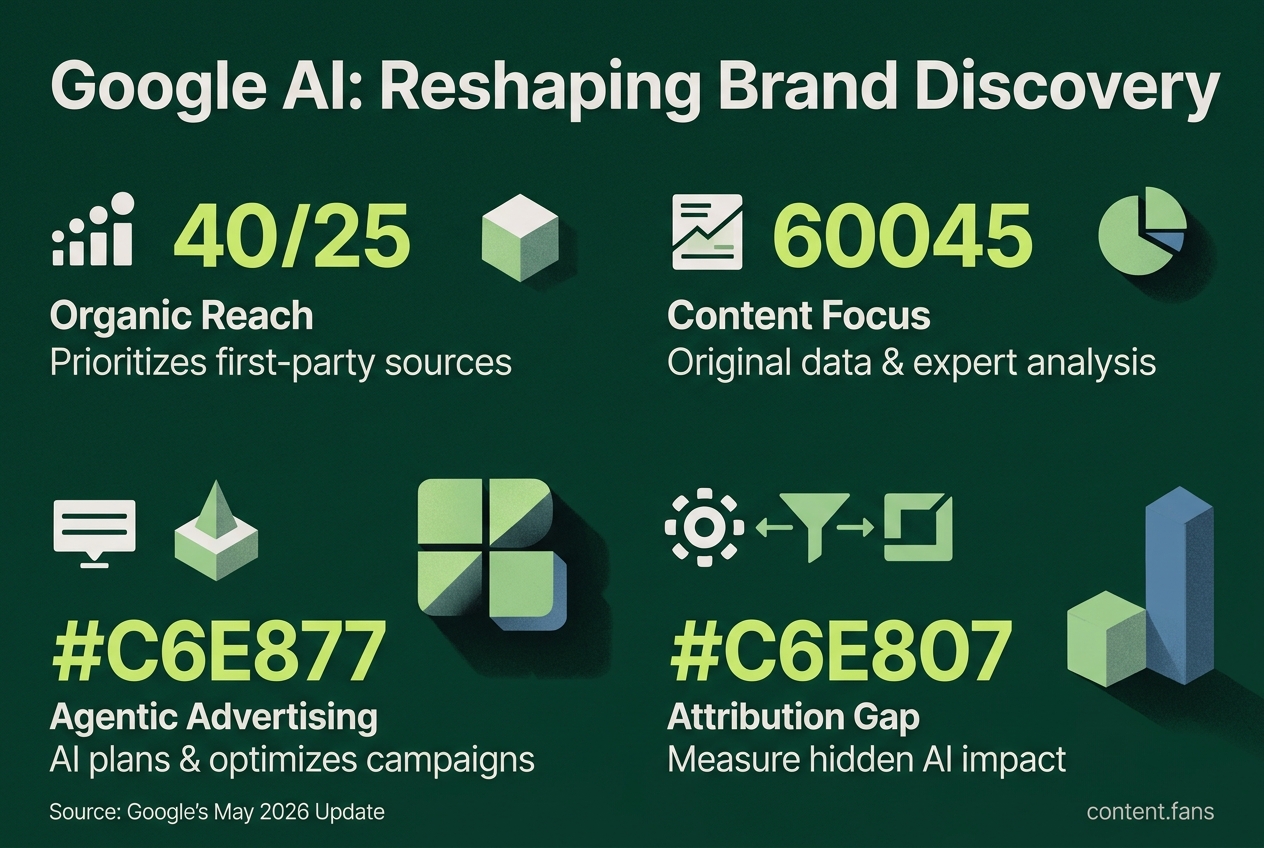
According to industry reports, future updates are likely to favor direct sources over intermediaries. For example, early research cited by AuthorityTech suggests streaming brands could see significant visibility gains while tourism boards may experience substantial losses. This change stems from Google's increased reliance on clear entity signals for its AI Overviews. To adapt, brands must reinforce authoritativeness through strong author bios, credible external mentions, and deep topical expertise, focusing on original data and expert analysis over repurposed content.
Agentic Advertising: From Concept to Campaign Execution
Autonomous AI agents are transitioning from theory to practice, with advertisers deploying them to plan, launch, and optimize campaigns within human-defined parameters. Industry leaders define agentic advertising as AI systems that can "perceive, reason, and execute" complex workflows. While full autonomy is not yet standard, adoption is accelerating. For instance, companies are testing protocols for direct negotiation between buyer and seller agents. Most brands are currently focused on workflow automation, using agents for tasks like reporting and real-time budget reallocation to meet ROAS goals.
Closing the AI Attribution Gap with New Measurement Stacks
Generative AI tools like ChatGPT and Google's AI Overviews influence customers long before a click occurs, creating what experts call the AI attribution gap. To measure this hidden impact, marketers are adopting a layered approach:
- Open-text self-reported attribution on lead forms
- CRM segments tagged "ChatGPT" or similar discovery notes
- Branded search-lift tracking in Google Search Console
- Geo holdout tests to validate incremental lift
- Citation share monitoring inside AI answers
To further enhance data accuracy, professionals recommend using server-side tagging and conversion APIs to improve event data for multi-touch models. Additionally, Marketing Mix Modeling (MMM) tools like Meridian or Robyn can help calibrate overall budget allocation.
The Common Thread: Becoming the Definitive Source
These three trends share a common imperative: brands must establish themselves as the definitive source of information and authority. Success in an AI-driven landscape depends on being the top choice for ranking algorithms, media-buying agents, and revenue attribution models. Companies investing in entity clarity, agent-ready data frameworks, and blended attribution will gain a significant competitive advantage as AI increasingly mediates the customer journey.
What changes are expected in Google's future core updates and why does it matter for brand discovery?
Industry reports suggest future updates will accelerate a clear shift toward direct brand discovery. Google is expected to reward pages that are the original source of a topic, not just the best-optimized middleman. According to industry analyses, streaming services, sports brands, and finance brands may gain visibility, while aggregation hubs like tourism boards and travel OTAs could lose ground. The practical takeaway: entity authority and first-party expertise may outweigh traditional keyword optimization in both AI Overviews and classic blue-link results.
How does "agentic advertising" differ from today's automated or AI-assisted campaigns?
Agentic advertising is the leap from AI-recommendation to AI-execution. Instead of merely suggesting headlines or bids, autonomous agents plan, negotiate, and optimize entire workflows toward a stated objective. Industry pilots suggest agents could reallocate live budgets, swap creatives, and enforce brand-safety rules without human micro-decisions. In testing environments, buyer and seller agents are exploring negotiations through emerging protocols, pointing to a future where media could be bought and sold by AI on both sides of the transaction.
What is the "AI attribution gap" and how can teams close it?
The gap is the invisible influence AI answers have on revenue that never shows up as a clean click. Because users often discover a brand inside ChatGPT or Google's AI Overviews and then arrive via direct or branded search, last-click dashboards may significantly understate AI impact according to industry studies. Use this measurement stack to close the hole:
- Self-reported attribution fields on every form ("Where did you first hear about us?")
- CRM segments tagging leads that mention AI tools
- Incrementality tests and marketing-mix modeling to estimate true lift
- Branded search lift in Google Search Console as a second-order proxy for AI exposure
Why are LinkedIn personal profiles now out-performing company pages?
LinkedIn's algorithm is surfacing expert-led content significantly more often than brand posts. In practice, an individual post from a recognized domain expert reaches more users than the same message from the corporate page. Brands are responding by turning executives into "micro-media" properties - ghost-writing posts, providing topic calendars, and measuring reach under the person's name rather than the logo. The upside is higher organic reach; the risk lies in tying brand equity to individuals who may leave.
With zero-click search becoming increasingly common, what should SEO teams prioritize?
A significant portion of queries now end without leaving Google, so the new SEO KPI is "AI citation share" - how often your brand is named in AI-generated answers. To win that real estate:
- Replace thin listicles with unique data sets, first-hand research, or interactive tools that AI can cite
- Strengthen entity signals - consistent naming, schema markup, and external mentions on trusted sites
- Track citation presence on high-intent prompts instead of obsessing over blue-link rankings
Industry case studies show companies can gain qualified demos despite organic click drops after dominating AI Overviews for comparison queries.