
Google's AI Mode Exceeds 1 Billion Users, Reshaping Search
Serge Bulaev
Google's new AI Mode in Search may be changing how people use the internet, with over 1 billion monthly users since its launch. Instead of just showing links, AI Mode gives chat-like answers and suggests follow-up questions, though users can still use the regular web tab. Reports suggest that most users now get their answers without clicking on outside links, which may be causing less traffic to other websites. There is some concern that this could hurt publishers and change how sites try to appear in search results. While competitors are trying similar things, none seem to have as many users as Google's AI Mode.

Google AI Mode is an AI search experience that exists alongside traditional Search, providing conversational AI capabilities while maintaining the traditional search box. At Google I/O 2026, the company announced significant growth for this new experience, marking a major shift in search behavior. Instead of a list of links, AI Mode provides synthesized answers in a chat panel, though a classic "Web" tab is still available.
How people use AI Mode
Google's AI Mode changes the search experience by delivering direct, AI-generated answers instead of just links. Users engage with longer, more conversational prompts, including voice and image queries. This shift leads to more time spent within Google's interface, as the AI synthesizes information from various web sources.
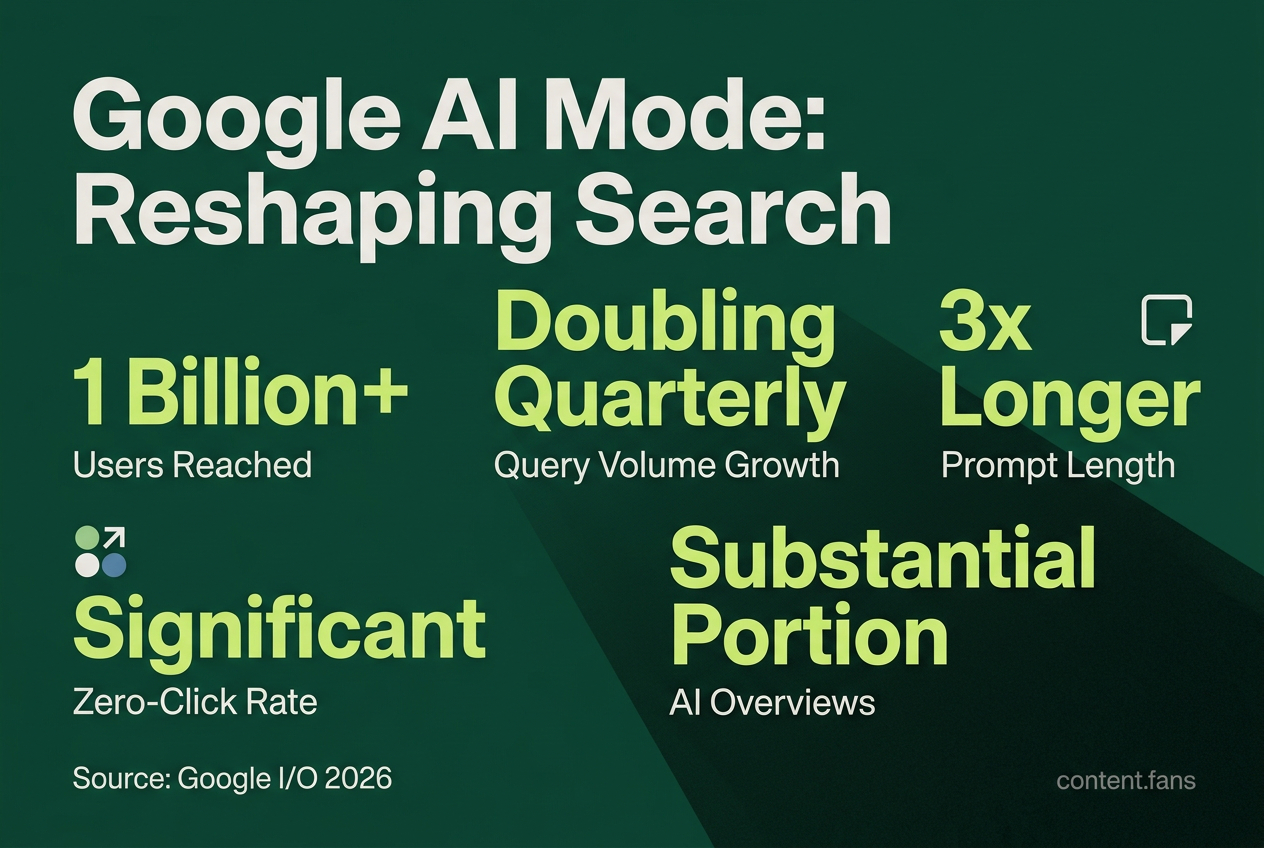
According to Google's VP of Search, Elizabeth Reid, query volume in AI Mode is doubling quarterly. User behavior shows a clear trend toward deeper engagement:
- Longer Prompts: The average prompt is three times longer than a typical keyword search.
- Multimodal Search: A growing number of U.S. searches use voice or images, with image queries showing significant monthly growth.
- High Engagement: Industry reports suggest that a significant portion of searches result in zero-click outcomes, meaning users find their answers without leaving the results page. Meanwhile, AI Overviews appear in a substantial portion of classic search results.
Early impact on publishers and SEO
The high zero-click rate directly impacts organic traffic for publishers, especially those focused on informational content. Industry reports show notable traffic declines for pages that previously ranked for simple questions. This trend has introduced a new strategy called "generative engine optimization" (GEO), where the goal is to be cited within the AI's answer. A new playbook for publishers includes:
- Creating concise definitions and using structured data for easy citation by Google's Gemini.
- Monitoring which content appears in AI answers and adjusting it.
- Diversifying traffic sources beyond search to include email, social media, and direct visitors.
Competitive context
Google's competitors are responding with their own AI-driven search models. Microsoft Bing integrates GPT-powered answers into Copilot while preserving traditional links, and Perplexity emphasizes prominent source citations. Meanwhile, ChatGPT focuses on integrating search into its assistant workflow. While these rivals are innovating, none can match the user scale of Google's AI Mode.
In a move to monetize this scale, Google is testing ads within AI answers, which appear in a significant portion of responses and resemble sponsored content more than traditional ads.
What comes next for users
Google maintains that AI Mode is an additive feature, with the traditional "Web" filter remaining accessible for users who prefer it. The company positions the tool as a faster way to explore topics and get consolidated answers. However, critics argue that because many sessions end without a click, AI Mode risks creating a "walled garden" that traps information within Google's ecosystem. Regardless of the outcome for publishers, massive user adoption, longer prompts, and multimodal inputs signal a lasting shift toward conversational, chat-first search.
What exactly is Google's AI Mode and how does it differ from classic Search?
Google's AI Mode is a conversational layer that replaces the familiar list of blue links with a single, synthesized answer followed by suggested follow-up prompts. Elizabeth Reid, VP of Search, calls it the biggest upgrade to Search in over 25 years. While the classic web filter remains selectable, the default experience now shows AI-generated responses first.
How fast is AI Mode growing?
At Google I/O the company announced significant growth for AI Mode and that queries are more than doubling every quarter since launch. The platform shows strong daily active user engagement, with ads appearing in a substantial portion of AI-generated results.
What impact does this have on website traffic?
Independent studies cited by SEO analysts show:
- A significant portion of AI Mode searches end without a click to an external site
- Organic click-through rates can fall substantially when AI summaries appear
- Published case studies note individual site traffic drops for many sites, especially for informational queries
These figures indicate that classic rank-high-and-earn-the-click SEO is weakening, forcing sites to optimize for being cited inside the AI answer rather than expecting direct visits.
Are rival search engines responding?
Yes, three main competitive reactions are visible:
- Microsoft Bing / Copilot: Keeps traditional ranking visible, then layers AI synthesis on top
- Perplexity: Leads with prominent citations, foregrounding sources before the generated content
- ChatGPT Search: Competes on workflow integration, letting users retrieve and compare without ever entering a classic SERP
This pressure has made citation transparency and source traceability key differentiators.
Can publishers still benefit from AI Mode?
Absolutely. Google's answers frequently pull from:
- Wikipedia, Reddit, YouTube, and independent review platforms
- Structured help docs and comparison tables
Publishing crawlable, authoritative, well-structured content increases the odds of being quoted inside AI Mode. As a result, many teams now track citation visibility rather than just ranking positions, and diversify traffic through email, communities, and direct brand demand to offset any lost organic clicks.