
Google updates Search, Gemini, and YouTube with new AI agents
Serge Bulaev
Google announced updates to Search, Gemini, and YouTube that use new AI agents to handle tasks instead of just giving links. The new Gemini 3.5 Flash model has become the default and is said to be faster and cheaper than older models, though it might not be the best at all tasks. Google also introduced Gemini Spark, which may work as a personal AI agent that helps even when users are offline. The Universal Cart feature lets users shop across Google apps and check out in one place, which could mean less direct traffic to retailer websites. These changes suggest Google wants to make its products more helpful by keeping users in a single, ongoing conversation.

At its I/O keynote, Google announced updates for Search, Gemini, and YouTube, introducing new AI agents to handle tasks directly. This shift moves beyond simple links, creating an agent-first product stack that keeps users in a single conversational flow for a more integrated experience.
AI Mode: Gemini Flash Becomes Default
Google is integrating AI agents across its products to create a unified conversational experience. Gemini Flash now powers a faster AI Mode in Search, while Gemini Spark acts as a persistent personal assistant, and Universal Cart streamlines shopping across Google's platforms, including YouTube and Gmail.
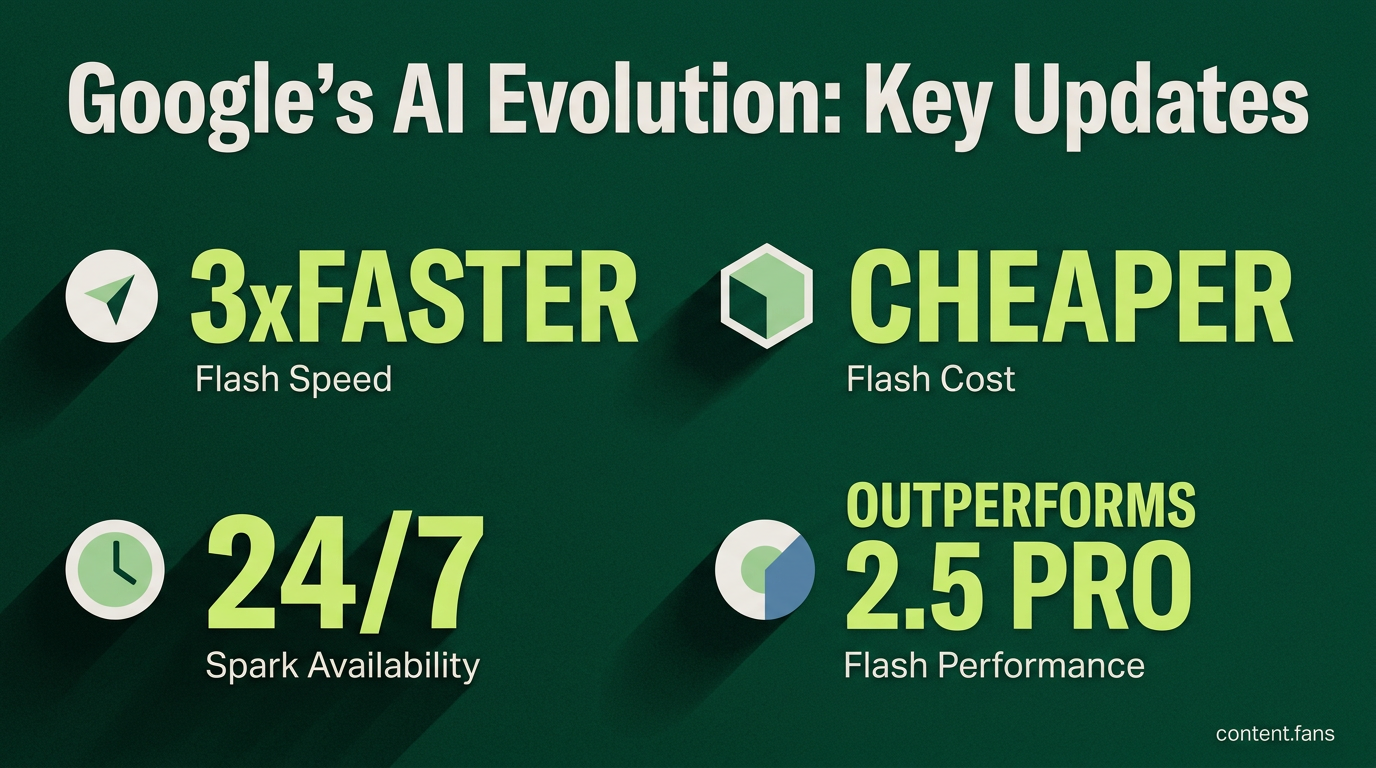
According to industry reports, AI Mode represents Google's enhanced AI Search experience with a significant user base. Google says Gemini Flash is the new default model in the Gemini app and AI Mode in Search, and that it outperforms Gemini 2.5 Pro while being 3x faster and cheaper based on Google/Artificial Analysis benchmarking Google Blog. While independent tests show Flash is significantly faster than competitors, it may lag in complex coding tasks.
The move to a faster, more cost-effective model suggests Google is prioritizing low latency and widespread adoption over leading every performance benchmark. This interpretation is supported by reports that the upgrade is being tested across user segments Engadget.
Google I/O Rebuilds Search and Assistants Around Agents and Gemini Flash
A key feature of the updated AI Mode is its ability to maintain context across devices and applications. Google demonstrated how a single conversational thread can start on a mobile device, continue on a desktop, and conclude within the Gemini sidebar in Google Docs, all without requiring the user to repeat the query. This transforms Search from a simple gateway into an actionable assistant that can summarize content, compare choices, and draft follow-up actions like emails. The focus on reducing cost-per-query over achieving top benchmark scores reinforces the strategy that broad distribution is more critical than raw performance.
Gemini Spark: Toward 24/7 Personal Agents
Google introduced Gemini Spark, a cloud-based personal agent designed to run continuously and proactively. Described as a "24/7 personal AI agent," Spark can perform background tasks like monitoring an inbox for travel confirmations, suggesting calendar appointments, and queuing follow-up actions, even when the user is offline. Because Spark operates from Google's data centers instead of on-device, it can handle long-running processes without impacting battery life. Demonstrations highlighted its persistence, showing a to-do item created in Spark appearing later in Google Tasks and a shopping list automatically populating with historical price data. This persistent context is crucial for enabling proactive agent recommendations.
Universal Cart and the Road to Agentic Commerce
The most significant commerce update is the new Universal Cart, which allows shoppers to add products from Search, Gemini, YouTube, and Gmail into a single checkout experience. This centralized cart can also monitor prices, track inventory, and provide alerts on price drops.
Key benefits for shoppers include:
- A unified shopping cart that works across different merchants.
- Access to real-time price history and automatic restock alerts.
- A streamlined checkout process using Google Pay and other gateways.
This feature is built on the Universal Commerce Protocol, an interoperability standard Google is developing with Amazon, Meta, and Microsoft. This industry collaboration means retailers may need to adapt their data for multiple agent-driven ecosystems. As a result, merchants might experience a decrease in direct website traffic as more of the shopping journey, including payment, takes place within Google's interface.
Competitive Context and Benchmarks
In the competitive landscape, Gemini Flash demonstrates a clear strategy focused on efficiency and scale. According to industry reports, Flash shows competitive performance while maintaining cost advantages over premium models. While other models may maintain an edge in difficult coding benchmarks, Google's emphasis is clearly on throughput and broad distribution.
Industry analysts view these updates as Google's most substantial change to search in years. By embedding features like Universal Cart directly into the user experience, Google moves closer to the point of transaction, capturing valuable data for advertising and recommendations while keeping users within its ecosystem.
What is AI Mode and how does the new Gemini Flash improve it?
Google calls AI Mode its enhanced AI Search experience, used by a significant number of users each month. In the latest update revealed at Google I/O, AI Mode now runs on Gemini Flash by default. Google says this model delivers improved performance at 3x the speed and lower cost compared to Gemini 2.5 Pro, cutting latency and serving charges for every query. Early benchmarks show Flash streaming tokens at significantly faster speeds compared with competitors, making long, context-heavy searches feel almost instant. The upgrade also adds multimodal inputs and persistent conversational memory, so users can continue a previous search thread without starting over.
What exactly is Gemini Spark and how is it different from today's voice assistants?
Gemini Spark is a 24/7 cloud-based personal AI agent. Unlike today's assistants that wait for a wake word or app launch, Spark is described as always on, running tasks in the background while you work in Search, YouTube, Gmail, or any Google surface. Example scenarios from the keynote include Spark tracking a price drop on a product you glanced at last week, pinging you when it restocks, or composing and sending follow-up emails while you focus elsewhere. Google stresses that Spark is not a simple chatbot; it is designed for proactive, long-running workflows that persist across sessions and devices.
How does Universal Cart change the way we shop online?
Universal Cart is a single, intelligent shopping hub that follows you across Google services. You can add items while browsing Search, chatting with Gemini, watching YouTube or reading Gmail, and everything lands in one cart powered by Google Pay and new Universal Commerce Protocol (UCP). The system also monitors price changes, price history and restocks, alerting you when it is time to buy. During the demo, Google showed a user adding a jacket from a small Shopify store, a TV from Best Buy and a phone from Amazon into the same checkout flow without ever leaving Google.
Why did Google partner with Amazon, Meta, and Microsoft on Universal Cart?
The partnership signals a rare cross-company agreement to create shared commerce primitives rather than each giant building closed ecosystems. By co-developing UCP and the related Agentic Payments Protocol (AP2), the four companies aim to standardize how AI agents access inventory, pricing, and payment rails across their platforms. For users, this means the Universal Cart can eventually surface products from multiple merchants in a single comparison view, regardless of which company owns the site. For brands, the collaboration reduces the need to maintain separate integrations, but it also moves more of the purchase journey onto the platforms, potentially lowering direct site traffic.
What should retailers and marketers do to prepare for agent-driven commerce?
- Feed quality over volume. Agents rely on structured data; incomplete feeds risk zero visibility.
- Prepare for less direct traffic as AI Mode and Spark surface products inside Google rather than sending users to websites.
- Opt into UCP early to stay eligible in agentic shopping flows across Google, Amazon, Meta and Microsoft.
- Embrace dynamic pricing because price-history transparency will pressure margins unless inventory is optimized in real time.
- Think multi-agent, because the same product may be compared inside Google, Amazon or Meta simultaneously, each with different ranking rules.