
Google unveils Gemini 3.5 Flash, new AI Mode, and Universal Cart at I/O
Serge Bulaev
Google announced new AI tools at I/O 2026, including Gemini 3.5 Flash, Default AI Mode, Gemini Spark, and Universal Cart. The new Gemini 3.5 Flash may respond faster and at a lower cost but shows mixed results in different intelligence tests. Default AI Mode and Gemini Spark appear to change search by using AI agents that can monitor information and help across devices. Universal Cart lets users keep their shopping carts across Google services, and industry collaborations may set new standards for AI-powered shopping. Some features, like autonomous purchases with AI, might take time as businesses need to adopt them.

Google unveiled Gemini 3.5 Flash at I/O 2026 and made it the default model for the Gemini app and AI Mode in Search. The keynote signaled a major strategic shift from simply answering user queries to proactively completing tasks using a new generation of AI agents.
These announcements reveal a clear strategy: integrate persistent, agentic AI throughout the Google ecosystem, with a focus on managing performance and operational costs.
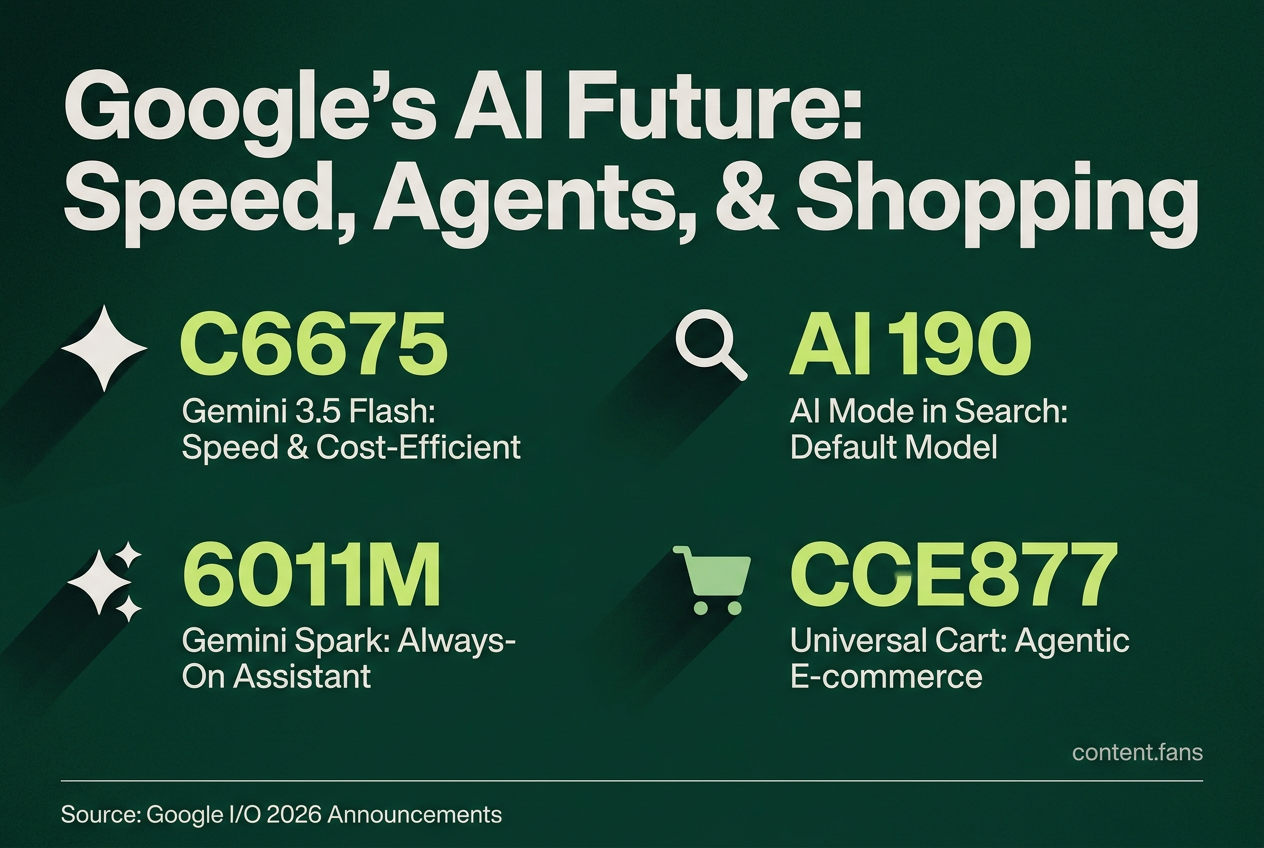
Gemini 3.5 Flash Targets Speed and Efficiency
Gemini 3.5 Flash is Google's latest AI model, optimized for speed and cost-efficiency. While Google claims intelligence comparable to Opus 4.7, benchmarks show mixed results. Flash excels in speed and certain coding tasks but may trail in others, representing a trade-off between reasoning ability and real-time performance.
According to industry reports, Google positions Gemini 3.5 Flash as delivering significant performance improvements with enhanced speed and substantial cost reductions over previous Gemini models. Internal benchmarks suggest Flash performs well on many coding and reasoning tasks, though performance varies across different evaluation metrics compared to competing models like Claude Opus 4.7.
This mixed performance was confirmed by independent analysis. Industry evaluations report Flash showing competitive performance metrics, with particularly strong throughput capabilities for coding applications. Analysts conclude that Google has prioritized speed for real-time applications over achieving the highest scores on all reasoning benchmarks.
AI Mode and Gemini Spark Redefine the Search Experience
Google Search is evolving with Default AI Mode, which transforms queries by breaking them into subtopics, performing parallel searches, and synthesizing a comprehensive answer instantly. Citing a technical recap from Marie Haynes, this happens before a user even scrolls. Google's own 2026 blog post reveals that users can now create persistent search agents to monitor topics "24/7" and receive updates automatically.
Gemini Spark builds on this concept, creating an always-on assistant that functions across devices to manage complex tasks like planning and price tracking. This shift moves the user experience from discrete search sessions to a state of continuous, ambient assistance. As Constellation Research notes, Google is effectively building a "universal AI assistant" that integrates with Android, Meet, and commerce, positioning Gemini Spark as the unifying fabric for its services, not just another chatbot.
Universal Cart Brings Agent-Powered Shopping to Life
The new Universal Cart introduces agentic logic to e-commerce, with several key features announced at I/O:
- A persistent shopping cart that syncs across all Google services.
- Automated deal tracking and product compatibility checks.
- A streamlined checkout process integrated with Google Wallet and the Universal Commerce Protocol (UCP).
- An international expansion plan starting with Canada and Australia, followed by the UK.
Google emphasized that Universal Cart is a proprietary service, but it's built upon the open Universal Commerce Protocol (UCP). A newly formed UCP Tech Council, which includes Amazon, Meta, Microsoft, Salesforce, and Stripe, will govern the standard. According to PPC Land, the council aims to create standards for "how AI agents interact with businesses," suggesting a focus on protocol governance over a unified retail platform.
Furthermore, industry analysts point to the upcoming Agent Payments Protocol (AP2) update as a key enabler for autonomous purchases by AI agents. While Google plans to integrate AP2 soon, a broad rollout depends on merchant adoption, and specific timelines have not been released.
What exactly is Gemini 3.5 Flash and how does it compare to Claude Opus 4.7?
Gemini 3.5 Flash is Google's new speed-focused large-language model that the company says reaches competitive intelligence levels while running significantly faster and costing substantially less than earlier internal baselines. Independent evaluations show a mixed picture across different benchmarks, with Flash showing strong performance in some areas while Claude Opus 4.7 maintains advantages in others.
In short, Flash wins on raw speed and some coding tests, but does not universally beat Opus 4.7 on every reasoning task.
How will the new default AI Mode change the way I use Google Search?
AI Mode replaces the traditional "10 blue links" entry point with an agent-first interface:
- Queries are broken into subtopics, searched in parallel, and answered in a single AI-generated response
- Follow-up questions feel conversational rather than keyword-based
- Background agents can monitor topics 24/7 and push updates to your results page
Early user tests show a significant reduction in query reformulation, hinting that people find what they need faster.
What is Gemini Spark and when will it be available?
Gemini Spark is the always-on agent layer inside the Gemini app. It can:
- Chain multi-step tasks (e.g., plan a trip, reserve a table, send invites)
- Run continuous price watching and auto-buy if you set rules
- Operate across Search, Gmail, YouTube, and Calendar from a single chat thread
Google says Spark will enter public beta this summer in the U.S. with plans for broader device integration.
Is Universal Cart a joint product with Amazon, Meta, and Microsoft or a Google-only service?
Universal Cart is built and operated by Google, but it relies on the Universal Commerce Protocol (UCP) - an open standard whose Tech Council now includes Amazon, Meta, Microsoft, Salesforce, and Stripe. The distinction matters:
- Shoppers see one Google cart that pulls items from Search, Gmail, and YouTube
- Retailers implement UCP endpoints so agents can add, price-check, and purchase on your behalf
- Each council member can surface their own UCP-ready carts; Google is simply the first to market with a consumer front-end.
Does the shift to agentic search raise any privacy or safety flags?
Google acknowledges three active review areas:
- Purchase authorization - AP2 protocol demands biometric or Wallet PIN confirmation for any payment
- Data scope - Spark accesses personal content (Gmail, Calendar) only after tier-2 OAuth consent per task
- Monitoring fatigue - early testers created multiple background agents on average, prompting Google to add a unified "agent dashboard" so users can pause or delete tasks in one place
No widespread security incidents have been reported since the limited rollout began, but enterprise-grade compliance audits are still under way.