
Google unveils "faithful uncertainty" to curb AI hallucinations
Serge Bulaev
Google has introduced "faithful uncertainty" to help AI give clearer signals about when its answers may not be trustworthy. This method checks if the AI's confidence matches how certain it sounds and may insert phrases like "I'm not fully certain" when needed. Early tests suggest it can cut down on wrong but confident answers by about one-third, though some mistakes still happen. Experts say this method is still new and should be used with other safety steps like human review. Researchers suggest that combining different techniques may be the best way to avoid errors, but more studies are needed.

Google is tackling AI hallucinations with a new technique called faithful uncertainty, a method designed to make AI models more transparent about their own confidence. This approach provides developers with a clearer signal to determine when an AI-generated answer can be trusted, hedged, or requires human review. It marks a significant shift from simple refusals to a more nuanced expression of confidence.
The methodology has been explored in recent research on faithful uncertainty in large language models. Researchers define faithful uncertainty as the discrepancy between a model's internal probability that its answer is correct and the confidence conveyed by its choice of words. During experiments, models like Gemini Ultra frequently expressed high confidence even when their internal certainty was low.
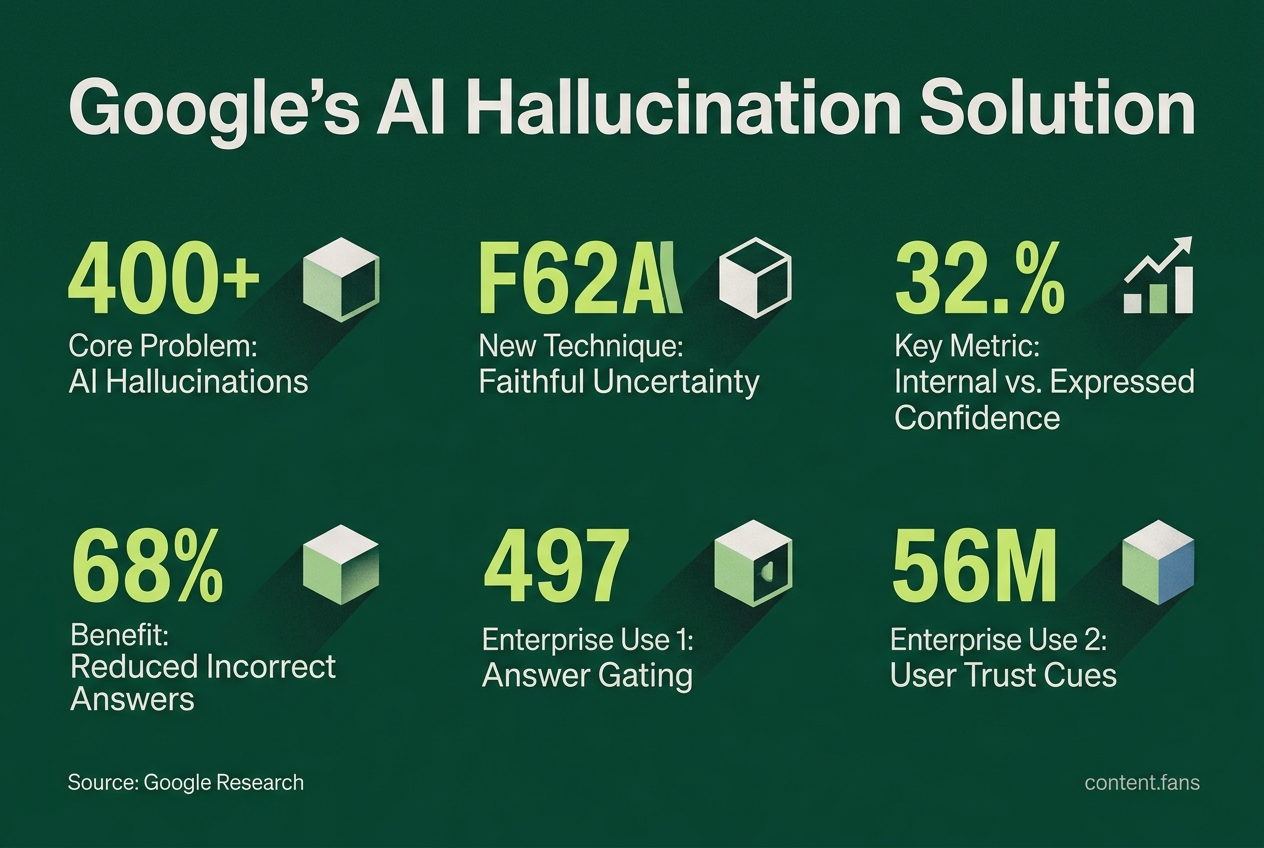
To correct this, the system learns to align its language with its internal confidence score. When a mismatch is detected, the model is trained to insert hedging phrases like "I'm not fully certain" or to abstain from answering. A subsequent project, MetaFaith, further explores using prompt-level controls to achieve this calibration without needing to retrain the base model.
Early performance signals
Faithful uncertainty is a technique that measures the difference between an AI's internal confidence in an answer and the confidence expressed in its language. By identifying and reducing this gap, the system learns to insert hedging phrases or abstain, providing a more transparent and reliable signal of trustworthiness.
Initial results from recent research are promising:
- On a specialized version of the PopQA benchmark, calibrated models showed significant reductions in confidently incorrect answers.
- The use of explicit uncertainty tokens led to improvements in Brier score, indicating better-calibrated probability assessments.
These metrics show the mechanism can effectively reduce hallucinations without resorting to blanket refusals. However, the system is not foolproof; "high-certainty hallucinations," where the model is both highly confident and incorrect, can still occur.
Enterprise relevance and current limits
For mission-critical applications, industry guidance still prioritizes established methods like retrieval-augmented generation (RAG) and human-in-the-loop verification. Faithful uncertainty is currently in the research phase, with no large-scale production case studies published.
However, analysts identify three key potential integration points for enterprise workflows:
- Answer Gating: Automatically routing low-confidence answers to a human expert or a traditional search query.
- User Trust Cues: Displaying calibrated hedge language to end-users so they know when to be skeptical and double-check information.
- Autonomous Agent Safety: Preventing AI agents from taking actions based on claims with low internal support.
This approach of calibrated confidence helps balance safety with utility. As noted in a developer newsletter, forcing AI models to refuse answers can "hide answers the model actually has." Faithful uncertainty offers a middle ground, though a key challenge remains in tuning confidence thresholds for specific domains.
Comparison with existing mitigation tactics
Faithful uncertainty complements existing hallucination mitigation tactics rather than replacing them.
| Technique | Strength | Trade-off |
|---|---|---|
| Retrieval Grounding | Provides verifiable, document-level evidence | Adds latency and depends on the quality of the knowledge corpus |
| Best-of-N Reranking | Simple to implement for a solid accuracy boost | Incurs higher computational costs |
| Faithful Uncertainty | Reduces confident errors without an external knowledge base | Can be vulnerable to model miscalibration and high-certainty errors |
Researchers stress that no single technique is a silver bullet. The most robust strategy involves a layered defense, combining faithful uncertainty with retrieval grounding and post-generation verification. While this layered approach is considered the most reliable path forward, comprehensive peer-reviewed studies validating such a stack are still emerging.
Looking ahead, the next frontier in AI safety is developing a unified policy layer that can dynamically decide whether to answer, cite sources, or abstain based on real-time confidence scores. Until that technology matures, faithful uncertainty stands out as a promising and essential addition to the modern AI hallucination-mitigation toolbox.
What does "faithful uncertainty" mean in practice?
Google's new technique trains a model to give calibrated best guesses while openly flagging its own uncertainty. Instead of the old "answer or refuse" rule, the system estimates its confidence and phrases the reply accordingly (e.g. "I'm 90 % sure that …"). This turns hallucinations from hidden risks into transparent, risk-scored information that humans can decide to trust or verify.
How is it different from the refusal-based approaches I already use?
Traditional refusal lets a model say "I don't know" when confidence is low. That sounds safe, but studies show LLMs sometimes refuse answers they actually know, wasting value. Faithful uncertainty avoids this trap by offering qualified answers rather than blanket refusals, so users keep usable results while still seeing the confidence score attached.
Does "faithful uncertainty" eliminate hallucinations completely?
No. The method is calibration-sensitive: it works best when the model's internal confidence is accurate. Research highlights that "high-certainty hallucinations" (cases where the model is wrong but still confident) are not fully eliminated by any single technique today. Enterprises should therefore treat faithful uncertainty as one layer of defense, not a silver bullet.
Is the feature ready for production use in enterprise stacks?
Current evidence shows the concept is still research-stage. Enterprise deployments currently rely mainly on retrieval grounding, governed data pipelines, and human-in-the-loop review to combat hallucinations. Google has not yet announced a public API or SLA-backed service for faithful uncertainty; early adopters should plan for internal pilots rather than immediate full-scale rollouts.
Where does it fit in my existing anti-hallucination toolkit?
Layer it after retrieval and before user delivery:
- RAG / knowledge bases anchor facts.
- Faithful uncertainty layer decides: answer, hedge, or escalate.
- Human review or reranking handles edge cases.
Benchmarks suggest this stack can reduce false-positive refusals significantly compared with hard-abstain policies, while keeping real hallucination rates flat.