
Google Pays Publishers for AI Answers in New Pilot Program
Serge Bulaev
Google has started paying about 100 publishers for content used in its AI answers, in a new pilot program. Publishers receive money only if Google decides their articles contribute significantly to answers, and the payment formula remains secret. Some large publishers have earned over a million dollars, while some smaller sites report receiving less than $1,000, which suggests deals may be tailored case by case. Terms are confidential, and it is unclear if the payments make up for possible lost website traffic. The future of the program may depend on whether Google shares more about how it values content and if it opens payments to more publishers.

In a major policy shift, Google now pays publishers for AI answers through a new pilot program, abandoning its long-held stance that referral traffic was sufficient compensation. An internal briefing reported by MediaPost reveals that a significant number of publishers are part of this experimental "AI contribution pilot."
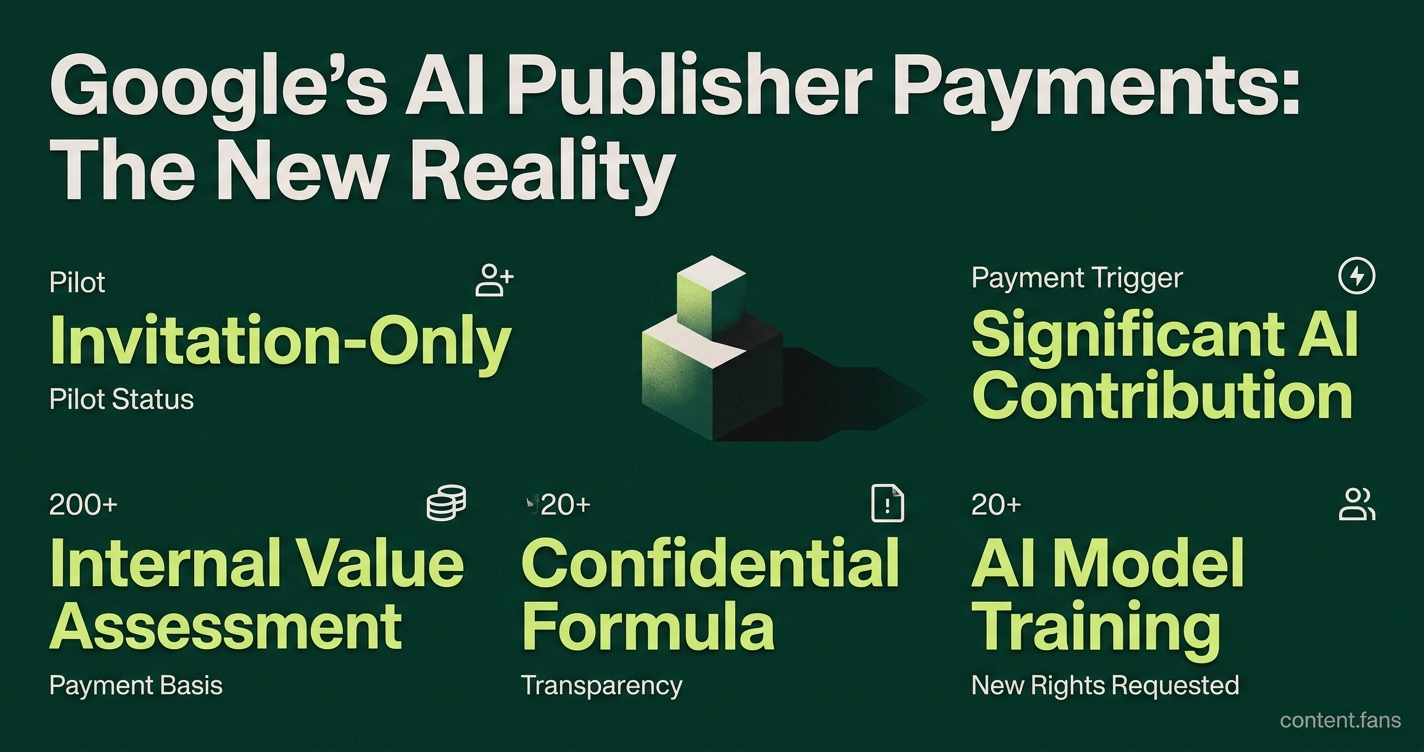
This invitation-only pilot functions as a test, not a public program. Payments are triggered only when Google determines an article has made a "significant contribution" to answers generated by its AI tools, including Gemini and AI Overviews. This model points to an experimental, value-based licensing system rather than a flat-fee structure.
How the pilot pays and what is unclear
Google's pilot pays publishers based on an internal, secret valuation of their content's contribution to AI answers, not traffic. Payouts are highly variable, with some large outlets earning substantial amounts annually while many smaller sites receive minimal compensation across several months.
According to Digiday, payouts are determined by an internal value assessment, not query volume. While publishers can view their monthly earnings in Search Console, the underlying formula and weighting metrics remain confidential, making the system opaque.
This lack of transparency is compounded by vast payment disparities. A few major publishers reportedly earn significant amounts annually, while some midsize sites receive minimal compensation over several months. This suggests Google may be tailoring deals individually, possibly using the payments as leverage in other negotiations.
Existing channels and new rights requests
The AI contribution pilot operates in parallel with existing agreements like Google News Showcase, which already compensates thousands of publications. However, sources note Google is now bundling these AI payments into "commercial partnerships" that request broader rights, including the use of content for training its AI models.
With confidential terms, publishers cannot determine if the payments adequately compensate for potential traffic loss caused by AI summaries. This concern is echoed in recent industry discussions, which warn that Google can monetize these AI-driven search sessions while the original content creator loses valuable page views.
Reported compensation models
- Flat annual fee tied to display rights.
- Contribution-based payout when content is used in AI answers.
- Bundled commercial partnerships that mix cash with extended AI usage rights.
Competitive and regulatory backdrop
In response, competitors are advocating for greater transparency. Cloudflare, for example, is pushing for crawler separation, which would allow publishers to differentiate between standard search indexing and AI data scraping. This highlights a key market tension: Google's control over both data and distribution, versus rivals who must license content more openly.
While Google positions the pilot as an "early-stage learning" initiative, regulators may see the payments as proof that publisher content has a quantifiable value within AI products. If payouts remain low while traffic declines, lawmakers could deem the voluntary program insufficient and push for stronger regulation.
The publishing industry is divided. Large media companies receiving substantial payments are reportedly more receptive to private deals. In contrast, smaller outlets receiving negligible sums are more inclined to pursue collective bargaining or regulatory solutions.
The future of publisher compensation in the AI era will likely depend on two factors: whether Google offers transparency into its value metrics and if it expands the program beyond the current invite-only group. Until then, the true economic impact of AI-generated answers on publishers remains uncertain.
What is Google's new AI payment pilot program?
Google has launched an experimental "AI contribution pilot" that marks a significant shift from its long-standing position that sending traffic to publishers was adequate compensation. The program pays participating publishers when their content "contributes significantly" to AI-generated answers across Gemini, AI Overviews, and AI Mode. Unlike traditional search referrals, these are direct payments based on value rather than raw usage or clicks.
How much are publishers actually earning from this program?
Reported payouts vary dramatically and have drawn criticism for being uneven and opaque. While some larger publishers have allegedly earned substantial amounts annually, many smaller participants have received minimal compensation over several months. The program operates through Search Console, where publishers see monthly earnings but no detailed formula for how contributions are calculated, making it difficult to predict or verify payments.
Why did Google change its position on paying publishers?
Google's shift from "traffic is payment" to direct compensation reflects multiple pressures: competitive moves by other AI companies signing licensing deals with publishers, ongoing regulatory scrutiny over how AI search features monetize third-party content, and publisher complaints about traffic declines from AI Overviews. Industry discussions have noted that search sessions can be monetized by Google while publishers receive reduced traffic or no visit - framing the economic tension that underlies this policy change.
How are competitors responding to Google's approach?
Competitor reactions have focused on transparency and structural reform rather than matching Google's opaque model. Cloudflare has pushed for crawler separation - distinguishing between search crawling and AI training data collection - plus effective attribution and detailed engagement metrics so publishers can evaluate true value. This contrasts with Google's discretionary, black-box approach. Other AI firms have pursued more explicit licensing arrangements with publishers, establishing clearer commercial frameworks.
What does this mean for future publisher negotiations and regulation?
The pilot is likely to reshape negotiations in several ways: pushing for more individualized deals based on Google's case-by-case value assessments, increasing demands for transparency around contribution calculations, and potentially triggering greater regulatory scrutiny if traffic declines continue while compensation remains minimal. The program may also split publisher coalitions - larger outlets receiving meaningful payments may favor negotiated partnerships, while smaller publishers could push for collective remedies or regulation. Google's move can be framed either as a voluntary market solution or as tacit acknowledgment that publisher content holds measurable value in AI outputs, strengthening arguments for mandatory compensation frameworks.