
AI orchestration market expands to $26.8 billion by 2029
Serge Bulaev
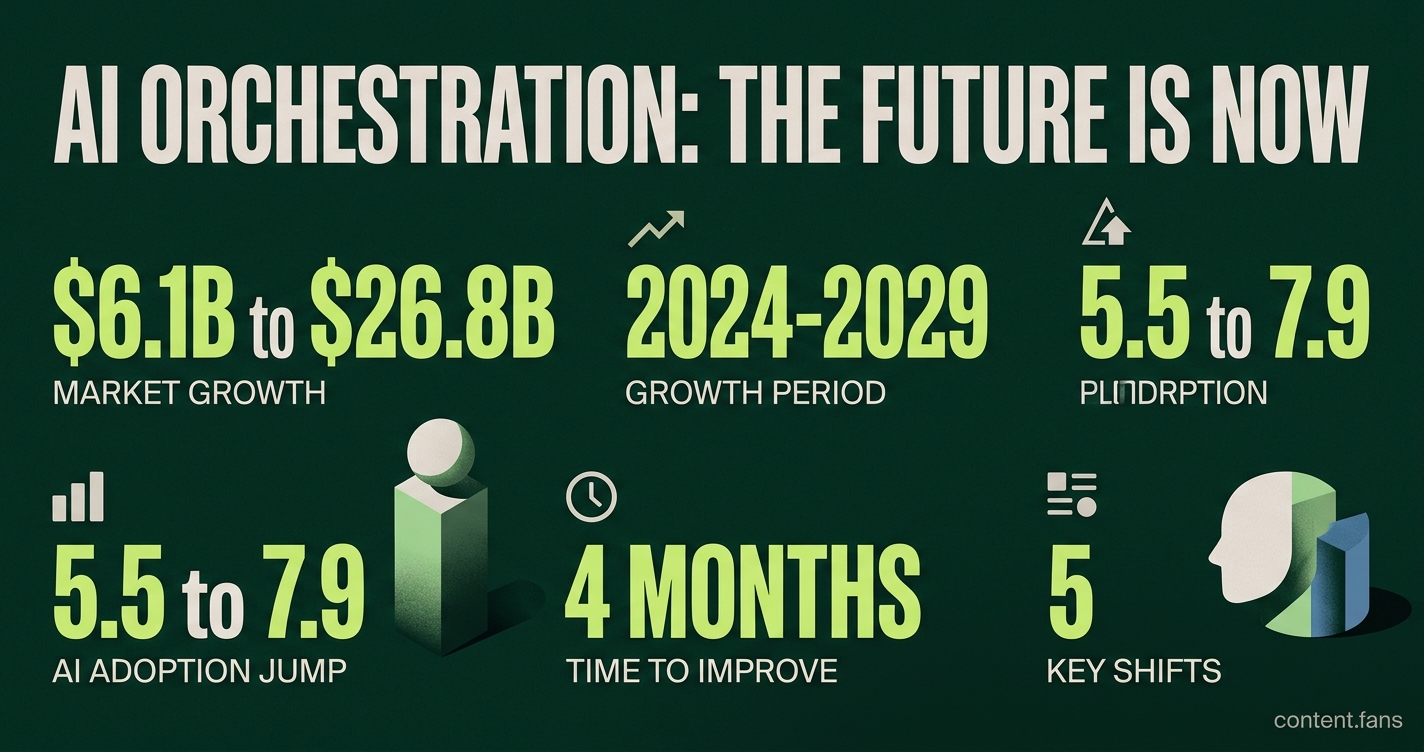
Arielle Shipper's experience suggests moving from simple AI prompts to using many coordinated AI agents may help improve workflow and results. Industry reports indicate the AI orchestration market might grow from $6.1 billion in 2024 to $26.8 billion by 2029, as more companies use multi-agent systems with strong governance. Teams that use orchestration report shorter process times and fewer mistakes. Following a regular feedback loop - assessing, reviewing, and improving - appears to help users and teams reach higher levels of AI adoption.

As the AI orchestration market prepares for explosive growth from $6.1 billion in 2024 to a projected $26.8 billion by 2029, businesses are rapidly moving from isolated AI prompts to sophisticated multi-agent systems. The documented experience of Arielle Shipper provides a practical blueprint for this transition. By implementing structured feedback loops, Shipper advanced from Level 5.5 to 7.9 on the Every guide's framework for AI adoption in just four months. This report analyzes the methods she used, their alignment with enterprise automation trends, and why governed orchestration is now a cornerstone of modern AI strategy.
From Single Prompts to Orchestrated Teams
The shift from single prompts involves creating a core orchestrator that decomposes large goals, routes subtasks to specialist agents, and uses a separate verifier to ensure quality. In a practical example, Shipper used an orchestrator for a Stripe revenue analysis that delegated work to three distinct agents: one to extract data, one to validate row counts, and a third to build a final workbook. This model aligns with what a Deloitte report defines as "agent orchestration," where role-specific agents coordinate, share context, and log their actions.
AI orchestration is the practice of coordinating multiple specialized AI agents to complete complex goals. An orchestrator agent breaks a primary task into smaller parts, assigning each to a specialist for functions like data extraction or analysis. This multi-agent system improves efficiency, handles errors, and maintains context.
Five Shifts That Accelerated Progress
Each shift tightened the feedback loop between user and AI, leading to clearer prompts, faster cycle times, and fewer manual corrections.
- Assessment: Used an AI to benchmark her current adoption level and pinpoint specific weaknesses.
- Recommendations: Requested actionable steps from the AI to advance to the next level.
- Guided Implementation: Leveraged agents to generate step-by-step instructions and code samples for new processes.
- Recurring Review: Implemented a weekly report to grade output quality and identify performance drift.
- Durable Fixes: Created a
/self improvecommand to save learnings and ensure future sessions started with updated rules.
Why Orchestration Is Gaining Traction in 2025
Industry data confirms the enterprise shift toward governed, multi-agent systems. Market studies project the AI workflow orchestration sector will climb from $6.1 billion in 2024 to $26.8 billion by 2029. Organizations that have deployed orchestration report significant reductions in process cycle times. This trend is driven by the demand for built-in governance and audit trails to prevent "agent sprawl" - the uncontrolled proliferation of unmanaged AI agents.
Implementing a Self-Improving AI Feedback Loop
Effective long-term AI performance relies on a closed-loop feedback system: generate, critique, revise, and log improvements. Shipper's workflow automated this cadence by having the orchestrator perform a weekly critique of its own performance, identifying strengths, errors, and high-impact improvements. While human oversight remains critical, this systematic self-correction ensures continuous refinement.
Practitioners can begin implementing this model with a simple recurring prompt, such as asking the system to review recent outputs, identify errors, and propose experiments to fix them. The evidence from both individual journeys and enterprise studies is clear: a combination of consistent assessment, governed orchestration, and scheduled self-improvement is the most effective strategy for advancing AI capabilities while maintaining control and quality.