
7 Questions Help Companies Truly Transform With AI Agents
Serge Bulaev
Solis and Wright suggest that companies should ask seven key questions before using AI agents, to make sure they really improve work instead of just speeding up old processes. Their advice includes mapping real workflows with employees, so hidden steps and problems can be fixed, not repeated. They say freed-up time from automation might be used for more valuable tasks, instead of cutting jobs. Building trust, setting clear rules, and making sure agents are treated like team members may help organizations move from simple automation to real transformation.

To ensure AI agents truly change work instead of just accelerating outdated processes, leaders can follow the "7 Questions to Ensure Organizations Transform - Not Just Automate - With AI Agents." This framework from Brian Solis and Dave Wright urges executives to redesign workflows before any pilot, involving employees who understand the hidden steps in official processes (Before you put AI agents to work, redesign the work). Their guidance rests on a bi-modal strategy of improving existing work while simultaneously pursuing new value, all while building a foundation of employee trust and clear governance.
Why the seven questions matter
These questions force organizations to move beyond simple automation by focusing on strategic outcomes. They help leaders map actual workflows, identify hidden inefficiencies, plan for redeploying human talent to higher-value tasks, and establish governance to build trust before deploying AI agents at scale.
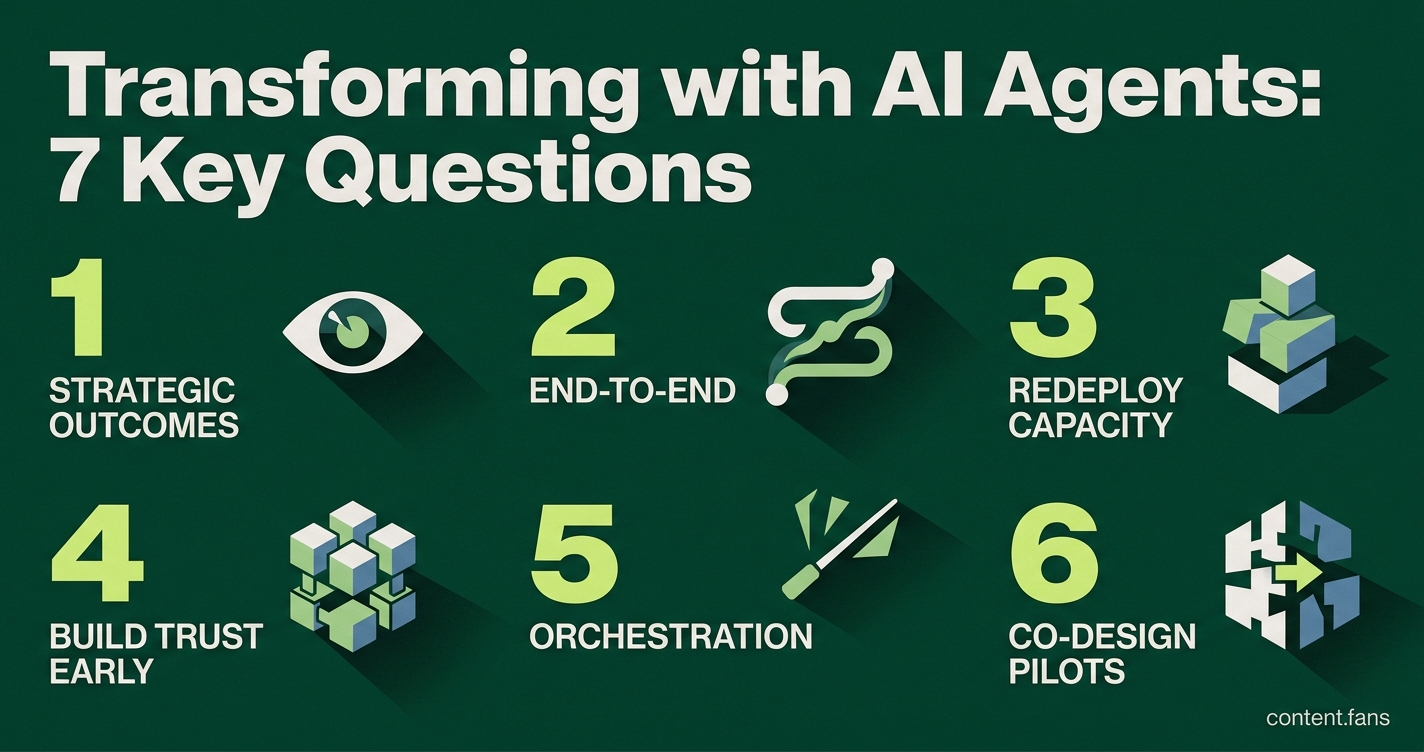
Without this strategic foresight, many companies simply plug AI agents into inefficient processes, which only replicates existing defects faster. Solis and Wright recommend mapping real end-to-end workflows with employees to uncover hidden approvals and workarounds. This allows leaders to strategically redeploy the capacity freed by automation toward higher-value initiatives instead of defaulting to headcount reductions. Furthermore, asking governance questions early establishes essential checkpoints for privacy, data rights, and escalation, ensuring trust is built into the system from the start.
7 Questions to Ensure Organizations Transform - Not Just Automate - With AI Agents
- What customer, employee, or business outcome are we improving?
- How does the real end-to-end workflow operate, including informal steps?
- Where will freed capacity be redeployed to create new value?
- Which agent actions are autonomous, which require approval, and which are prohibited?
- Who owns data access, privacy compliance, and ongoing monitoring?
- How will we measure performance beyond productivity, for example innovation or customer satisfaction?
- What training and feedback loops enable employees to critique and improve agent output?
From question list to daily practice
Putting these questions into practice requires shifting leadership from supervision to orchestration. Solis suggests that employees should co-design pilot programs, define escalation rules, and test prototypes in rapid cycles. Early involvement from front-line experts can significantly boost adoption rates. This operationalizes the two-mode strategy: Mode One enhances existing work with AI, while Mode Two invents entirely new workflows and services. Leaders must decide which mode applies to a use case before committing resources.
Governance and trust boundaries
Solis and Wright stress the importance of establishing three clear boundaries before any AI agent is deployed: Competence, proving the agent can perform reliably; Trust, ensuring its reasoning and data are transparent and auditable; and Delegation, defining explicit limits on autonomy with human override points. Aligning with frameworks like ISO 42001 or the NIST AI RMF helps create 'legible and governable agents' with named owners. Ultimately, as Solis concludes, workforce trust grows when agents are treated like teammates with job descriptions and performance metrics, a principle core to his argument that AI agents won't transform work until humans trust the work. This perspective is the key to pivoting from automation to transformation.