
Gartner: Global AI Spending Jumps 47% to $2.59 Trillion in 2026
Serge Bulaev
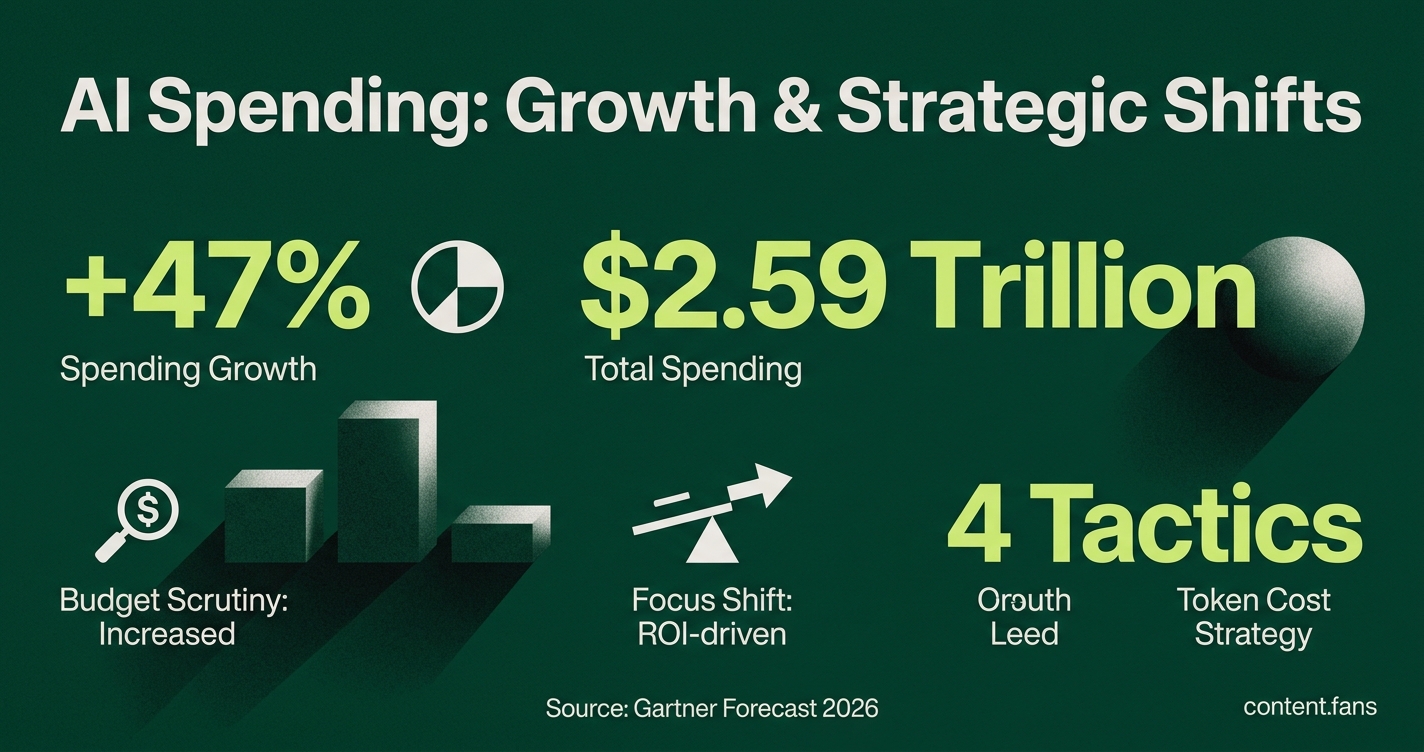
Global AI spending may rise 47% to $2.59 trillion in 2026, according to Gartner, even as businesses look for more value and become cautious with their investments. Many companies are focusing on proven uses and optimizing costs, often choosing standard models instead of the most advanced ones. Spending appears to be shifting toward infrastructure and tools that show clear returns, with strict controls on experimental projects. Experts suggest that companies are using different ways to cut costs, such as routing simple tasks to cheaper models and reducing unnecessary outputs. There may be challenges ahead, like rising token use, high switching costs for hardware, and a need for strong tracking tools to manage spending.

Global AI spending is projected to climb 47% to $2.59 trillion by 2026, even as businesses adopt a more cautious approach to their investments. According to a Gartner forecast, this growth is driven by a strategic shift away from pure experimentation toward AI infrastructure and use cases with measurable returns. As CFOs demand proof of value, many companies are replacing open-ended pilots with tightly scoped deployments. This sentiment is echoed by SAP CEO Christian Klein, who noted, "We don't need to always use the best, best model from an outcome perspective" during a recent keynote address.
Budget Growth Meets Scrutiny
Despite increased budget scrutiny, enterprises continue to boost AI investments because the focus has shifted. Spending is now directed toward core infrastructure and proven applications like internal copilots and automation, which offer clear, trackable returns on investment within a short timeframe, justifying the rising costs to finance leaders.
Research shows a growing number of enterprises now dedicate a significant portion of their ICT budget to AI, with many planning further increases. This growth is sustainable only when tied to clear returns. As a result, spending is shifting toward AI-optimized servers, networking, and governance tools, which comprise a substantial portion of the market. Finance leaders are redirecting capital from unfocused pilots to projects with quarterly trackable ROI, such as internal copilots and customer-facing automation.
Tactical Levers to Tame Token Bills
While individual token prices have fallen, overall token expenditures are rising, largely because agentic AI systems can use significantly more tokens than a simple chatbot. To manage these expenses, enterprises are using a toolbox of cost-control tactics:
- Model Routing: Routing simple tasks to less-advanced models can cut spending substantially.
- Prompt Caching: Reusing static input prefixes can reduce repeated input tokens significantly.
- Output Control: Trimming verbose model answers can cut output token usage considerably.
- Batching: Using asynchronous calls and batching for high-throughput tasks can lower per-token charges substantially.
These strategies help shift the key metric from cost-per-token to cost-per-resolved-task, enabling teams to select more economical models for routine jobs.
Standard Models Find a Seat at the Table
The trend toward cost optimization signals a recalibration of model strategy. Instead of relying on a single marquee model, companies are finding a competitive edge in contextual orchestration. For example, SAP's Business AI Platform allows customers to use any LLM within pre-built, process-aware agents. This pattern is also seen in financial services, where firms use open-weight models for routine tasks like sentiment analysis, reserving premium models for complex reasoning.
What to Watch Through 2026
Looking ahead, market watchers see three key pressures shaping the next AI budget cycle:
- Rising Token Volume: The adoption of AI agents could increase token consumption faster than unit costs decline.
- Infrastructure Lock-In: Long-term commitments to specific hardware ecosystems may increase switching costs.
- Governance as a Prerequisite: Funding may become conditional on having governance tools that track model choice, costs, and outcomes.
The result is a maturing AI procurement strategy that treats AI as a standard operating expense - one that is forecastable, benchmarked, and continuously optimized.
What is driving the 47% jump in global AI spending?
According to Gartner's forecast, worldwide AI spending will reach $2.59 trillion in 2026, with enterprises significantly increasing their investment in generative AI models and AI agents. This surge reflects a critical inflection point: businesses are moving beyond experimentation toward infrastructure, governance, and measurable use cases. Notably, AI infrastructure accounts for a substantial portion of spending, covering AI-optimized servers, networks, semiconductors, and devices.
Why are companies shifting from "best-in-class" to standard AI models?
SAP CEO Christian Klein crystallized this strategic pivot when he stated that firms "don't need to always use the best, best model from an outcome perspective." This signals a broader enterprise trend toward balancing cost and performance - selecting capable standard models when they deliver sufficient results rather than defaulting to premium frontier models. The approach reflects growing CFO scrutiny and demands for measurable ROI as AI budgets expand.
How are enterprises optimizing AI token spending?
Organizations are deploying sophisticated model routing strategies to contain costs without sacrificing outcomes. Key tactics include:
- Contextual routing that directs simpler tasks to smaller models, yielding significant savings
- Prompt caching to reuse static inputs, reducing repeated token costs substantially
- Batching requests for high-throughput systems, cutting per-token costs considerably
Companies that manage consumption thoughtfully can achieve substantial savings on AI costs, while agentic workflows now consume significantly more tokens than traditional chatbots - making optimization essential.
What percentage of IT budgets are companies allocating to AI?
A growing number of enterprises now spend a significant portion of their ICT budget on AI, with many expecting further increases in the coming year. Organizations are investing an increasing percentage of annual revenue in AI - representing one of the fastest budget reallocations in enterprise technology history.
How is SAP implementing its "Autonomous Enterprise" vision?
SAP is executing what Klein calls a "once-in-a-lifetime opportunity" through its Business AI Platform. The strategy centers on combining the best available AI models with SAP's enterprise context, data, and governance rather than building proprietary foundation models. SAP is working to deploy multiple AI assistants and agents embedded directly into business processes - allowing any LLM to operate within SAP's controlled environment while leveraging extensive data fields and institutional process knowledge.