
AI Agent Pilots Automate Finance, Flag Brand Tone Risks
Serge Bulaev
AI agents are being tested in finance teams to automate tasks like creating virtual debit cards and managing spending limits. Early pilots show the agents can handle data and issue cards correctly, but messages sent to users may sound too formal and not match the company's tone. Experts suggest keeping human reviewers involved to check data, spending limits, and message style before final approval. Logging corrections helps the AI improve over time. These early results suggest combining automation with human checks may control risks and save time, but more testing is needed before wider use.

AI agent pilots are successfully automating finance workflows but also surfacing unexpected risks beyond mere financial accuracy. A recent case demonstrated an end-to-end process where agents issued virtual debit cards perfectly based on Stripe data, but the automated user notifications via Slack failed to match the company's brand voice, creating a significant communications disconnect.
Workflow design: from data pull to Slack alert
Early pilots of AI agents in finance demonstrate a powerful capacity for automating rule-based tasks like data processing and virtual card issuance. However, they also reveal critical risks related to qualitative factors, such as brand voice, underscoring the ongoing need for human-in-the-loop review and governance.
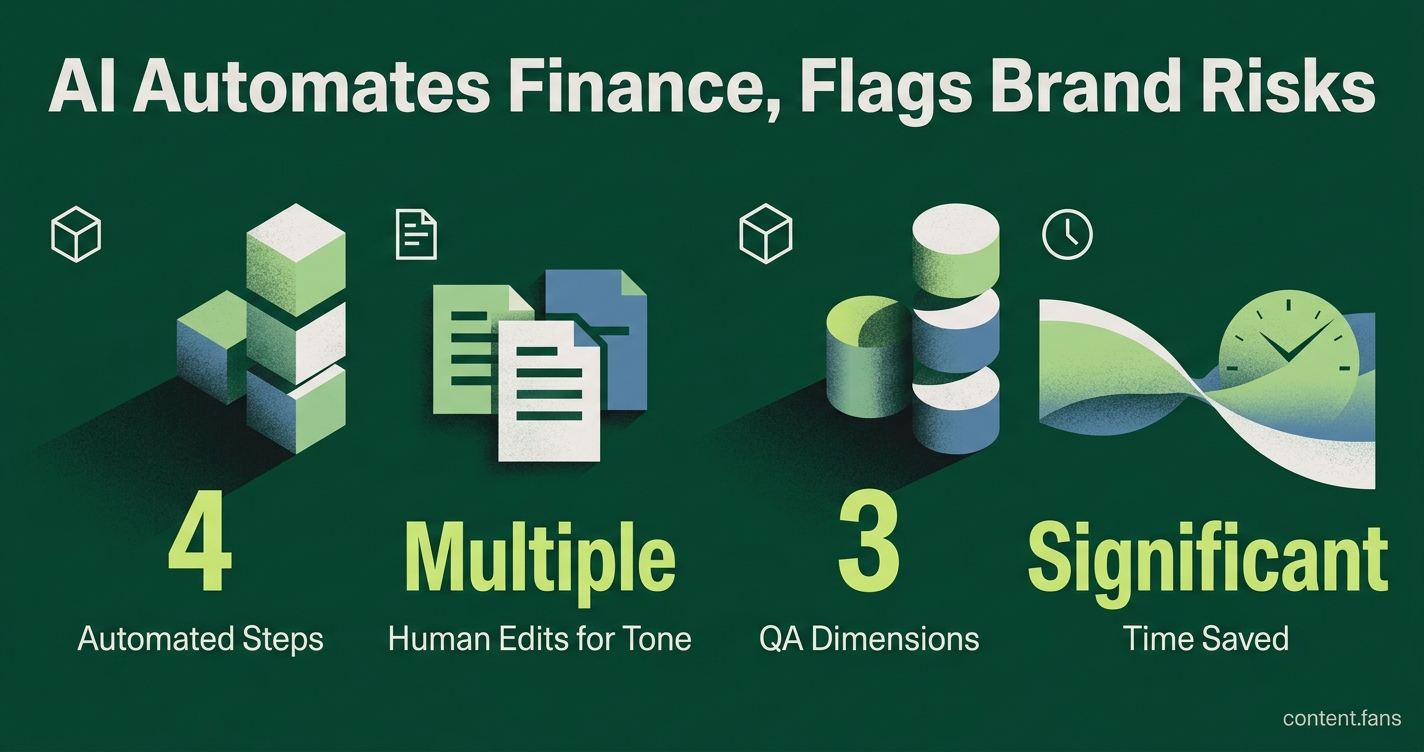
The automated workflow involved four distinct agent-led steps:
1. Data Agent: Fetches and timestamps card transactions for a precise three-month window.
2. Analytics Agent: Averages the spend, adds an 8% buffer, and determines the final spending limit.
3. Issuance Agent: Posts a fund to Ramp's API, where the platform "issues a virtual card automatically" when a fund is created (Ramp docs).
4. Messaging Agent: Drafts a Slack direct message detailing the card's limit, allowed MCCs, and expiration date.
While the card issuance via Ramp was flawless, the Slack messages required multiple human edits to align with the company's established voice. Each correction was logged to create a 'Self Improve' style guide for future AI-generated messages.
Why human approval gates matter
Industry guidance for finance automation emphasizes a cautious approach: begin with low-risk, rules-based tasks and implement human review checkpoints to maintain control. Research highlights that finance teams must "establish governance structures at the start" and require final human sign-off on AI-generated financial outputs (Alice Labs insight). In this pilot, managers reviewed every new card and message, confirming that a controlled rollout is key to protecting brand integrity while validating the automation's reliability.
Multi-dimensional QA: data, controls, and tone
Effective finance automation requires quality assurance that extends beyond mathematical accuracy. This pilot highlighted the need for a multi-dimensional QA process covering three distinct areas:
- Data validation: Confirming transaction timestamps and currency before analysis.
- Spend-limit verification: Ensuring computed caps align with company policy to prevent outliers.
- Tone audit: Reviewing all outbound communications for brand voice consistency and regulatory compliance.
While these checks introduce minor latency, the time spent by reviewers is significantly less than in manual workflows. Exception-based routing alone can reduce processing time substantially without increasing operational risk.
Building durable style rules
To address inconsistencies in tone, the pilot used a 'Self Improve' function to store corrections, allowing the AI to learn and reuse approved phrasing. This method transforms one-off edits into durable style rules, which aligns with best practices for governing AI communications that often combine template generation with human-in-the-loop oversight to maintain brand voice at scale (Prezent customer data). By systematically saving approved language, teams convert ad-hoc feedback into scalable operating procedures.
Takeaways for the next pilot
The Stripe-to-Ramp flow proved that agent teams can reliably execute financial controls while surfacing qualitative risks like messaging tone. For future pilots, key takeaways include logging all corrections, maintaining complete audit trails, and enforcing human review gates. These practices build the confidence needed to expand automation into higher-value areas like AP coding or anomaly detection. Before any full-scale production rollout, continuous measurement of speed, error rate, and user feedback is critical.
What specific steps did the AI agent follow to automate the finance workflow?
The workflow orchestrated through Codex followed a clear sequence: data extraction from company debit card spend records, calculation of a trailing three-month average, addition of a tax buffer, automated issuance of merchant-specific Ramp cards at the computed limit, and Slack notification to each cardholder. This pattern illustrates how AI agents can handle the full lifecycle of a finance operation - from analysis through execution - when APIs are properly integrated.
Why did the Slack messages become a problem despite successful card issuance?
The Ramp card issuance succeeded technically, but the Slack notifications failed on tone quality. The messages did not match the author's natural communication style, creating a jarring experience for recipients. This reveals a critical insight for automation: functional success and experience quality are separate dimensions that both require validation. AI-generated business communications are becoming increasingly common in organizational workflows, yet tone mismatches remain a common failure mode when organizations scale these tools without governance.
How was the tone issue resolved?
The author implemented a "/self improve" step that extracted style rules from repeated corrections and persisted them as a durable skill. Rather than fixing each message ad hoc, the system learned from feedback and encoded preferences into reusable style rules. This approach aligns with emerging best practices for AI-native communications teams, where organizations are increasingly using brand-voice governance, template-based generation, and structured knowledge retrieval to keep outputs aligned with approved tone.
What safeguards are recommended for finance automations involving sensitive actions?
Current guidance emphasizes multiple layers of protection for financial workflows: verifiers to check data accuracy, skeptics to challenge assumptions, and human approval gates for execution. For card issuance specifically, this means threshold-based routing where unusual amounts or policy exceptions escalate to manual review. Industry frameworks for AI in financial reporting recommend final human sign-off on AI-generated outputs, while documented review trails showing what the AI did, what was reviewed, and who approved are considered essential for audit and compliance.
What makes this case study relevant for teams building agent systems?
This example demonstrates practical implementation patterns that transfer across domains: the separation of technical and qualitative QA, the value of encoding corrections into persistent rules, and the necessity of human oversight for financial decisions. With Ramp's API supporting AI-agent-friendly workflows through MCP servers and single-use virtual cards with precise spend controls, the infrastructure for such automations continues to mature. The key lesson: start with high-volume, rules-based workflows, add clear review points, and expand only after proving stable, measurable, and auditable outcomes.