
Google Orders 3 Million Intel Chips Through 2028 for AI
Serge Bulaev
Google has ordered over three million chips from Intel through 2028, which may help reduce its dependence on manufacturers in Taiwan. The company appears to be continuing to use Nvidia GPUs while shifting some work to its own chips made by outside partners. Intel's new chip processes are still developing, and there are uncertainties about cost and performance. This move suggests that Google, and possibly other companies, are trying to reduce supply risks by having backup manufacturers in different regions. The final results are not certain, but having more options could help manage future disruptions.

Google reportedly ordered more than 3 million TPUs from Intel for delivery through 2028, according to industry reports. For procurement leaders, the key question is how a secondary fabrication agreement alters exposure to sudden export rules or wafer shortages.
The pressures are evident in Google's silicon roadmap. According to industry reports, the company plans to continue purchasing Nvidia GPUs while also moving workloads to its own Tensor Processing Units (TPUs) made by external partners. The Information reports that as part of this shift, Google ordered a significant number of TPUs from Intel for delivery through 2028, according to industry sources seeking to reduce reliance on Taiwanese manufacturing by establishing a U.S.-based fabrication alternative Alphabet Taps Intel to Make Three Million In-House Chips, the Information Reports.
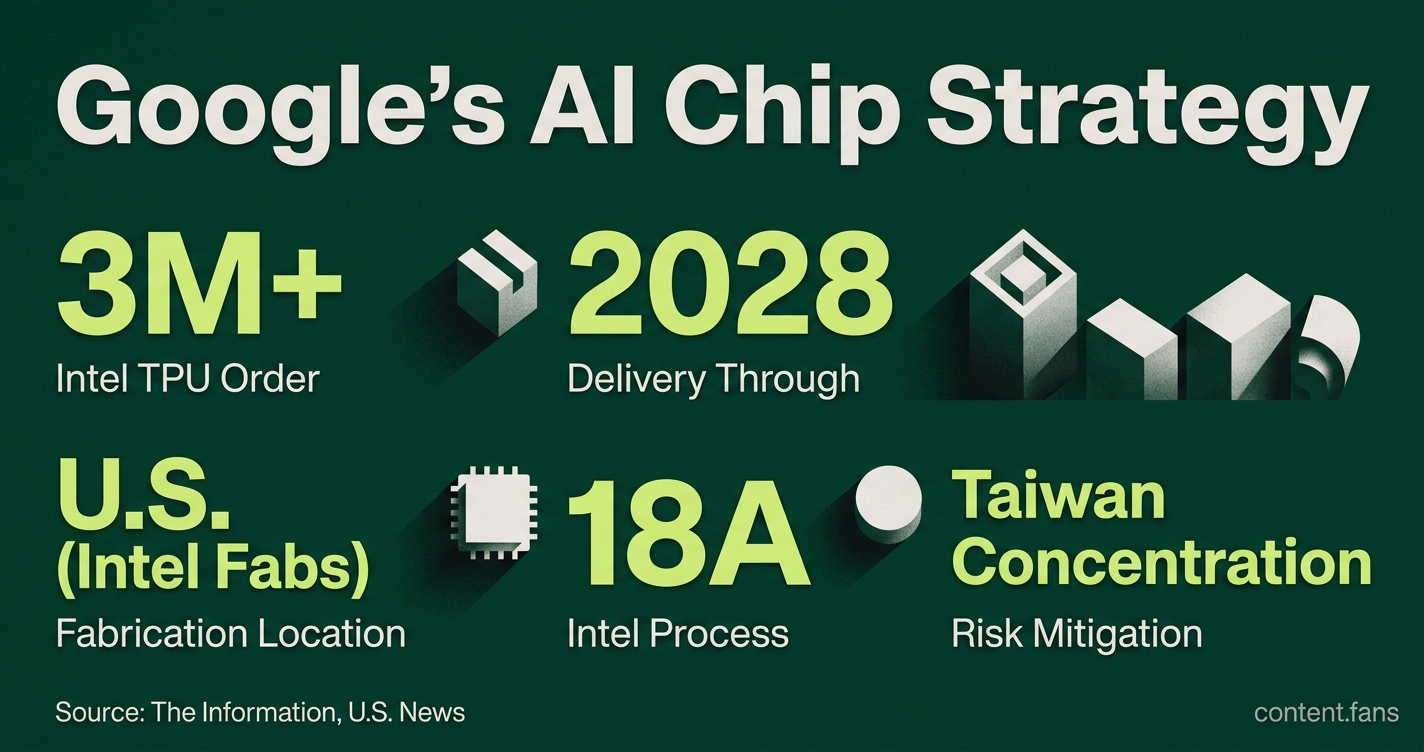
Supply-chain risk analysis: Why companies consider backup chip manufacturers like Intel
Google is diversifying its semiconductor suppliers to mitigate significant risks associated with manufacturing concentration in Taiwan. By engaging Intel for high-volume production, the company secures a domestic U.S. fabrication alternative, protecting its data-center expansion from potential geopolitical disruptions, sanctions, or transport delays impacting a single region.
Vendor scoring now weighs production capacity as heavily as performance. According to industry reports, Intel's 18A process has entered risk production with executives citing yield improvements. While exact wafer counts are not public, this progress indicates growing capacity for third-party orders. Geopolitically, the move to regional redundancy is a direct response to widening export controls and the recognized risk of over-concentration in Taiwan. Intel's U.S. fabs in Arizona and Oregon provide a crucial domestic alternative, aligning with U.S. strategic and compliance priorities.
Trade-offs procurement teams weigh
Engaging Intel as a secondary foundry involves several key trade-offs that procurement teams must evaluate:
- Node Readiness: According to industry reports, Intel's 18A process is targeting volume production in the coming years, with subsequent nodes following on Intel's roadmap.
- Cost Visibility: Per-wafer pricing for external foundry customers has not been released, forcing budget models to depend on scenario-based estimates.
- Packaging Integration: Advanced packaging techniques, like those for specialized variants, may mature on a different timeline than baseline processes.
- Contractual Rigidity: While long-term capacity agreements reduce price volatility, they can limit the flexibility for mid-cycle design modifications.
Procurement frameworks now incorporate quantitative vendor-risk scoring, weighting factors like geographic exposure, node maturity, and export-control resilience. In this model, Intel scores high on geographic security but will likely rate as 'medium' on node maturity until independent yield data becomes publicly available.
Early lessons from Google and Nvidia
Google's large commitment demonstrates how major buyers can secure early access to emerging production nodes, using financial leverage to offset the lack of established yield records. Meanwhile, Nvidia continues as Google's primary GPU supplier. This proves that a dual-sourcing model is viable even for specialized AI accelerators, offering a template for cloud providers who require both top-tier performance and supply chain redundancy.
The strategic lesson is to adopt an incremental, data-driven approach: secure foundry options before geopolitical risks escalate, monitor yield trends closely, and maintain transparent performance benchmarks. While no outcome is guaranteed, adding qualified fabs systematically reduces the supply chain tail risk that threatens large-scale infrastructure expansion.
What exactly did Google order from Intel and when will the chips arrive?
According to industry reports, Alphabet placed a significant TPU order with Intel, with delivery scheduled through 2028. The agreement covers Tensor Processing Units that will be manufactured at Intel foundries, marking what appears to be the first time Google will rely on Intel for high-volume production of its in-house AI accelerators.
Why is Google turning to Intel instead of expanding TSMC capacity?
According to industry analysis, Google's procurement strategy appears built on supplier diversification beyond TSMC in response to capacity constraints and geopolitical risk. By adding Intel to a supply chain that reportedly includes various partners, Google reduces its single-foundry exposure as demand for advanced nodes continues to grow.
How capable is Intel's foundry roadmap for this workload?
According to verified sources, Intel's 18A node has entered risk production, with Intel indicating that Panther Lake products are targeted for 2026. Industry reports suggest:
- 18A - Intel has indicated volume production capabilities for high-performance chips
- Subsequent nodes - Intel continues development on its roadmap according to company statements
These developments suggest Google could gain access to a domestic U.S. supply route that meets advanced requirements while staying ahead of export-control uncertainties.
What geopolitical factors make Intel a safer bet right now?
The semiconductor supply chain is fragmenting into regional blocs as U.S. - China tensions broaden, making Intel a strategically safer choice:
- Export controls now cover equipment, EDA software, and advanced packaging
- Critical material bottlenecks are flagged as chokepoints in industry analysis
- Taiwan concentration risk remains a significant disruption threat according to analysts
By pivoting part of the TPU volume to Intel's U.S.-based fabs, Google appears to gain a supply line with reduced geopolitical risk without full decoupling from existing partnerships.
How should procurement teams replicate Google's risk-balanced strategy?
Procurement teams can consider adopting a similar risk-balanced strategy by implementing frameworks that include:
- Vendor risk scoring - weight geopolitical exposure as a significant factor
- Contract flexibility - include volume-adjustment clauses tied to export-rule changes
- Dual-node strategy - qualify multiple foundry options including domestic alternatives
- Inventory buffers - maintain appropriate safety stock on critical components
- Tiered hardware SKUs - design alternate chipsets that comply with regional control lists
Following similar approaches may help procurement teams secure continuity while maintaining competitive unit economics.