
Google, Nvidia explore Intel as backup chip maker for AI
Serge Bulaev
Google and Nvidia are exploring Intel as a backup chip manufacturer because their main supplier, TSMC, may not have enough capacity for their needs. Reports suggest this is to prevent delays in AI hardware in case of supply problems or geopolitical issues. Intel's new 18A chip production may be available in small amounts starting in 2026, but bigger deliveries might only happen after production stabilizes. Industry experts say this move appears to be a way for Google and Nvidia to lower risks, not to replace TSMC completely. By 2028, both Intel and TSMC may have new technologies online, and success may depend more on supply chain stability than market share.

Reports indicate that Google and Nvidia are exploring Intel as a backup chip maker for AI development, a strategic move driven by capacity constraints at their primary supplier, TSMC. These discussions highlight the growing pressure on TSMC's advanced manufacturing, whose nodes and CoWoS packaging lines remain oversubscribed. Major AI firms are now creating contingency plans to prevent supply chain disruptions or geopolitical events from derailing their hardware rollouts.
Intel's 18A roadmap and near term capacity
Intel is pursuing an aggressive "five-nodes-in-four-years" strategy, with its 18A process node central to these discussions. According to industry reports, Intel's 18A process is expected to ramp production capabilities in the coming years. This node is Intel's first to combine RibbonFET transistors with backside PowerVia technology, a combination designed to reclaim manufacturing leadership. According to industry reports, capacity for 18A will be distributed across multiple facilities, enhancing regional supply chain diversity. However, industry analysts suggest the initial phases will primarily focus on testing and qualification, with significant volume for external customers available only after production stabilizes.
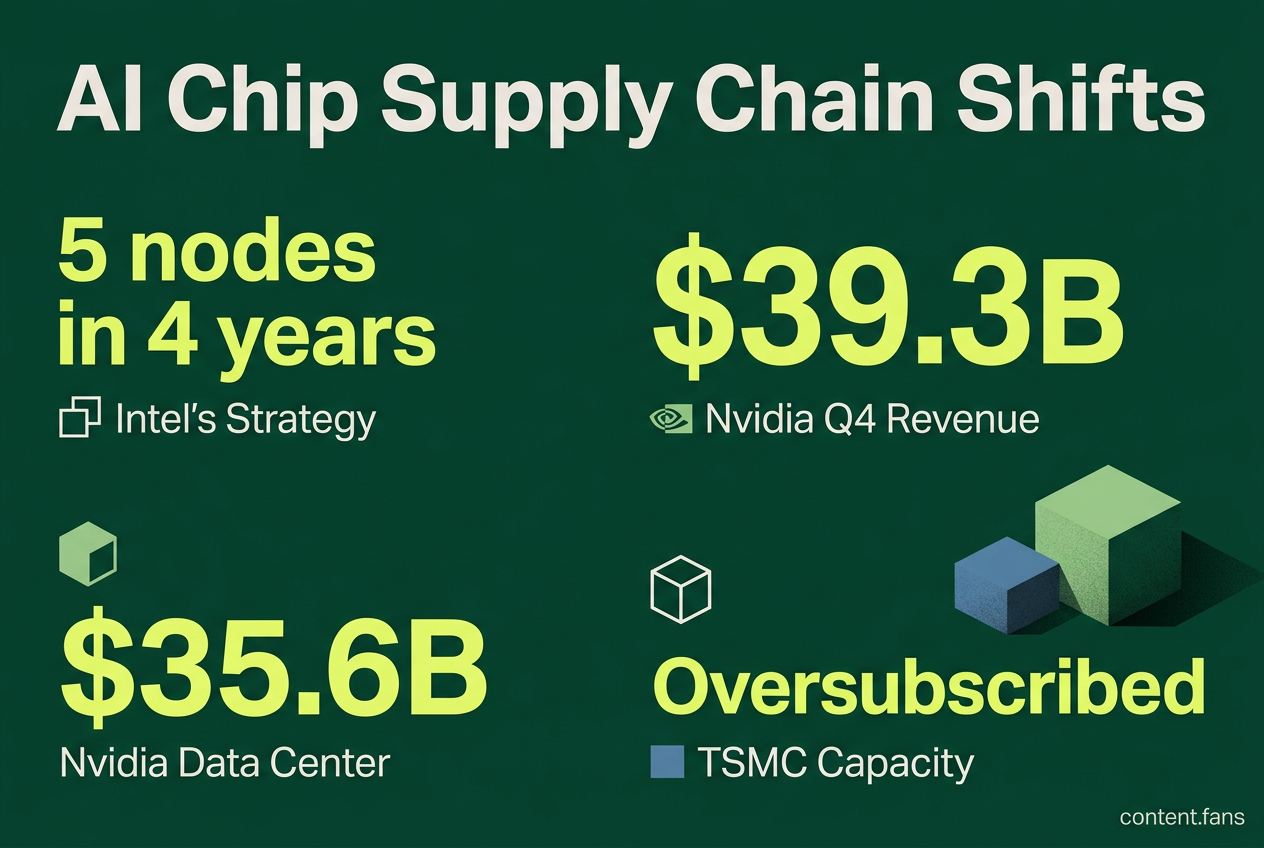
Google and Nvidia are diversifying their semiconductor supply chain to mitigate risks associated with their primary manufacturer, TSMC. With demand for AI chips causing TSMC's advanced capacity to be oversubscribed, securing a secondary source like Intel ensures a stable supply for future hardware, hedging against production bottlenecks and geopolitical instability.
The Supply Chain Rationale for Diversification
The strain on TSMC's capacity is evident. Nvidia reported $39.3 billion in fiscal Q4 2025 revenue and $35.6 billion in Data Center revenue, highlighting the massive scale of AI chip demand. Demand is so high that TSMC has already outsourced some advanced packaging work. For customers like Google and Nvidia, engaging a second foundry minimizes dependence on a single manufacturing region. This "dual-sourcing" strategy acts as insurance against logistical disruptions or policy shocks that could otherwise halt AI hardware production.
Competitive signals and market reaction
Despite the news, investors largely view TSMC's position in the AI supply chain as secure. The market perceives this diversification as a manageable headline risk for TSMC, not a structural threat, given that overwhelming AI demand will keep its facilities at full capacity. For Intel, however, securing orders from high-profile customers is a critical validation of its foundry turnaround strategy. A successful partnership would have several key implications:
- A symbolic shift of some wafer production from TSMC to Intel's 18A process.
- Increased outsourcing of packaging by TSMC to meet continued high demand.
- A boost to Intel's credibility, turning its foundry roadmap into tangible business.
- New engineering challenges for Google and Nvidia in validating designs across two different foundries.
Looking toward the future
The strategic landscape will continue evolving as Intel advances its roadmap with future nodes while TSMC expands its advanced capacity. By that time, the success of this diversification will be measured not by market share shifts but by supply chain resilience. The current discussions are effectively a trial run, securing modest production volume on Intel's 18A process now to ensure manufacturing flexibility when next-generation chip technologies mature.
Why are Google and Nvidia talking to Intel about chipmaking?
According to industry reports, TSMC's most advanced lines are heavily booked, and both companies need backup capacity for their next-gen AI parts. Intel's 18A node represents a significant rival process that could provide manufacturing flexibility, making it an important hedge against potential TSMC shortfalls.
What can Intel deliver?
- Intel announced 18A had entered risk production in 2025, and later reporting said it was expected to reach volume manufacturing in 2026; Intel's 18A uses RibbonFET + PowerVia technology designed for improved performance per watt.
- Multiple fabs will contribute to output capacity once fully equipped.
- A performance-enhanced 18A-P refresh is reportedly on Intel's roadmap for customers that need extra frequency headroom.
Would shifting a portion of Nvidia's AI line away from TSMC impact the foundry's revenue?
Industry analysts suggest Nvidia represents a significant portion of TSMC's revenue. Moving a substantial portion of that order book would still leave TSMC's CoWoS and advanced node capacity heavily utilized, so the immediate financial impact may be limited; the bigger impact is headline risk that could affect TSMC's premium valuation multiple.
How do geopolitics drive the "two-foundry" strategy?
- A significant majority of advanced AI chips are currently built in the Taiwan strait.
- New U.S. export curbs could widen; China could retaliate with rare-earth or gas embargoes.
- Washington incentives under the CHIPS Act can cover a substantial portion of Intel's wafer costs, making U.S. production both cheaper and policy-proof for American designers.
What are the odds any of these talks turn into a signed Intel foundry deal?
No purchase orders have been disclosed, but both Google (TPU) and Nvidia (GPU) have reportedly requested multi-quartz shuttle runs on 18A - a step that normally precedes production tape-out by many months. Future Intel Foundry events will likely provide more clarity on 18A yields and production readiness, which could influence whether formal contracts materialize.