
Google, Nvidia Expand Chip Orders, Adopt Intel Foundry for AI
Serge Bulaev
Google and Nvidia may use Intel to make some of their AI chips because TSMC cannot meet all of the current demand. Intel is offering new chip-making services that might help reduce reliance on only one company. Reports suggest it could take until 2027 or later for significant chip production to move to Intel or other suppliers. Google also appears to be talking with Samsung to make future chips, possibly to spread out risks. There still seems to be a chance that chip supply will remain tight for several years, and companies might need to use more than one manufacturing partner.

As demand for AI chips continues to outpace supply, Google and Nvidia are expanding their chip orders and adopting Intel Foundry as a crucial secondary manufacturing partner. This strategic shift addresses chronic oversubscription at TSMC, where CEO C.C. Wei reports that demand significantly exceeds capacity (Bloomberg). With TSMC unable to close the supply gap, the tech giants are pursuing geographic and technical diversification to secure their AI hardware roadmaps.
Google and Nvidia Consider Intel as Backup Chip Supplier as TSMC Capacity Tightens
Facing significant production shortfalls at TSMC, Google and Nvidia are turning to Intel Foundry as a viable second source for their advanced AI chips. Intel's integrated "systems foundry" model provides an end-to-end solution, including cutting-edge process nodes and advanced packaging, to alleviate supply chain bottlenecks.
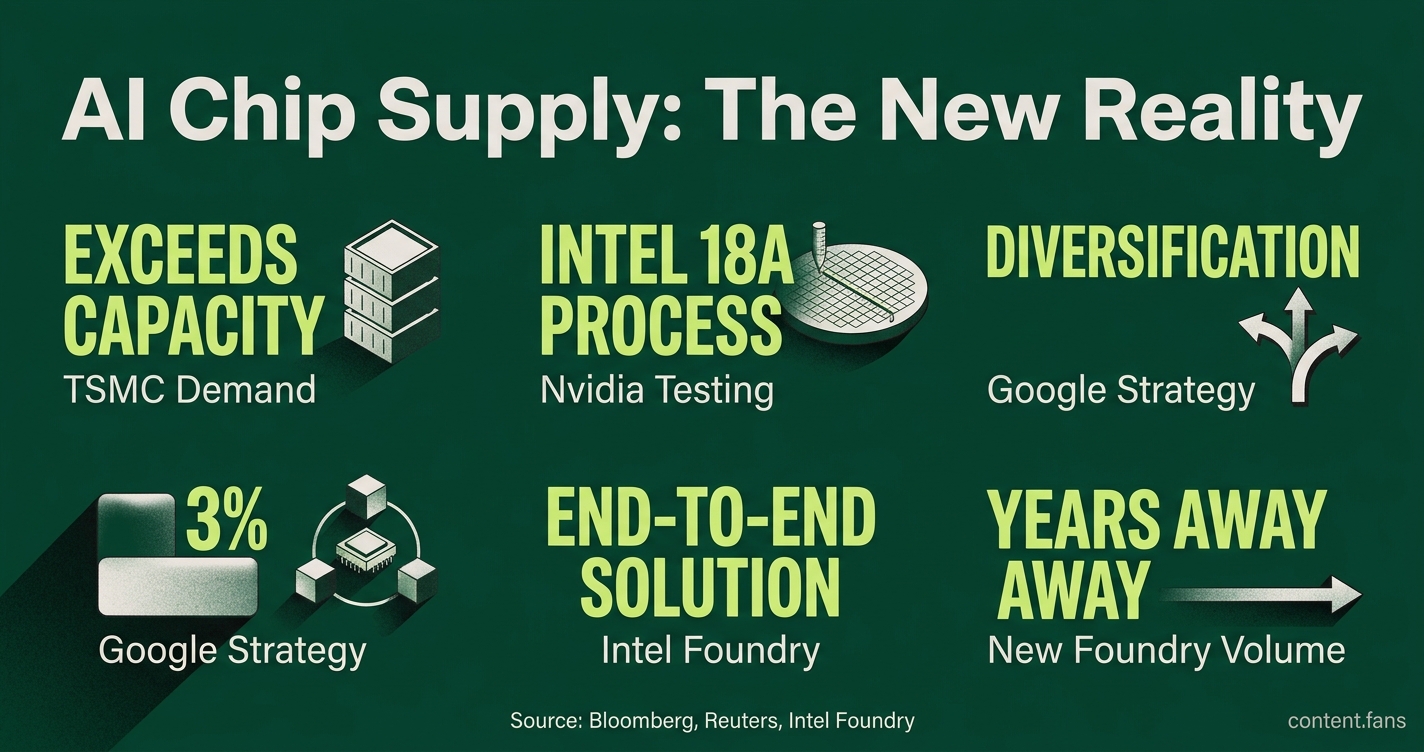
Intel is attracting these high-profile customers with its "systems foundry" model, which integrates process nodes, 2D/3D packaging, and assembly-test services into a single offering. The company's roadmap includes several nodes suitable for AI accelerators, such as Intel 18A, Intel 3, and Intel 16, with the next-generation 14A node planned for the coming years (Intel Foundry overview). According to industry reports, Nvidia has been testing its GPUs on Intel's 18A process (Reuters).
To mitigate single-source dependency on TSMC, Intel Foundry highlights several key advantages:
- Advanced packaging options (2D, 2.5D, 3D) essential for complex, chiplet-based AI hardware.
- A comprehensive design ecosystem with IP, EDA tools, and co-optimization services.
- End-to-end production through its Intel Foundry ASAT (Assembly and Test) services.
Supply Pressures Shaping Design Timelines
The supply crunch is particularly acute, with reports indicating Nvidia commands a significant portion of TSMC's total CoWoS packaging allocation. At the same time, Google's demand for its internal TPUs has surpassed its reserved capacity, forcing major AI players to either delay roadmaps or find alternative suppliers.
Migrating a sophisticated AI accelerator to a new foundry is a complex undertaking, requiring months of redesign and qualification for new process rules and packaging standards. According to industry reports, significant chip volumes from a new foundry like Intel may not be available for several years.
Google's Broader Diversification Play
Google's strategy extends beyond Intel, as the company is reportedly in discussions with Samsung to manufacture components for future AI hardware. These talks focus on using Samsung's advanced nodes for next-generation TPU components, with production targeted for the coming years (US News - Reuters relay). This multi-foundry approach, which includes both Intel and Samsung, demonstrates a clear strategy to diversify its supply chain and reduce manufacturing risks.
What May Happen Next
The industry's future balance depends on execution. Intel must demonstrate high-yield manufacturing on its 18A node and meet its development targets for the 14A process. Meanwhile, although TSMC is expanding its CoWoS capacity, industry observers predict that demand for advanced processes will continue to significantly exceed supply in the coming years.
For AI hardware developers, the path forward involves a two-pronged strategy: accelerating the transition to alternative foundries like Intel and Samsung while simultaneously competing for limited capacity at TSMC. This dynamic is actively reshaping technology roadmaps, driving investment in advanced packaging, and influencing the global distribution of semiconductor manufacturing.
Why are Google and Nvidia considering Intel as an alternative chip manufacturer?
With TSMC capacity reportedly significantly short of demand, both Google and Nvidia are actively testing Intel's 18A process node as a backup. Intel's systems-foundry model offers leading-edge nodes, 2.5/3-D packaging, and full-stack design support specifically tuned for AI accelerators, giving customers a realistic second source beyond Taiwan.
How tight is TSMC's supply situation for AI chips in 2025-2026?
According to industry reports, TSMC's CoWoS advanced-packaging lines and advanced node wafers remain heavily oversubscribed. Many analysts expect a significant supply deficit at advanced nodes, while lead times for surrounding components like PCBs have stretched considerably.
What would a move to Intel mean for chip design timelines?
Switching foundries normally adds many months of re-qualification because libraries, standard cells and IP blocks must be re-validated for Intel's PowerVia backside-power and RibbonFET architectures. Google is nevertheless said to be targeting volume production on 18A in the coming years, indicating the work has already started.
Is Google already producing AI chips with Samsung?
Media reports indicate Google is negotiating with Samsung to fabricate components on advanced nodes for a next-gen TPU, while TSMC still provides the main compute tile. The reported Google TPU order points to future production, but the available sources do not establish Samsung as a specialized packaging partner or a replacement for full-flow manufacturing.
Could diversifying away from TSMC affect AI hardware pricing?
Any relief in supply constraints would help moderate pricing pressures. Yet because Intel and Samsung remain in early ramp phases, many forecasters expect gradual price changes as alternative foundries reach scale over the coming years.