
Google limits Meta's Gemini access, disrupting AI projects
Serge Bulaev
Google has limited Meta's access to its Gemini AI infrastructure, which may have disrupted some of Meta's AI projects. Google says it is "compute constrained," and Meta was only partially approved for more Gemini capacity, leading Meta to slow down some experiments and look for other providers. Reports suggest a wider shortage of AI hardware is causing delays for many companies, and businesses are changing strategies to cope, like signing long-term contracts or adjusting models. The shortage may continue for some time, and both Meta and other big tech firms are increasing spending on hardware and training new data center workers. This situation suggests that access to physical infrastructure could be a key factor in AI development.

Recent reports confirm that Google limits Meta's Gemini access, a move disrupting key AI projects by restricting the capacity Meta can lease. Google reported it could not provide the specific amount of compute Meta requested due to capacity constraints, illustrating a broader supply squeeze now shaping negotiations between major cloud providers and their customers.
Gemini capacity limits ripple through Meta's roadmap
Google's decision to cap Gemini access forced Meta to immediately re-prioritize its AI development. The restriction meant internal teams had to delay several AI experiments, ration the use of "AI tokens" to stay within new quotas, and begin searching for alternative hardware providers for its large-scale workloads.
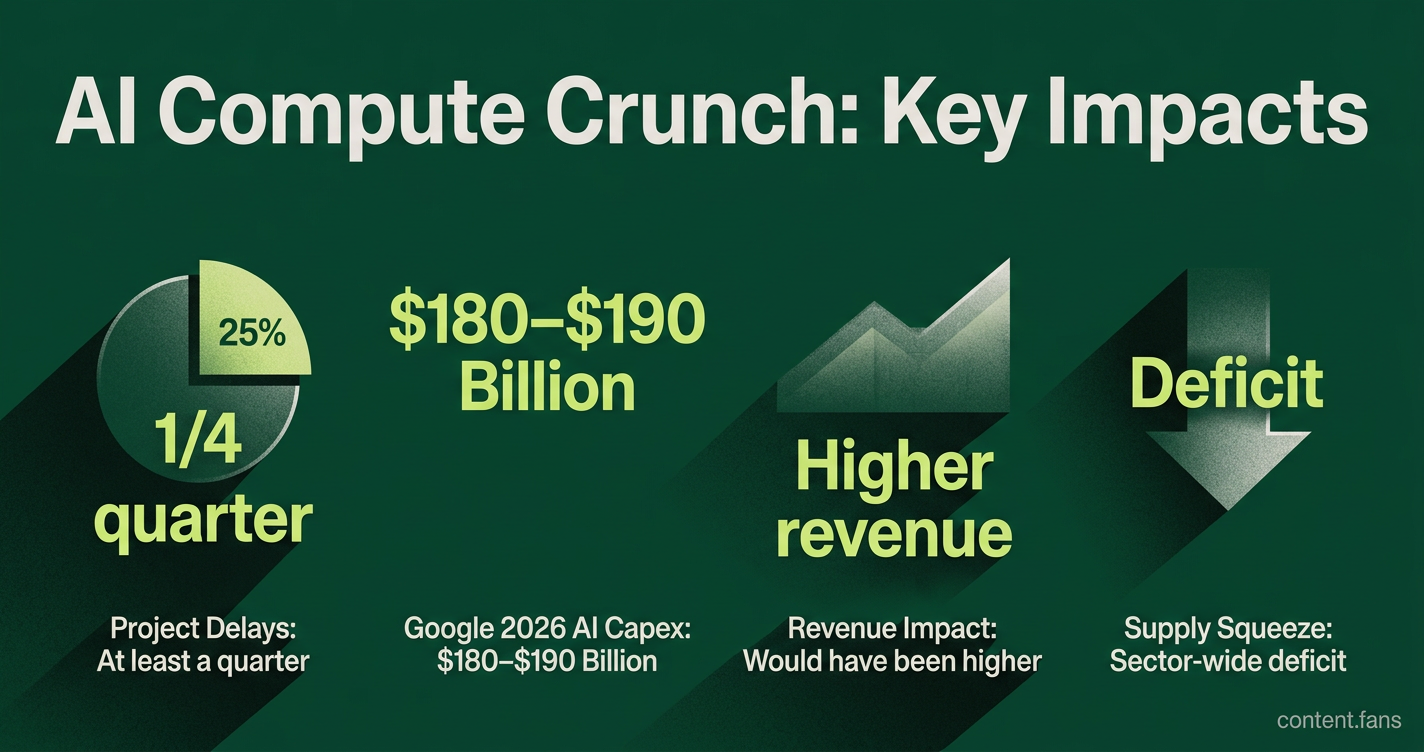
The Financial Times reported that Google limited Meta's access to Gemini AI models in March 2026 due to insufficient computing resources, partially fulfilling Meta's demand. Reports indicate Google restricted Meta's Gemini access due to resource constraints and existing backlogs. In response, Meta is prioritizing in-house models and scouting alternate providers, though the size of its workloads makes transitions slow. Internal messages reviewed by the Financial Times suggest some project launches have slipped by at least a quarter.
Exposing a Sector-Wide Compute Crunch
Google Cloud revenue has been growing steadily, though capacity constraints have limited potential growth. However, leadership conceded that revenue "would have been higher" if not for hardware shortages. Research from industry analysts points to a sector-wide deficit of accelerators, power, and cooling - not just chips. This scarcity effectively turns public cloud backlogs into a queue where early reservations provide a significant strategic advantage.
How the shortage changes enterprise behaviour
- Some enterprises have begun to sign multi-year, take-or-pay contracts to secure future GPU clusters.
- Others are re-architecting models to reduce token use or shift inference to CPUs when adequate.
- Private colocation builds are rising as firms look beyond the big three hyperscalers.
Industry analysts warn that late movers face "allocation queues that threaten product launches," while pricing terms have become more variable month by month.
Capital expenditure accelerates
Hyperscalers are increasing capital expenditure for AI infrastructure, with Google's 2026 AI capex guidance at $180 - $190 billion. According to industry reports, a significant portion of that spending is for AI-specific hardware. With industry reports indicating extended lead times for high-end GPUs, immediate relief is unlikely.
Workforce implications
Meta has invested in workforce training programs for data center construction, focusing on electricians and plumbers for infrastructure projects. Reports suggest these programs aim to build talent pipelines alongside server infrastructure.
The combination of constrained compute, surging capital expenditure, and new labor programs signals that physical infrastructure - from chips to skilled trades - is becoming the primary lever for competitive advantage in large-scale AI.
Why did Google start limiting Meta's Gemini access?
Capacity shortages were the official reason.
According to the Financial Times, Google restricted Meta's Gemini capacity in March due to general computing capacity constraints and existing backlogs.
Leadership later confirmed that revenue would have been higher if servers were available, turning AI workloads into a zero-sum game among customers.
How severe is the overall supply crunch?
Industry reports show a significant gap between supply and demand.
- Across major cloud providers, demand significantly outstrips available supply for AI compute resources.
- Global data-center CapEx is expected to grow substantially, with various industry estimates showing strong increases from previous years.
- Multiple non-AI factors now limit chip deployment: power-grid bottlenecks, transformer shortages, and cooling-system lead times.
What did Meta do once capacity was cut?
Meta pivoted fast and rationed hard.
1. It redirected teams to internal models to reduce reliance on external APIs.
2. Staff received guidance to "be more conservative" with AI tokens, rationing every text-analytics task across product teams.
3. Meta has invested in workforce training programs for data center construction, focusing on building infrastructure capacity.
Does the shortage affect only Google and Meta?
Every hyperscaler and most enterprises feel the squeeze.
- Anthropic's Claude, OpenAI's GPT-family, and Amazon Bedrock have all introduced tighter rate limits or higher pricing tiers since January.
- Small and mid-size AI start-ups now sit in allocation queues that can stretch several months, delaying product launches.
- Early movers with pre-signed contracts hold an "infrastructure moat": securing additional GPU hours today requires either secondary-market premiums or substantial long-term commitments.
What should companies do right now?
Treat compute as a capacity plan, not a cost line.
- Lock multi-year reservations to secure 2026-2027 supply, but only after quantifying actual demand and establishing baseline utilization.
- Diversify across at least two hyperscalers plus emerging regional providers to reduce single-vendor risk.
- Budget for higher OPEX; GPU pricing has increased significantly in recent months.
- Explore edge and on-prem clusters for latency-sensitive workloads; the supply crunch is pushing more AI inference to smaller, regional data centers.