
Google Leases 110,000 Nvidia GPUs From SpaceX For $920 Million Monthly
Serge Bulaev
Google has agreed to lease 110,000 Nvidia GPUs from SpaceX for about $920 million each month, in a deal that could last several years and might be worth $30 billion. The agreement appears to show how hard it is to get enough advanced AI hardware, as even big tech companies like Google are turning to non-traditional suppliers like SpaceX. Google will not pay the full monthly amount until late 2026, and it may cancel if SpaceX does not deliver on time. Some experts suggest this move could make it harder for other companies to get GPUs and signals that SpaceX is becoming a major player in the AI hardware market. Details are still limited, but the deal may have big effects on GPU prices and data center planning.

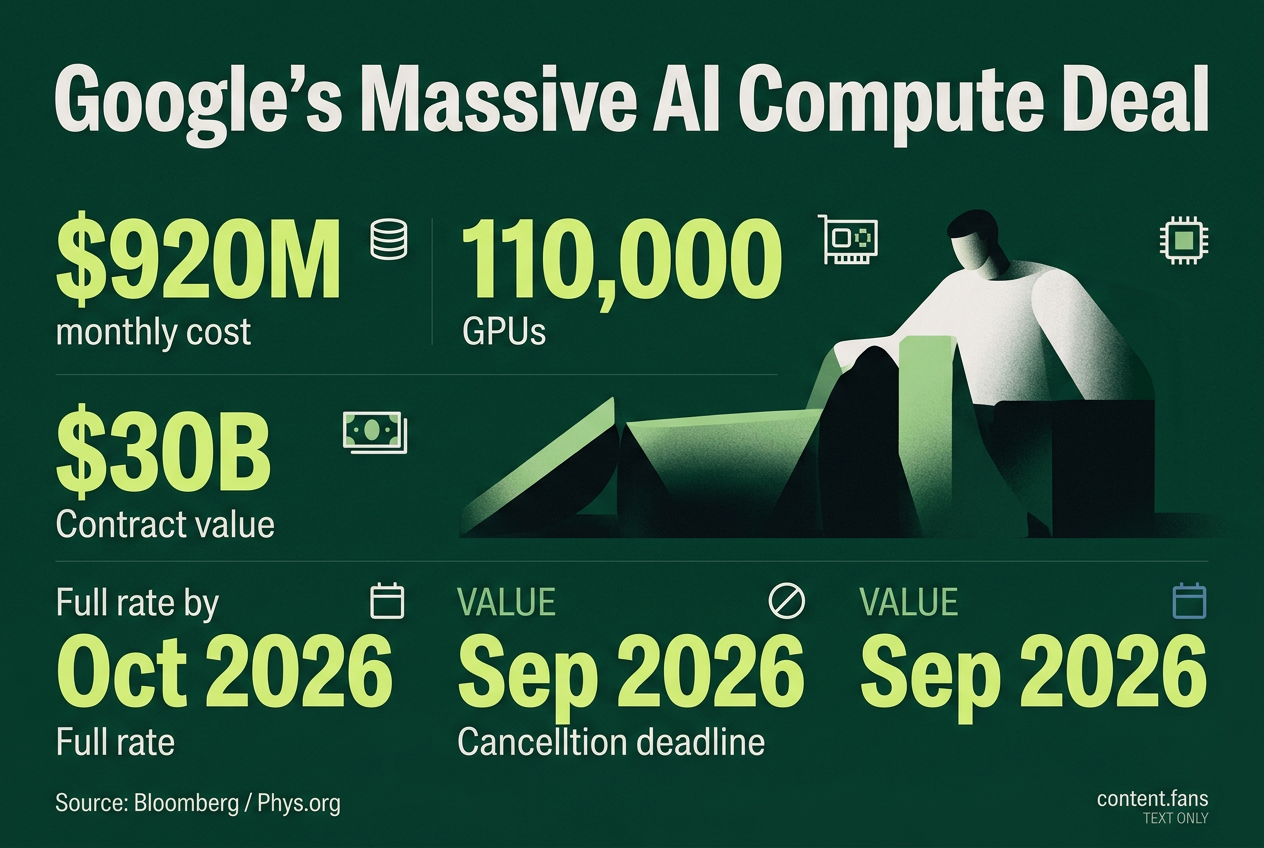
In a landmark deal shaking the cloud computing market, Google will lease compute capacity from SpaceX, and the package includes approximately 110,000 Nvidia GPUs plus CPUs, memory, and other related components for AI development. A regulatory filing, first reported by Bloomberg and confirmed by outlets like Phys.org, outlines a monthly commitment of $920 million for the high-demand hardware and its supporting infrastructure.
Valued at approximately $30 billion over its multi-year term, the arrangement highlights the intense scarcity of advanced AI compute. This move shows that major tech companies are now turning to unconventional suppliers like SpaceX to secure essential processing power, a sign of a major shift in the data center landscape.
What Google is actually buying
This multi-billion dollar agreement secures Google long-term access to compute capacity including approximately 110,000 Nvidia GPUs plus CPUs, memory, and other related components hosted in SpaceX data centers. The deal is structured to guarantee AI compute capacity for Google's future projects, like its Gemini models, addressing the current global shortage of high-end hardware and data center space.
The full $920 million monthly payment is not immediate. As detailed by TechTimes, payments will follow a ramp-up schedule, reaching the full rate in October 2026. The contract includes specific terms:
- Delivery Deadline: Google can cancel the agreement if SpaceX does not provide the GPUs by September 30, 2026, following a one-month grace period.
- Termination Clause: After December 31, 2026, either Google or SpaceX can terminate the contract with 90 days' notice.
These powerful GPUs will operate from SpaceX-managed data centers, a strategic dependency that ties Google's Gemini AI roadmap to external infrastructure. Analysts suggest this reliance indicates that even tech giants are struggling to build and scale their own data centers quickly enough to satisfy the voracious demand for AI.
Google to lease Nvidia chips from SpaceX in massive multi-year deal - market context
This agreement is considered one of the largest take-or-pay GPU leases ever disclosed. It reinforces the idea that developing frontier AI models is a capital-intensive endeavor, a sentiment echoed in reports on similar deals, underscoring that "AI runs on capital."
The deal has several major implications for the market:
- Securing Scarce Resources: The long-term contract shields Google from persistent supply chain bottlenecks for critical components like HBM memory and advanced packaging.
- Emergence of New Suppliers: SpaceX, traditionally an aerospace company, is now positioned as a major wholesale compute provider, competing with established cloud giants.
- Increased Market Pressure: This single massive lease removes 110,000 GPUs from the open market, intensifying competition and likely driving up prices for Google's rivals.
How SpaceX fits into the AI compute landscape
SpaceX's ambitions extend beyond ground-based data centers. The company is actively exploring both terrestrial and orbital compute solutions, as shown in an FCC filing for an Orbital Data Center network. While the Google deal is for ground-based facilities, it could provide the capital for SpaceX to pursue its long-term vision of space-based clusters, which could alleviate the power grid constraints faced by AI training on Earth.
This move signals a strategic convergence of SpaceX's core competencies: rocket launches, satellite networking (Starlink), and now, AI infrastructure. This vertical integration could grant SpaceX significant leverage in future negotiations for GPU allocations and cloud partnerships.
Even with some details undisclosed, the financial scale of this deal is staggering, dwarfing many public cloud commitments. The substantial cost of this lease alone highlights its significance. Consequently, suppliers, regulators, and investors are closely monitoring the potential ripple effects on GPU prices and data center power requirements globally.
What are the exact terms of the Google-SpaceX GPU lease?
Google will pay $920 million each month for access to compute capacity including approximately 110,000 Nvidia GPUs plus CPUs, memory, and other related components, plus supporting power/cooling infrastructure.
- Contract window: October 2026 - June 2029.
- Financial ceiling: Sources value the full deal at ~$30 billion over the entire term.
- Safety valves:
- If SpaceX fails to deliver the full compute stack by 30 September 2026, Google can walk away after a 30-day grace period.
- Either party can terminate with 90 days' notice after 31 December 2026.
Why does Google need to rent chips from SpaceX instead of building more of its own data centers?
The decision shows compute shortages are real and intensifying.
- Even hyperscalers with deep pockets cannot add enough power, land, and advanced GPUs fast enough to meet AI demand.
- By locking in a five-year lease, Google secures guaranteed capacity at a fixed price instead of gambling on spot markets.
- SpaceX is bundling rare assets: chips, racks, renewable power from Starlink ground stations, and rapid deployment via rocket logistics.
How does SpaceX suddenly have 110,000 datacenter-grade GPUs to spare?
SpaceX has quietly assembled a hybrid-earth-orbit compute network through a mix of purchase orders, equity swaps, and pre-IPO financings.
- Confirmed purchases: Reuters notes SpaceX is already one of Nvidia's largest customers, separate from this Google deal.
- Ground sites: The company repurposes Starlink gateway facilities into GPU farms, leveraging existing power and fiber.
- Future leverage: SpaceX has filed with the FCC to deploy satellites that could act as orbital data-center nodes. While speculative, the filing shows long-term intent to own compute outside traditional ground facilities.
What does a $920 million monthly payment mean for AI economics?
It anchors the new baseline cost for large-scale training and inference.
- The substantial annual spend represents a significant investment equal to the entire R&D budget of many major companies.
- Industry observers estimate the fee could underwrite expensive training runs, suggesting Google plans multiple frontier-scale models across the deal term.
- Market signal: the figure pressures rivals to pre-pay or pre-order scarce chips, accelerating the shift from spot purchasing to take-or-pay contracts.
Will other cloud providers follow Google's lead and lease external GPUs?
Early indicators say yes, but terms may differ.
- Other major AI companies have reportedly signed significant capacity agreements, though no provided source supports an Anthropic $45 billion, three-year capacity agreement with SpaceX; the referenced source material instead mentions a separate $1.25 billion monthly Anthropic compute deal in secondary coverage.
- Amazon, Microsoft, and Meta are reportedly exploring joint ventures with utilities, real-estate trusts, and even defense contractors to secure power-plus-GPU packages.
- Analysts predict that by late 2026, a significant portion of new AI workloads in the U.S. could run on non-traditional infrastructure owned by aerospace, energy, or telco firms instead of classic hyperscalers.