
Google launches Gemini Spark for AI Ultra users, expands agent capabilities
Serge Bulaev
Google has launched Gemini Spark, a 24/7 personal agent for U.S. AI Ultra users, which may shift Gemini from an on-demand helper to a more active coworker. The agent appears to automate work across Google Workspace and other connected tools, running tasks in the background and handling things like document creation and inbox summaries. Availability is limited to paying Ultra subscribers aged 18+ in the U.S., and Google seems to be collecting feedback before a wider rollout. Analysts suggest Spark is part of a trend toward more autonomous AI agents, but details about access, controls, and error handling are still unclear. The full impact of Spark may depend on how well it integrates with other services and on future enterprise features.

Google has announced Gemini Spark, a new 24/7 personal AI agent, which was rolling out in beta to trusted testers and Google AI Ultra subscribers in the U.S. This update shifts Gemini from a simple on-demand helper into a proactive coworker that automates tasks. After its reveal at I/O 2026, Google said Spark would first roll out to trusted testers, then to Google AI Ultra subscribers in the U.S. as a beta the following week, according to the company's launch blog and early coverage from 9to5Google.
The tool sits on top of the existing Gemini app and Workspace integrations. Google positions Spark as an agent that "does real work on your behalf and under your direction," suggesting a strategic move toward outcome-focused automation rather than prompt-by-prompt chat.
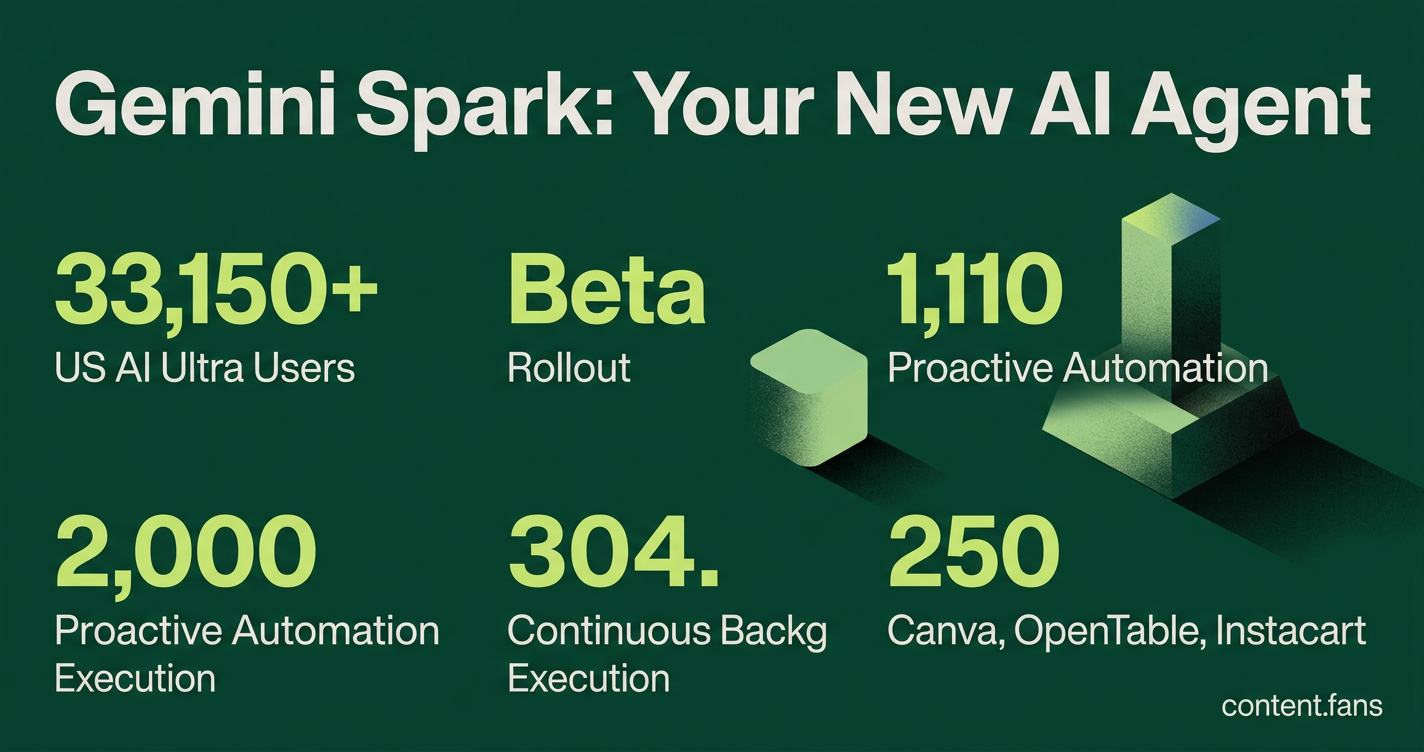
How Gemini Spark works across products
Gemini Spark is a proactive AI agent that operates continuously in the background to automate tasks across Google services and connected apps. Unlike the standard prompt-based Gemini, Spark can execute multi-step workflows, manage recurring jobs, and act on your behalf without requiring constant user input.
Operating from Google's cloud, Spark continues running tasks even when your device is off. The official announcement states it works "across Workspace, custom connectors, and the open web," with future growth planned through Model Context Protocol (MCP) add-ons. Initial MCP partners like Canva, OpenTable, and Instacart extend its capabilities beyond standard Google apps. Google also says this protocol will later be used to enable desktop automation and local file access.
Key abilities at launch
At launch, Spark's core capabilities focus on proactive automation:
- Continuous background execution without needing an open browser window
- Recurring or trigger-based tasks, such as parsing monthly statements
- Multi-step document production that can convert email threads into Google Docs drafts
- Automated daily digests synthesized from inboxes and delivered to key contacts
This list, reflecting examples from Google's product post, shows how Spark builds on existing Workspace features by adding autonomous, multi-step actions with third-party services.
Availability and Rollout
Currently, access to Gemini Spark is limited. PCMag notes the rollout targets AI Ultra subscribers in the United States who are 18 or older. The rollout began immediately with trusted testers and was slated to expand to U.S. Google AI Ultra subscribers the following week; Google also publicly mentioned later expansion to Workspace and Enterprise, while broader international or lower-tier timelines were not specified in the cited sources.
For business users, the Google Cloud team writes that the same agent technology will extend to Workspace and Cloud customers "across custom connectors" later in the year, hinting at eventual feature parity between consumer and enterprise versions.
What makes Spark different from earlier Gemini releases
Spark represents a significant evolution from previous Gemini features in three key ways:
1. Proactive Posture: Unlike earlier versions that required explicit prompts, Spark can initiate tasks autonomously after an initial setup.
2. MCP Ecosystem: It launches with the Model Context Protocol (MCP), enabling third-party hooks from day one. 9to5Google reports that more partners are expected to be added over the summer.
3. Cross-Surface Reach: According to Google's May 19 post, future updates will bring Spark to the desktop, allowing it to access local files in addition to cloud services.
Industry Analysis and Open Questions
Industry watchers interpret Spark as Google's strategic entry into the growing field of autonomous AI agents. While Google frames it as a natural extension of Gemini, this positioning may also help users see it as a free upgrade for AI Ultra subscribers, though future pricing remains unconfirmed.
However, significant questions about governance and safety persist. Google has stated that Spark acts "under your direction," but details on practical controls like audit logs or rollback options have not been released. The agent's long-term success will likely depend on the depth of its MCP integrations and the clarity around its enterprise controls. For now, early U.S. adopters can experiment with its always-on workflows, a capability Google underscores in promotional material linked through its official blog.
What exactly is Gemini Spark and how is it different from the regular Gemini assistant?
Gemini Spark is Google's first always-on personal agent that can run continuously in the background and take actions for you instead of waiting for prompts. While the standard Gemini assistant replies when you ask, Spark can proactively monitor your data, learn custom routines, and execute multi-step workflows across Workspace apps and beyond. Google frames this as shifting Gemini from "an assistant that answers questions into an active partner that does real work on your behalf".
Who can use Gemini Spark right now?
Access is limited to U.S. AI Ultra subscribers aged 18 and over. The rollout began immediately with trusted testers and was slated to expand to U.S. Google AI Ultra subscribers the following week; Google also publicly mentioned later expansion to Workspace and Enterprise, while broader international or lower-tier timelines were not specified. This premium-first strategy lets Google gather feedback from power users before wider release.
Which apps and services does Spark connect to on day one?
Spark launches inside Gmail, Docs, Drive, Calendar, and other Workspace tools, but Google says it already reaches further:
- Third-party connectors via the open-source Model Context Protocol (MCP) with launch partners Canva, OpenTable, and Instacart
- Cloud routines that keep running even when your phone or laptop is locked
- Planned summer update will add local browser control and the ability to read desktop files through the upcoming Gemini desktop app
What kinds of tasks can I hand off to Spark?
Google demoed several "set it and forget it" examples:
- Recurring finance checks - parse every monthly credit-card statement, list subscription price changes, and drop the summary into Sheets
- School inbox monitor - watch for new emails from your child's school, compile a daily digest, and share it with multiple guardians
- Post-meeting package - pull notes from Gmail and Chat, create a polished Doc, and draft a kick-off email to the project team
Users can teach Spark custom routines and trigger them by event, schedule, or simple chat message.
How does Spark stack up against Microsoft Copilot and other proactive agents?
Industry watchers say the competitive battle is moving from "who has the biggest model" to "who can best orchestrate data plus actions". Spark's edge today is tight integration with Google's productivity suite and the new MCP ecosystem that invites third-party services to plug in. Microsoft and Salesforce are pushing similar event-driven agents, but Google's cloud-native, cross-platform approach positions Spark as an open web layer rather than a single-app feature.