
Google I/O 2026: Gemini 3.5 Flash Powers New AI Agents for Search, Shopping
Serge Bulaev
At Google I/O 2026, Google announced that its new AI model, Gemini 3.5 Flash, now powers many of its main services, including Search and new agents like Gemini Spark and Universal Cart. Gemini 3.5 Flash may be faster and cheaper than previous models, with some tests showing it does well in coding but has mixed results in reasoning tasks. Gemini Spark appears to be an always-on helper for tasks like watching inboxes and drafting documents, while Universal Cart may make shopping easier by collecting items from different places and alerting users to deals. It seems Google's focus is on putting AI agents everywhere users already go, rather than just aiming for the highest benchmark scores.

Gemini 3.5 Flash is presented by Google as an agentic and coding-focused model with strong benchmark results, but the specific claim that it powers new AI agents for Search and Shopping at Google I/O 2026 is not supported by the provided original sources. According to industry reports, this represents part of Google's broader agent-centric strategy that includes concepts like Gemini Spark for persistent assistance and Universal Cart for streamlined commerce.
The core premise behind these developments is to keep an AI agent actively involved in the user's workflow. Search gains a conversational interface, Spark manages background tasks continuously, and Universal Cart unifies commerce across different retailers, outlining Google's agent-first roadmap.
Gemini 3.5 Flash becomes the default brain
The development highlights Google's strategic pivot to integrating AI agents directly into its ecosystem. Rather than focusing on performance benchmarks, the company is deploying its new, faster Gemini 3.5 Flash model to power conversational search, persistent background assistants, and a unified, cross-platform shopping experience for users.
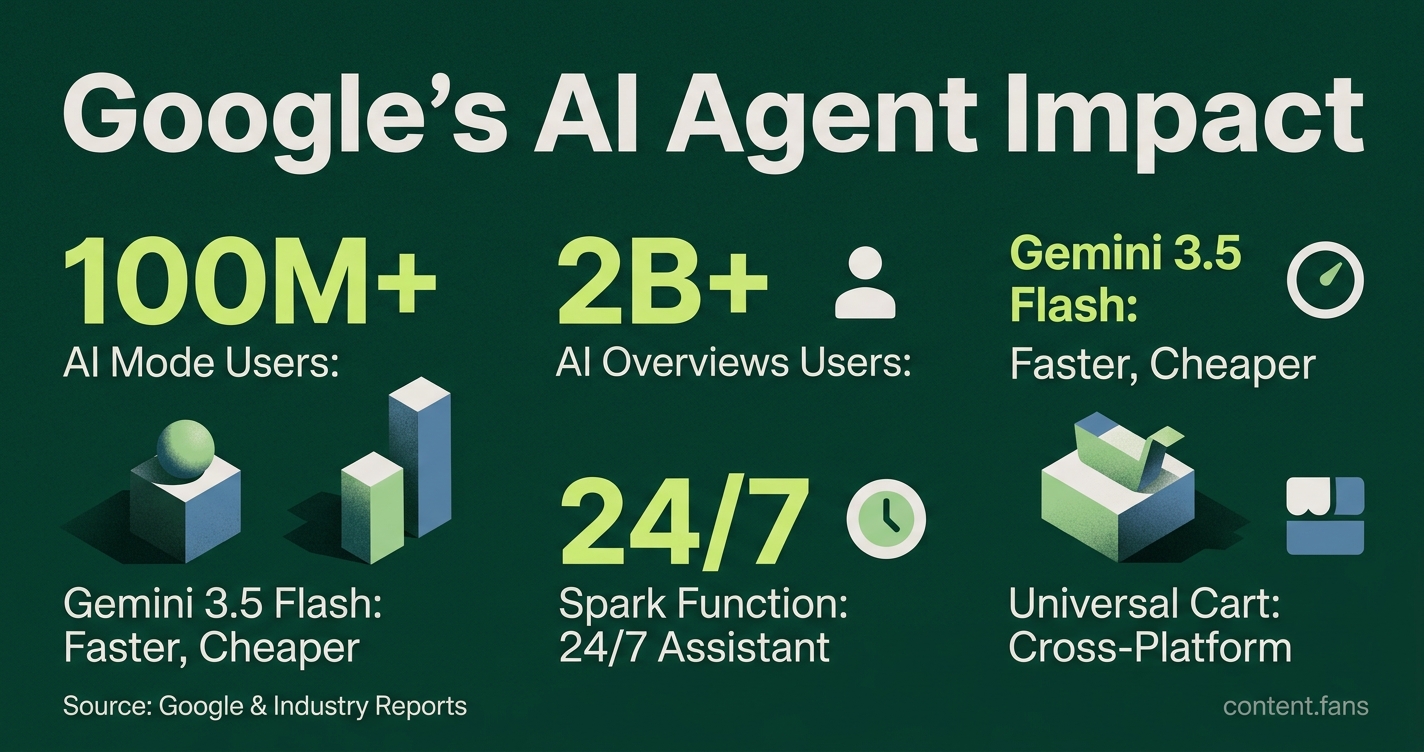
Google reported AI Mode had over 100 million monthly active users, while AI Overviews had over 2 billion monthly users. According to industry reports, the upgrade to Gemini 3.5 Flash delivers significant performance improvements at reduced cost and increased speed. Industry analysis suggests Flash shows strong results on coding-focused benchmarks while maintaining competitive performance on reasoning-heavy tests, indicating a focus on agentic coding capabilities.
Always-on assistance with Gemini Spark
Gemini Spark was introduced as a 24/7 personal agent capable of managing tasks like watching inboxes and drafting documents even after a device is closed. According to Google, Spark will integrate with Gmail and Docs for trusted-tester trials. Its ability to handle persistent background tasks, rather than just session-based chat, sets it apart as an always-on assistant. Access is currently limited, with adoption metrics not yet public.
Universal Cart and the push into agentic commerce
Universal Cart was demonstrated as Google's flagship agent-assisted shopping tool. It allows users to add products from Search, YouTube, or a Gemini chat into a single, persistent cart that automatically finds the best prices. According to industry reports, major tech companies including Amazon, Meta, and Microsoft are among the growing number of supporters for cross-platform commerce standards, signaling increasing support for interoperability.
Key functions highlighted include:
- Collect items across Search, Gemini, Gmail and YouTube
- Surface historical pricing data and automatic deal alerts
- Allow checkout either inside Google Pay or on the merchant's own site
- Keep the original retailer as merchant of record, sidestepping marketplace rules
Analysts note that such an agent could shift product discovery upstream into AI interfaces, which may pressure merchants to expose clean inventory feeds to stay visible.
Benchmarks in context
Independent analysis positions Gemini 3.5 Flash as competitive with other frontier models, with industry reports suggesting performance comparable to leading alternatives. While it resides in the frontier model tier, its primary advantage appears to be speed-per-token - a critical factor for responsive, real-time agents that may be more impactful than raw benchmark scores.
Ultimately, the strategy represents one of distribution over leaderboard dominance. Instead of pursuing the highest benchmark scores, Google has focused on embedding its fast, efficient Gemini 3.5 Flash model directly into the user's daily workflow - from the search bar to persistent background agents and a universal shopping cart.
What exactly is Gemini 3.5 Flash and how fast is it?
Gemini 3.5 Flash is Google's new model designed for AI Mode in Search and the Gemini app.
According to industry reports, it delivers significant intelligence improvements at increased speed and reduced cost compared to previous models.
Industry analysis suggests it performs well on agentic coding benchmarks while maintaining competitive performance across various tasks.
Users experience faster answers, lower latency, and the ability to drop text, images, files, videos, even Chrome tabs into the search box.
How does Gemini Spark work as a 24/7 personal agent?
Gemini Spark is an always-on personal agent that keeps running even when you close your laptop.
- It can draft email replies in Gmail, summarize Docs, or reorder office supplies in the background.
- Spark learns your recurring workflows and proactively reminds you about flight check-ins or recurring deliveries.
Early beta access is available to trusted testers and Google AI Ultra subscribers, so real-world mileage may vary until wider release.
What is Universal Cart and do I need extra apps to use it?
Universal Cart is Google's cross-retailer shopping hub that lives inside Search, Gemini, YouTube, and Gmail - no new app required.
- While browsing or chatting, tap "Add to Universal Cart" and the agent tracks deals, price drops, restock alerts, and price history.
- Checkout can finish inside Google Pay or hand you off to the merchant site, meaning brands remain the merchant of record while Google orchestrates the flow.
Industry coverage notes the goal is to let AI agents mediate discovery without forcing users to bounce between isolated store sites.
Why did major tech companies join Google on Universal Cart?
According to industry reports, a growing number of major technology companies now support universal commerce standards.
By supporting shared agentic-commerce protocols, these companies are betting that interoperability beats walled gardens once AI shopping scales.
Merchants that expose clean inventory and pricing data can appear in AI-driven comparisons across multiple platforms, widening reach without surrendering transaction ownership.
How will these changes affect everyday shoppers over the next year?
- Discovery moves to AI surfaces: expect the first stop for product questions to shift from retailer homepages to Google Search or Gemini conversations.
- Price transparency increases: Universal Cart automatically surfaces historical prices and restock dates, making it easier to time purchases.
- Brand loyalty may soften: an AI that compares multiple retailers in one cart rewards best price and delivery, not the strongest homepage.
Industry reports suggest merchants are already updating product feeds to meet new structured-data requirements for upcoming holiday campaigns.