
Google invests $3.2B in NY TPU data center for Anthropic
Serge Bulaev
Google is investing $3.2 billion in a new data center in western New York that Anthropic will lease to run Google's specialized AI chips called TPUs. This project may let Google make steady income from rentals rather than just selling chips once. The data center could become one of the biggest in North America by power use, and it seems Google will keep offering Nvidia GPUs along with its own TPUs. Analysts suggest this approach might help Google serve more types of customers and capture more of the AI market, but it is not certain how fast the site will grow or how many jobs it may create.
Google is backing a $3.2 billion New York data center project tied to Anthropic's TPU access and leasing arrangement, a strategic move to build a dedicated AI chip business by leasing its custom Tensor Processing Units (TPUs). This landmark project shifts Google's model from one-time chip sales to recurring revenue from cloud infrastructure, positioning it to capture a larger share of the booming AI market while serving diverse customer needs with a hybrid offering of TPUs and Nvidia GPUs.
Google emulates Nvidia playbook to build AI chip business
Google is funding a dedicated New York data center for its custom Tensor Processing Units (TPUs) and leasing access to AI labs like Anthropic. This strategy allows Google to generate recurring rental revenue from its AI hardware, mirroring Nvidia's successful model of tightly coupling hardware with cloud services.
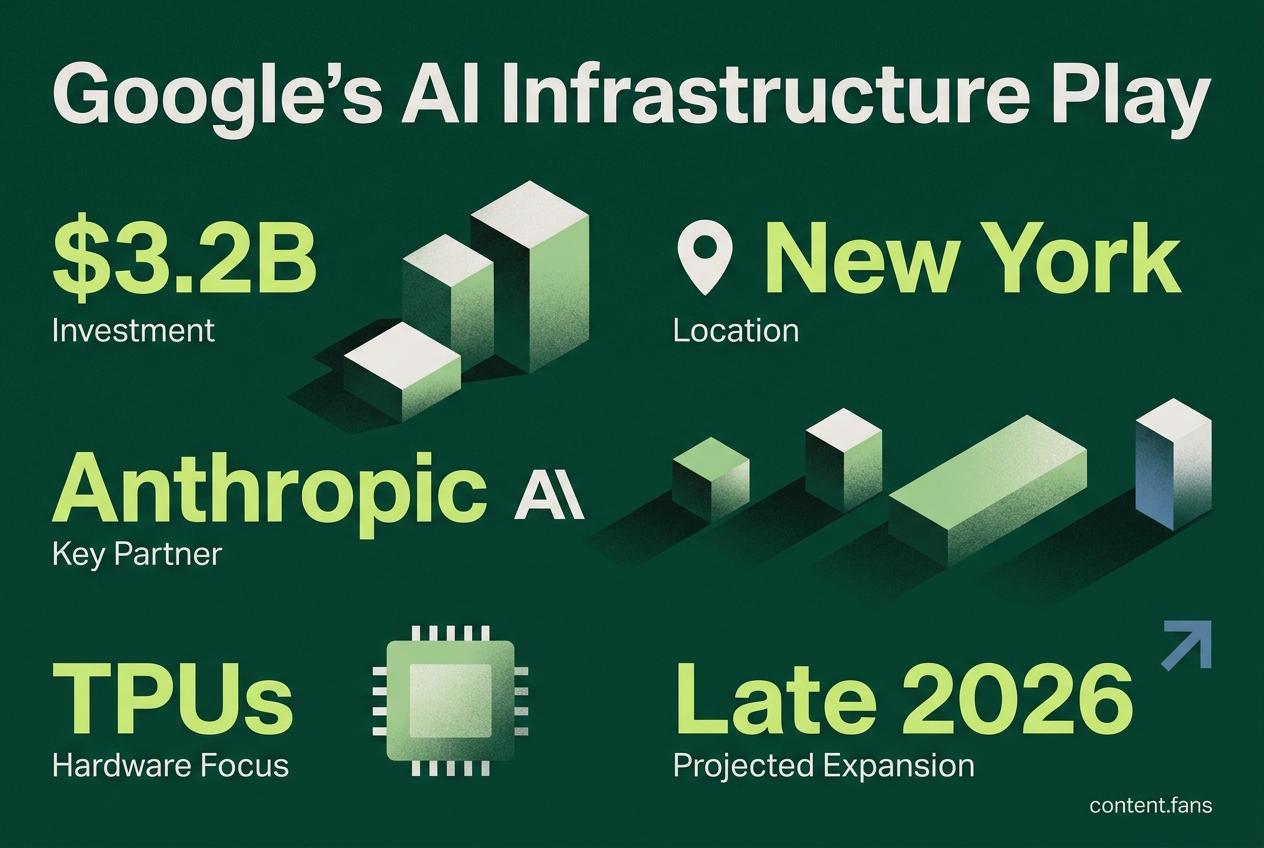
This investment in New York's Lake Mariner site is a significant expansion. Reports summarized by AI Weekly indicate the facility could scale to substantial IT load capacity, supporting massive TPU clusters and enabling Google to shift from one-time chip sales to a recurring rental revenue model.
Inside the substantial New York commitment
According to industry reports, the commitment involves a partnership with TeraWulf, with infrastructure including power upgrades, advanced cooling, and specialized racks designed for Anthropic's frontier AI workloads. The facility is expected to become one of North America's largest data centers by power capacity. This project contributes to Alphabet's significant projected capital expenditures, primarily driven by servers and data center expansion.
Key reported elements of the New York plan:
- Long-term lease to Anthropic for exclusive TPU access
- Conversion of a former crypto-mining site in western New York
- Projected expansion by late 2026
Competitive context and hybrid cloud positioning
Industry analysts view this as a strategic hedge, not a full replacement of its GPU offerings. Google has assured customers it will continue providing Nvidia's latest Vera Rubin GPUs and is even collaborating with Nvidia on network optimizations. By controlling the entire stack - from custom silicon design to hyperscale cloud hosting - Google aims to capture more AI market share. This hybrid strategy appeals to a broad range of enterprises, offering cost-effective TPU inference alongside the familiar GPU training ecosystem.
What to watch through 2026
While Google has not revealed the exact number of TPU 8 series chips for the New York site, its cloud division has hinted at future clusters exceeding one million accelerators. Alphabet's significant capex forecast suggests this model could be replicated, fueling infrastructure growth driven by demand from AI developers. Although specific New York job and tax figures are unavailable, similar Google projects globally have created thousands of jobs, raising expectations for local economic benefits. The project's final timeline hinges on power-grid upgrades and environmental permitting, which will dictate how quickly Anthropic can access its TPU capacity.
What exactly is Google funding in New York and why is it a major investment?
Google is constructing a large-scale AI data center near Lake Mariner, Western New York that is purpose-built to host the company's latest Tensor Processing Units (TPUs). According to industry reports, the substantial investment covers land acquisition, electrical substations, cooling systems, and enough server infrastructure to house significant IT load capacity, making it one of the largest single AI-specific builds in North America. Unlike typical general-purpose cloud regions, this facility is optimized for high-density AI training and inference clusters, giving Google direct control over both power and hardware economics.
How does the deal with Anthropic work - does Google just hand over the chips?
Instead of selling TPUs outright, Google is leasing the pre-installed TPU capacity to Anthropic under a long-term rental contract. Anthropic pays recurring cloud fees to Google, which mirrors the model Nvidia uses with cloud providers, but here Google is both the financier and the landlord. This approach lets Google keep ownership of every accelerator, capture recurring infrastructure revenue, and guarantee Anthropic dedicated compute without Anthropic having to raise substantial capital for the build.
What performance gains do the latest TPUs offer compared with Nvidia GPUs?
Google's eighth-generation TPUs (TPU 8t and TPU 8i) announced in April 2026 deliver up to 3× faster training and 80 % better performance per dollar than the prior Trillium generation. Ironwood TPUs (7th gen) already claim 10× peak performance uplift over TPU v5p and 4× more performance per chip versus the v6e/Trillium line. While Google continues to offer Nvidia Vera Rubin GPUs in the same cloud, the TPU route is expected to be the cost-optimized path for transformer-scale training and high-throughput inference.
Does this New York site create local jobs or just move electricity around?
Industry filings from TeraWulf and utility disclosures point to construction, electrical, and ongoing operations roles in the region, although exact head-counts have not been released. According to industry reports, similar Google builds have generated significant job creation and regional economic impact, suggesting a comparable multiplier is likely in New York once the campus is fully online.
How does Google's approach differ from Nvidia's and is it working?
Nvidia supplies general-purpose GPUs plus software to any customer with the budget, while Google designs the chip, owns the data center, and rents time on the silicon. This hybrid model lets Google scale custom silicon without betting on external GPU sales and gives customers like Anthropic dedicated AI compute without CapEx. Early signs of traction include Google's substantial capital-spend guidance, a figure explicitly tied to "servers, data centers, and networking gear."