
Google invests $3.2B in NY TPU data center for AI chip business
Serge Bulaev
Google is investing about $3.2 billion in a New York data center to support its AI chip business, using its Tensor Processing Units (TPUs). Reports suggest this center will mostly be used by Anthropic, showing how Google links hardware investments to ongoing cloud service revenue. Google appears to be following a strategy similar to Nvidia's, offering both TPUs and Nvidia GPUs so customers can choose what works best. While Google's approach may give it more control over the AI cloud market, it is not replacing Nvidia hardware completely and customers might still want other options. Analysts estimate Google has a large share of the custom AI cloud accelerator market, but exact numbers are not confirmed.
A recent report reveals that Google invests $3.2B in a NY TPU data center for its AI chip business, a strategic move positioning the company as a financier, chip supplier, and cloud provider. Google's $3.2 billion backing was for a western New York TPU data center initiative, with compute planned for lease to Anthropic. According to an AI Weekly report, this capacity will be leased to AI firm Anthropic, showcasing how Google connects hardware capital to long-term cloud revenue.
This strategy marks a significant shift for Google, which is evolving its TPUs from a private, internal advantage into an external platform. By offering TPUs alongside Nvidia GPUs in Google Cloud, the company aims to secure compute-hungry customers through comprehensive finance and hosting deals.
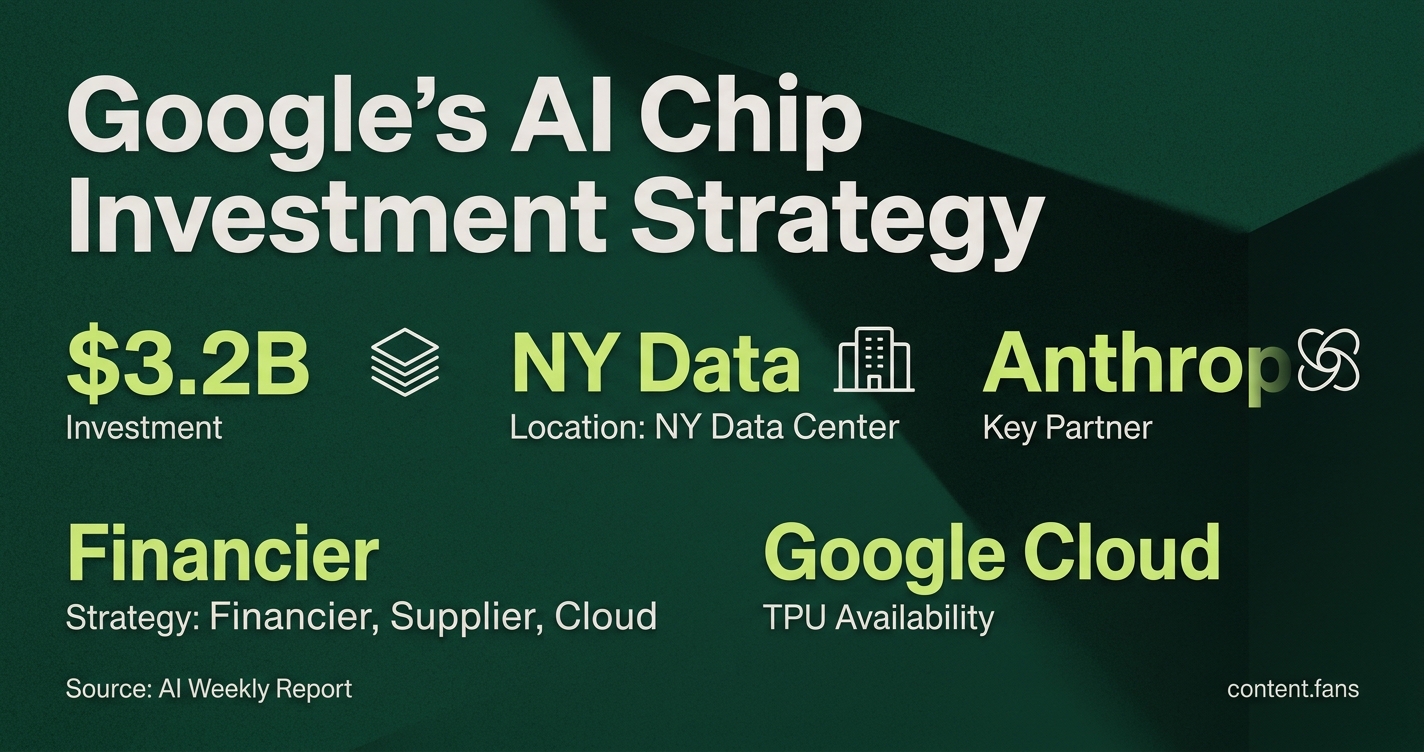
Google's "Nvidia Playbook" for AI Chips
Google's strategy involves financing and building its own TPU-based data centers, then leasing the computing power to large AI companies like Anthropic. This vertically integrated model, similar to Nvidia's, locks in customers and creates a recurring revenue stream, turning hardware investments into long-term cloud service contracts.
Key elements of the current playbook include:
- Financing data centers directly, as with the reported New York build, instead of waiting for third-party operators.
- Offering TPUs on Google Cloud next to Nvidia's newest GPUs so customers can match workloads to the best chip.
- Using long-term leases with labs such as Anthropic to lock in demand and de-risk capital spending.
- Partnering with manufacturers like Broadcom to diversify supply and reduce dependency on external GPU vendors.
TPU leasing and the Anthropic example
The partnership with Anthropic exemplifies this strategy. According to industry reports, Anthropic has committed to securing significant TPU capacity in a substantial deal. The AI company has expanded this relationship, targeting significant next-generation TPU capacity. However, Anthropic continues to use AWS Trainium and Nvidia GPUs, suggesting that even major customers prefer a diversified compute infrastructure.
Competitive context inside Google Cloud
While a CNBC profile labeled TPUs Google's "secret weapon," the company is not aiming for a total replacement of Nvidia. Google continues to offer the latest Nvidia hardware, pursuing a hybrid stack that allows customers to blend custom chips with off-the-shelf GPUs to optimize price-performance and mitigate supply chain risks. This dual-track approach gives Google significant control over the AI value chain. By financing facilities and bundling TPU access, Google shifts the customer's focus from raw chip performance to total cost of ownership, availability, and integration with services like BigQuery.
While official figures are unavailable, analyst estimates on TPU economics are telling. The Futurum Group calculates Google's share of the custom cloud AI accelerator market at around 58%. This, combined with high-profile adoption and a pipeline of data center deals, indicates Google's strategy is gaining significant traction without seeking to displace Nvidia entirely. Industry observers are now watching to see if other major cloud tenants will commit to long-term TPU leases and how Google manages its manufacturing partnerships. The outcome will reveal the viability of this vertically integrated model within the broader cloud ecosystem.
What exactly is the $3.2 B New York project?
Google is fronting the full capital cost to build a New York facility that will be purpose-built around its own Tensor Processing Units (TPUs). Rather than simply selling chips, Google is shifting to a finance-and-host model: it funds construction, delivers the hardware, and then leases TPU capacity to customers such as Anthropic under multi-year agreements. This turns one-time hardware sales into years of predictable rental revenue while guaranteeing Google Cloud a captive supply of AI compute.
How does the deal compare with Nvidia's playbook?
The structure mirrors Nvidia's "DGX Cloud" approach: control silicon, attach it to cloud services, and lock in large clients through long-term contracts. However, Google has an extra lever because it also owns the data-center real estate. Google's latest TPU generation shows significant performance improvements over prior generations, according to industry reports.
Why is Anthropic renting TPUs instead of buying its own hardware?
According to industry reports, Anthropic's roadmap shows significant TPU capacity coming online in the coming years. By choosing a usage-based lease, Anthropic avoids substantial upfront costs needed to build an equivalent on-prem cluster and gains the flexibility to scale up or down as models evolve. Google benefits by keeping capacity utilization high and by making TPUs the default engine for Claude's training runs, reinforcing the chip's external credibility.
What does this mean for Google's overall AI chip market share?
Third-party estimates already credit Google with a 58 % share of the custom cloud AI accelerator market, far ahead of AWS Trainium and Microsoft Maia. As the New York site reaches deployment, Google would add significant TPU capacity, potentially increasing its market share according to analyst models cited by CNBC.
Are other hyperscalers following the same model?
Yes, but none at the same scale. Amazon offers Trainium/Inferentia on standard AWS leases, and Microsoft resells Maia through Azure. Google's unique twist is that it owns the data center, the chip design, and the cloud platform, giving it tighter control over cost and supply. If Meta finalizes the rumored TPU trial that Mexico Business News reported, the model will graduate from niche experiment to mainstream alternative to Nvidia.